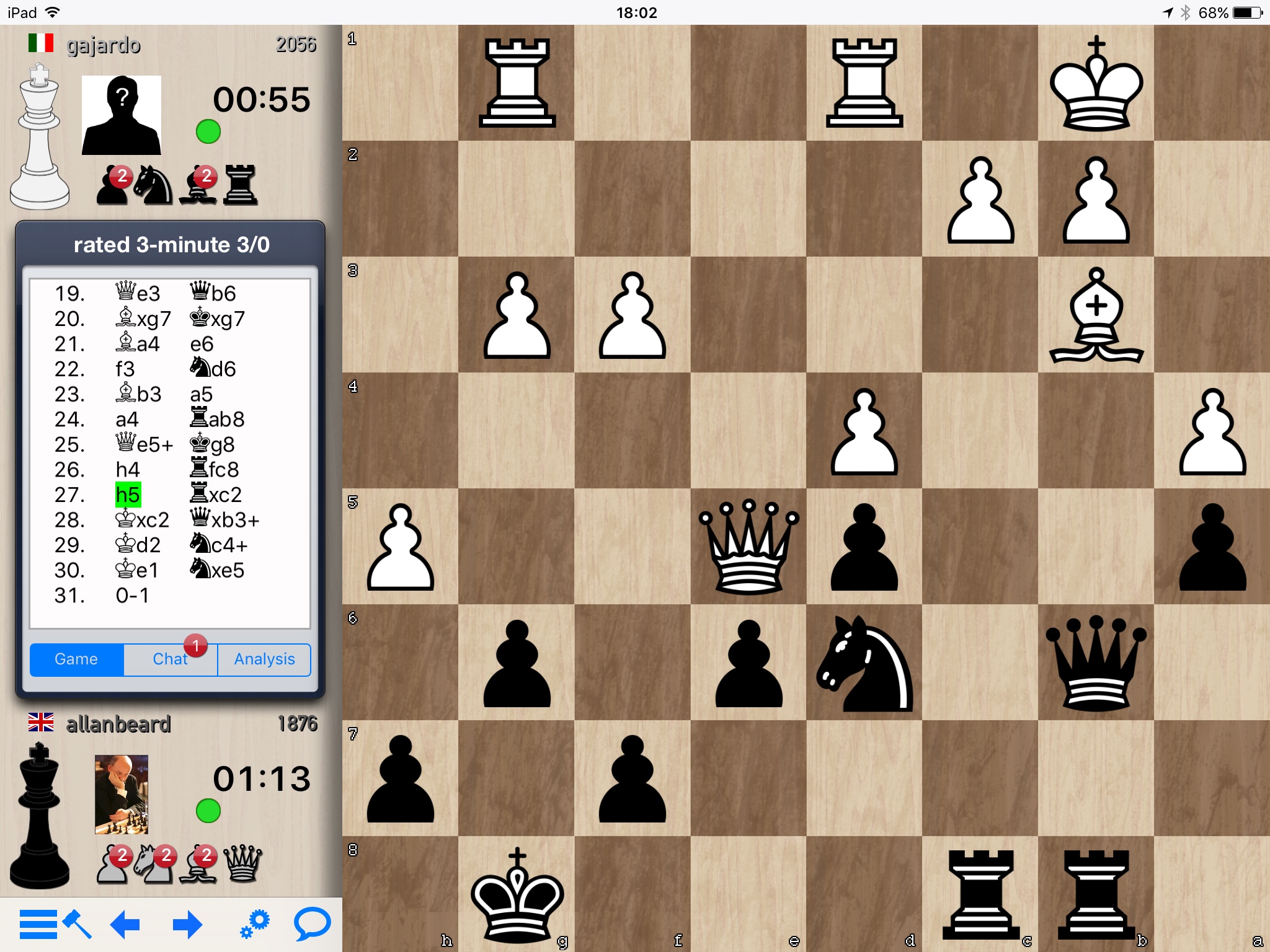
Another break from my Matni Udar series, to show a quick tactic from one of my ICC 3-0 games.
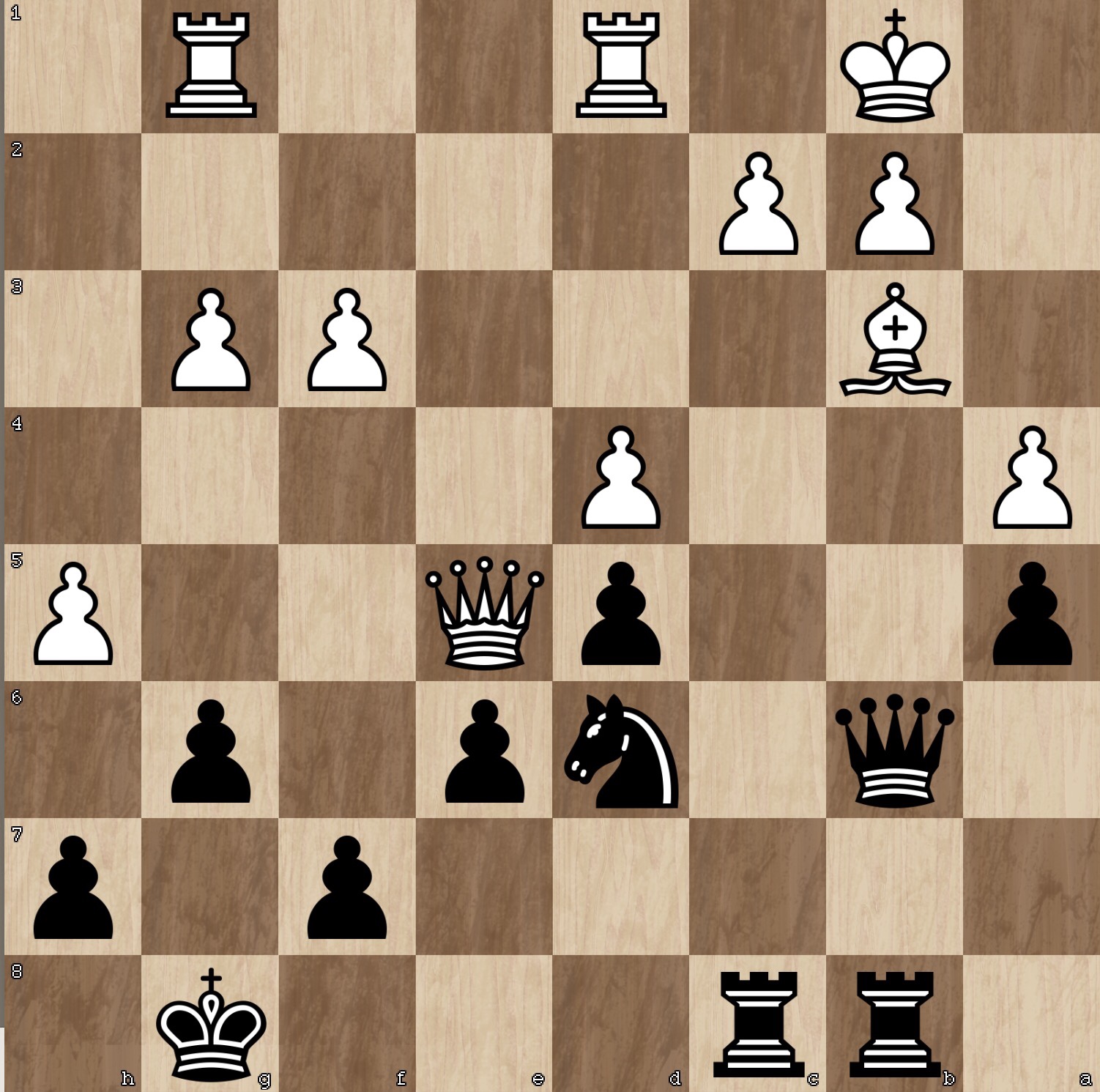
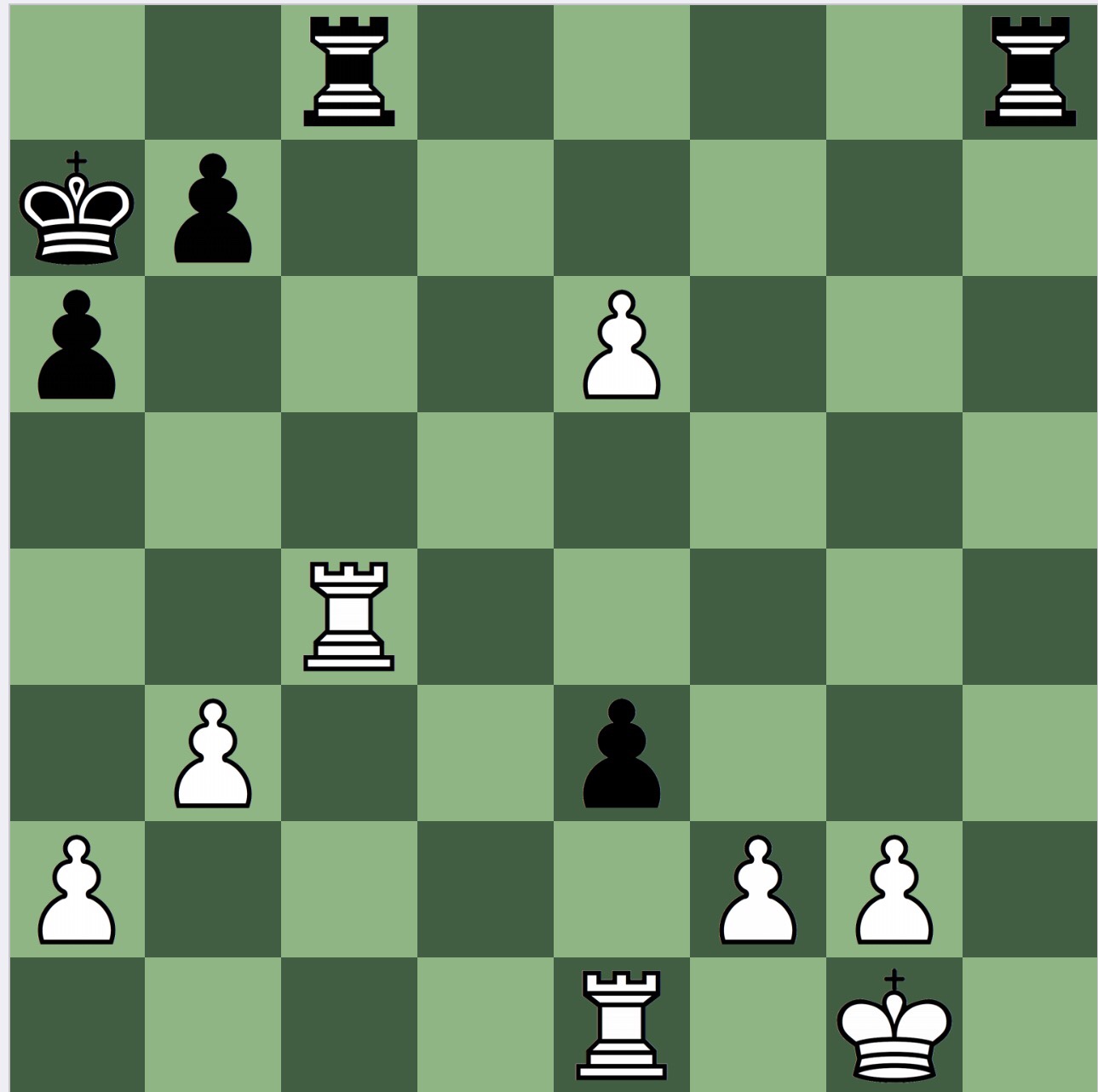
Black to play and win
Solution
1…Rc2! destroys White’s defences.
In the game, Black took the rook, and the main motif is that there is a Nc4+ forking King and Queen.
If instead 2 h6, then 2…Rb2+! and if 3 Ka1 I had planned 3…Ra2+!!, mating. Writing this blog now, I see that White could also play 3 Kc1, when either Black can play safe with 3…Ne8, which I always has in reserve, or play more consistently with 3…Rc2+! when either capture leads either to mate or to the winning knight fork.
 Posted with Blogsy
A break for a day from my series of postings from Matni Udar.
One of my habits is to cut and keep cuttings of problems that I can’t solve. A treasure chest for a later day.
Some I keep in a filing cabinet, a few I keep in the pocket of my Kindle case. Why do I mention this? I am posting this blog whilst on holiday in Turkey, and was reading a book on my Kindle, but at times dipped into my cache of problems. Some turn out to be trite, and I wonder why I missed the solution first time round, others stump me for a while long, and these I will post on my blog. This is one of them.
White to play and win
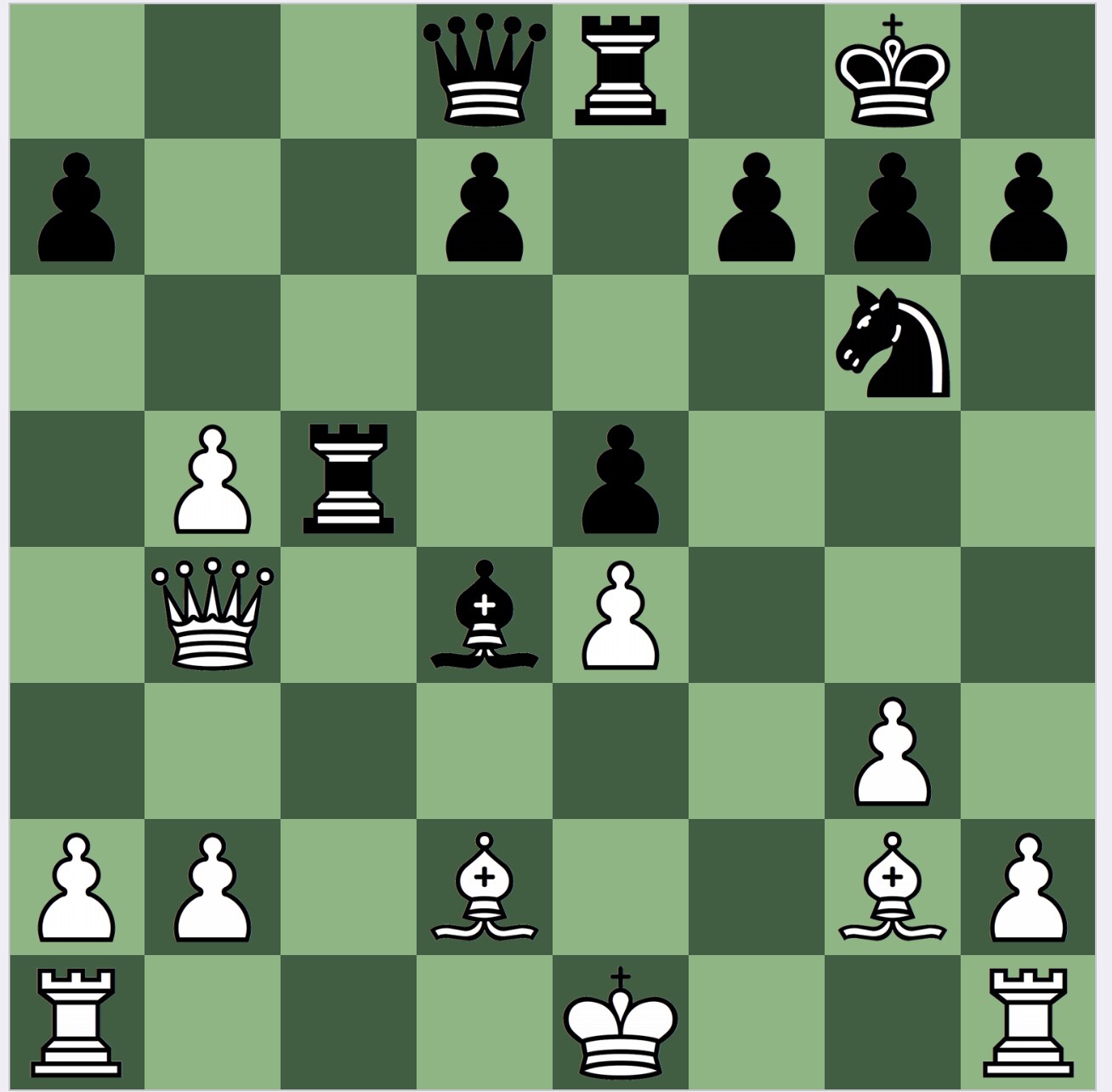
Unknown players: clipping from the Daily Telegraph, and I was too zealous in my tearing out.
Solution
Examine all biffs
1…Nh4, and again, examine all biffs, 1….Qa8! (a pleasure to find this move)
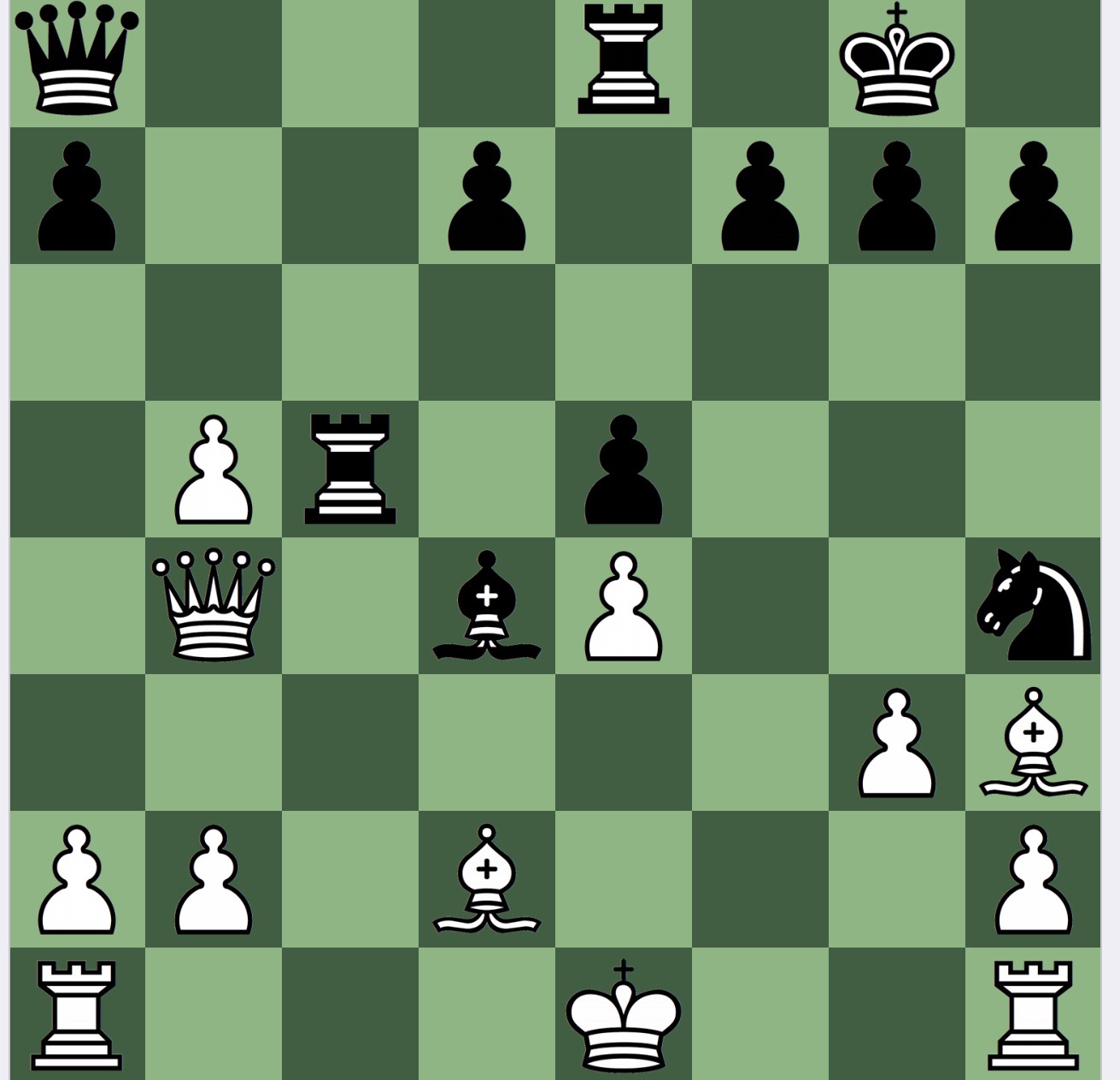
Or, if 2 Bf1, then 2 Nf3+ and all the pieces enter. For instance 2 Ne2 Rc2 3 Rd1
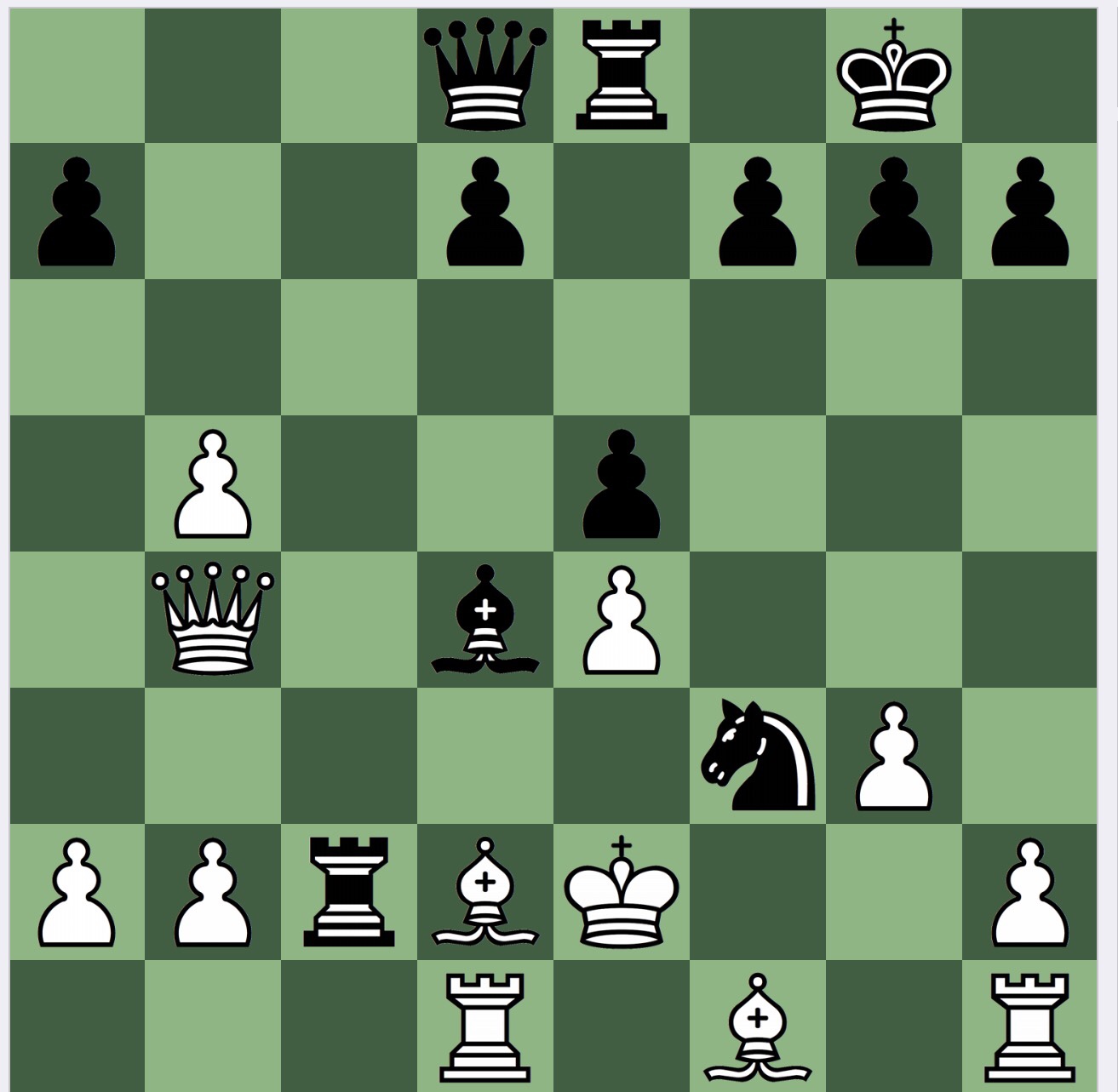
And probably 3…Bc5 followed by 4….Nd4+, and Black dominates.
Another puzzle from Dragoslav Andric's 1981 book “Matni Udar”.
White to play and mate Black.
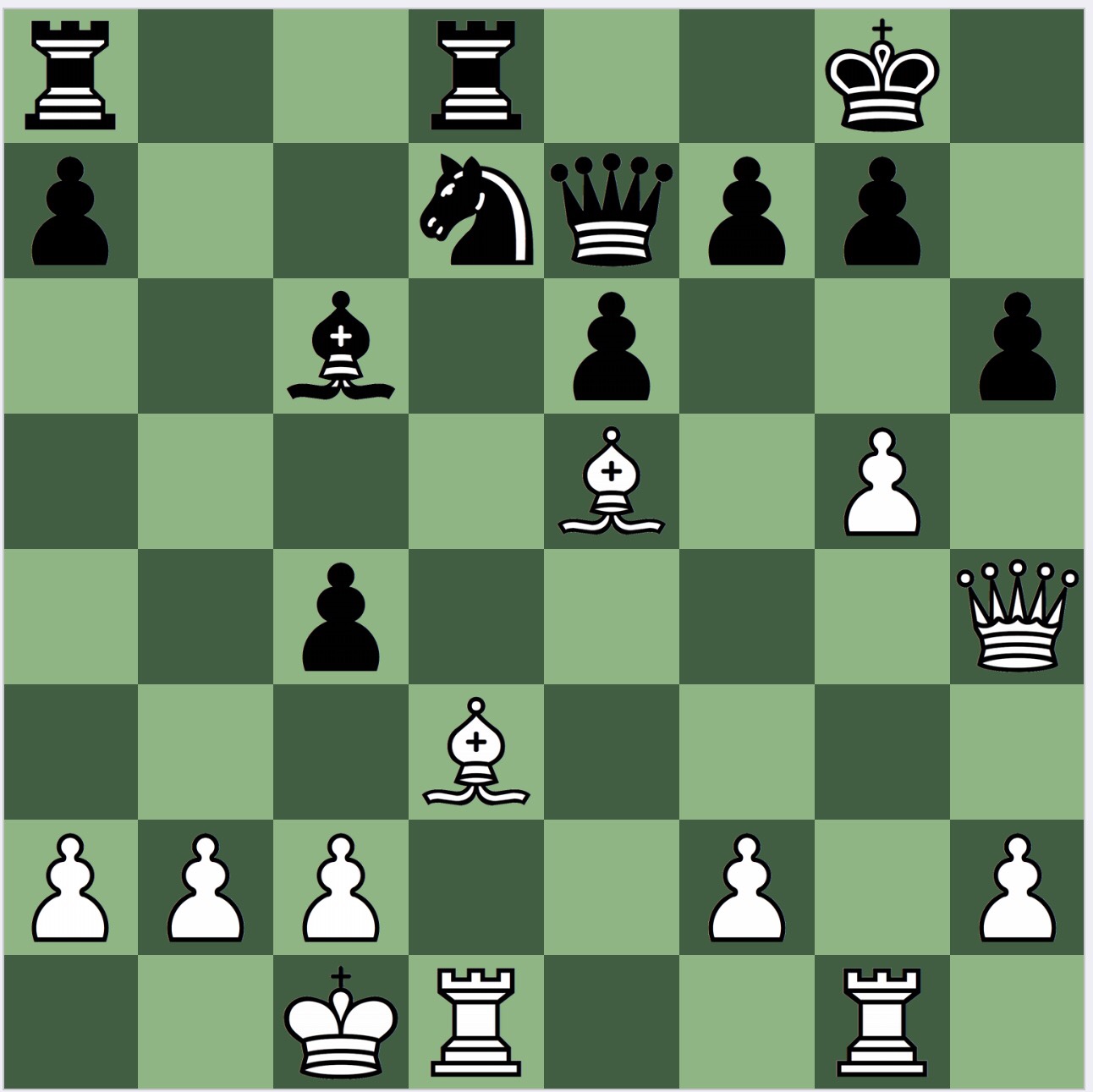
Spielmann v L'Hermet, Magdeberg 1927
Solution
I suspect I have seen this puzzle before, since I saw the solution, including the third move, instantly.
1 Qh6! gh 2 gh+ Kf8 (Black could grovel with 2…Qg5 to avoid the mate, but he is totally lost)
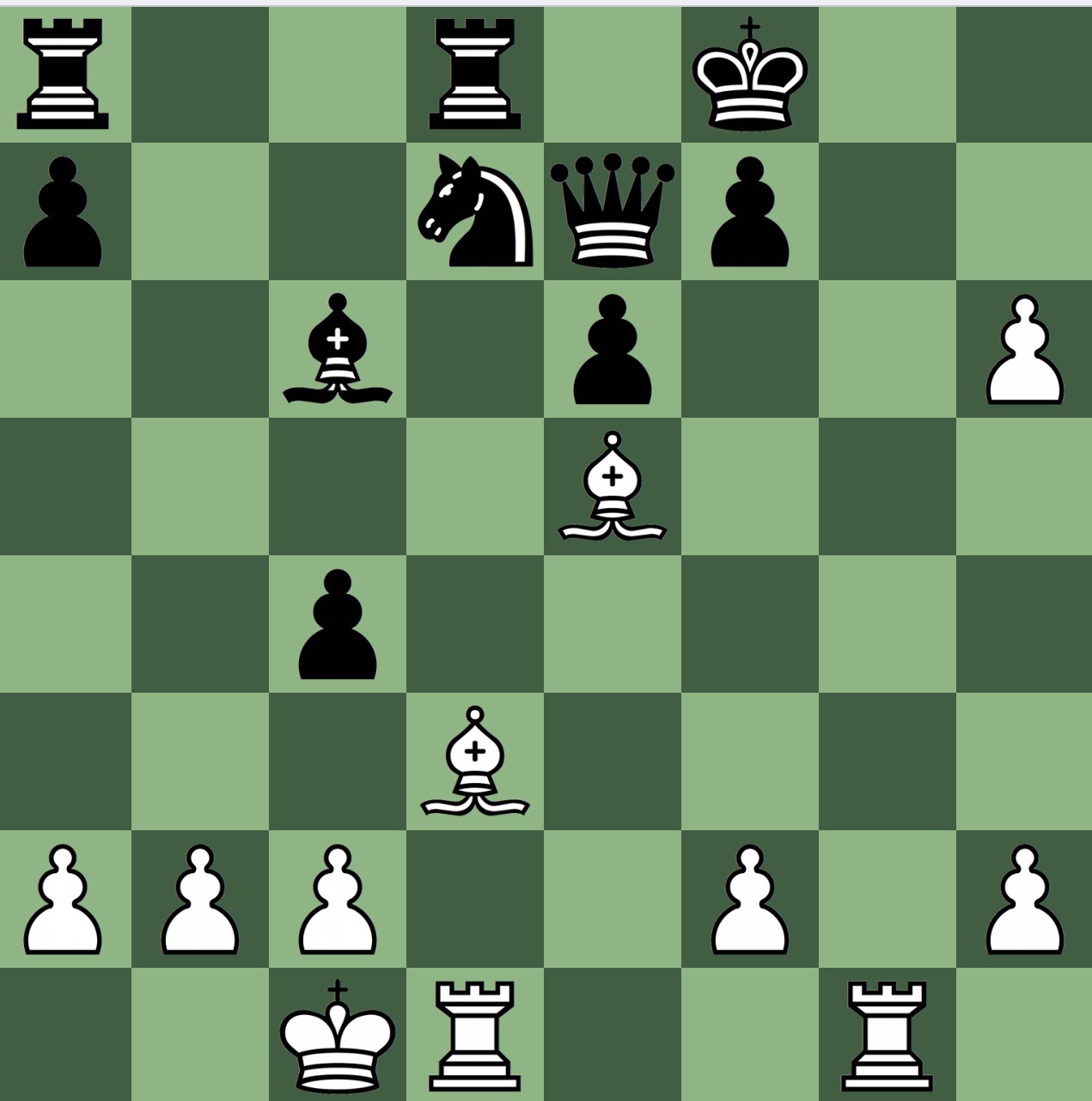
3 Rg8+!! Kg8[] 4 h7+ and mate next move.
Another puzzle from Dragoslav Andric's 1981 book “Matni Udar”.
White to play and win
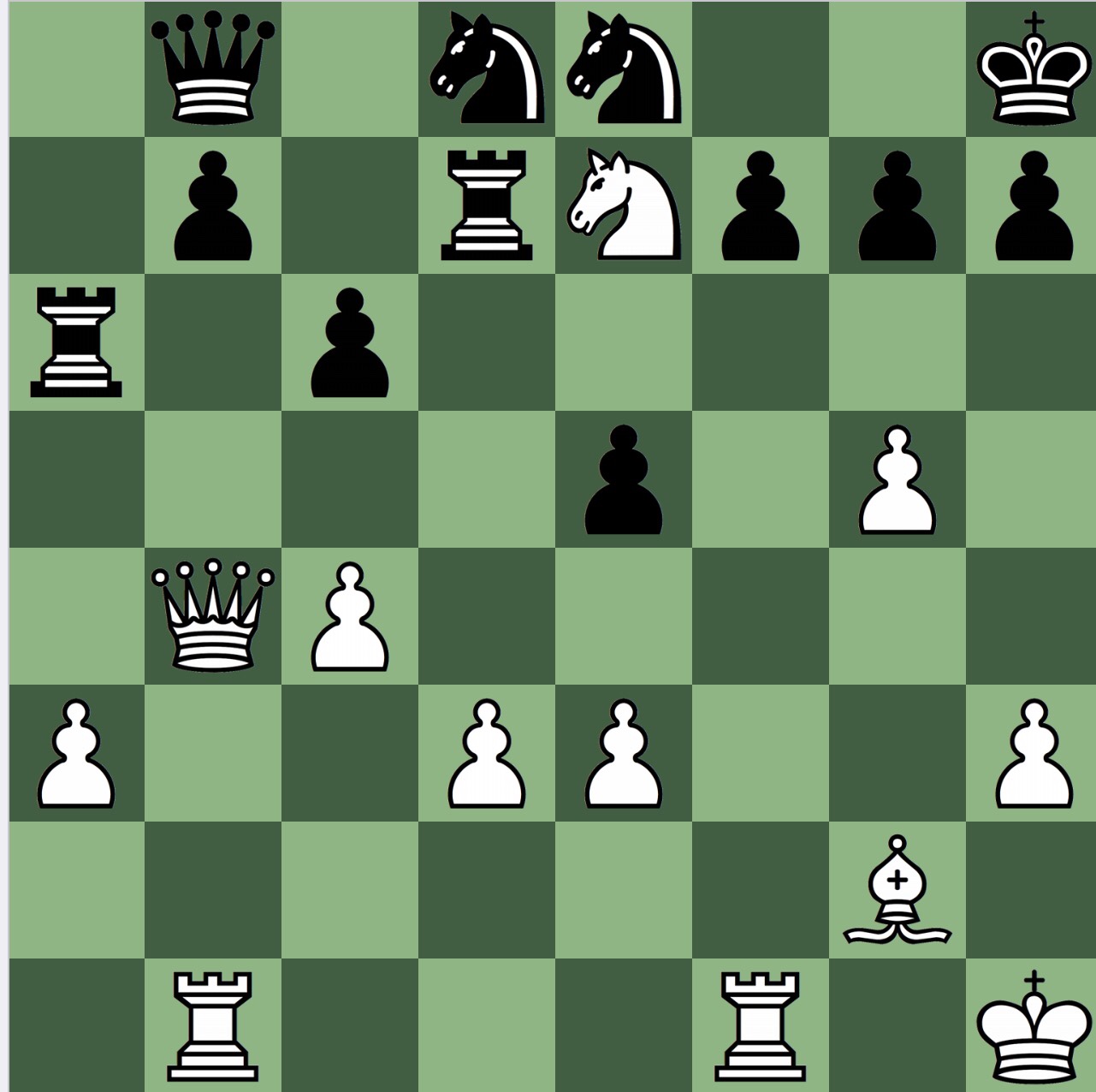
Grigoriev v Čhelikov, Moscow 1926
Solution
This puzzle took me a long time, but only because the move I immediately thought of, 1 Nc6, isn't a mating line, but just wins the house: 1….Qd6 2 Nb8 and 1-0. 1…Qd8 is of course necessary since Nc6 opened White's Queen's route to f8.
So I looked, and looked again at 1 Ng6+ but couldn't see any rook lift, and then turned to the solution, seeing this one is the first in the book which is a +- but not a mate.
Another puzzle from Dragoslav Andric's 1981 book “Matni Udar”.
Black to play and mate White
(Find the solution and the cook)
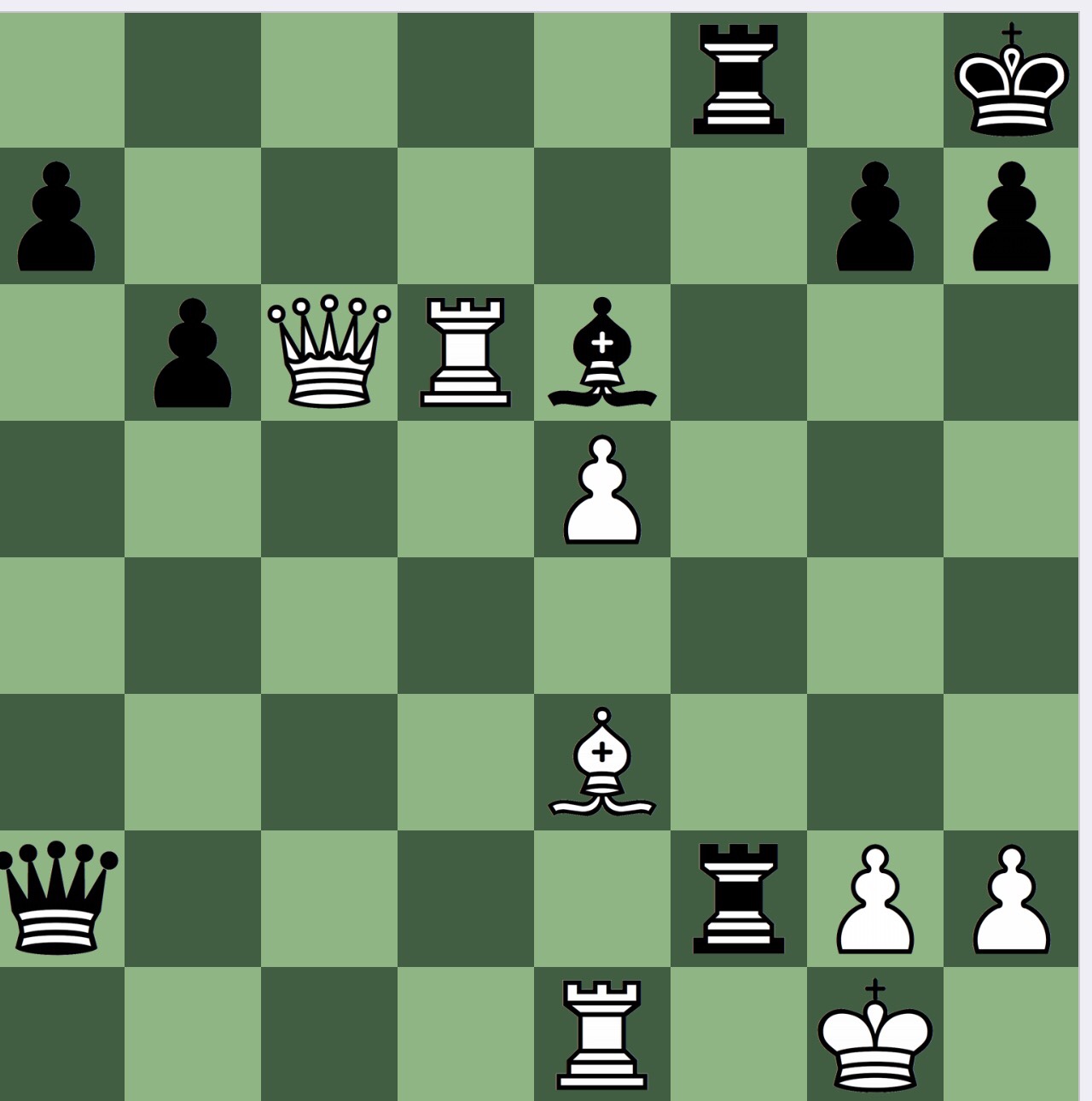
Khan v Bernstein, Paris 1926
Solution
I spent a lot of my time on this one, trying to spoil the cook that I spotted as soon as I saw what I knew was the 'solution'.
1…Rf2 2 Re6? Qe2! struck me immediately, but so 2 Rdd1 (which is followed by 2…Rc2, and Black is better) and more or less just as quickly by 2 h3!, same idea of avoiding back rank mate tictacs whilst keeping the Rd6 in a menacing position.
After 2….Rc2 3 Qe4 White has compensation in terms of centralised pieces and an advanced passed e pawn and the game is unclear.
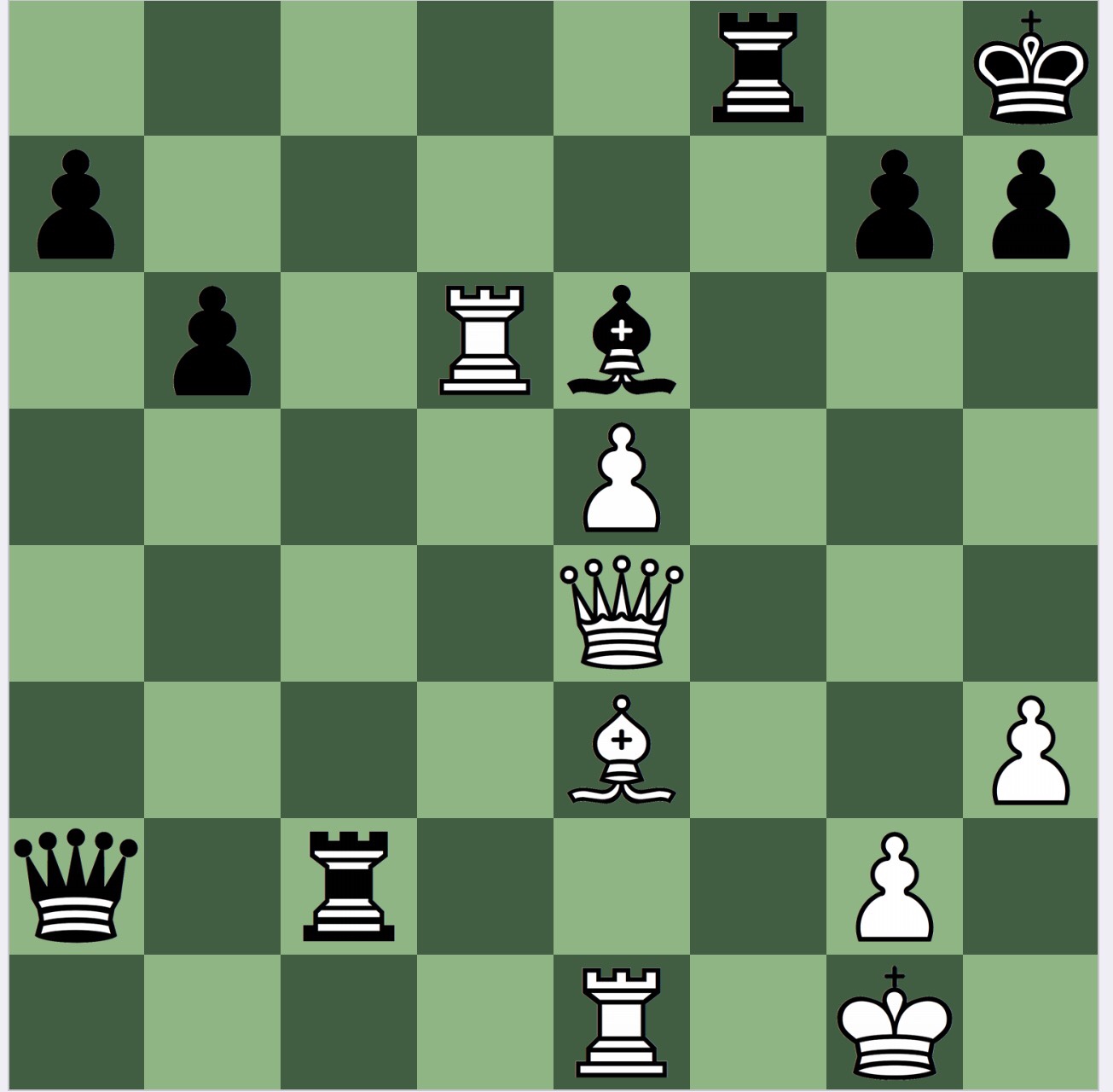
Another puzzle from Dragoslav Andric’s 1981 book “Matni Udar”.
White to play and mate Black

Marmoroš v unknown, simultaneous, Jerusalem 1926
Find the winning line, including some pretty variations; and find the cook.
Solution
The first move, 1 Rg7! is ‘obvious’, being the only forcing move (or, as Purdy says, “examine all biffs“). But the various defences need refined and different handling.
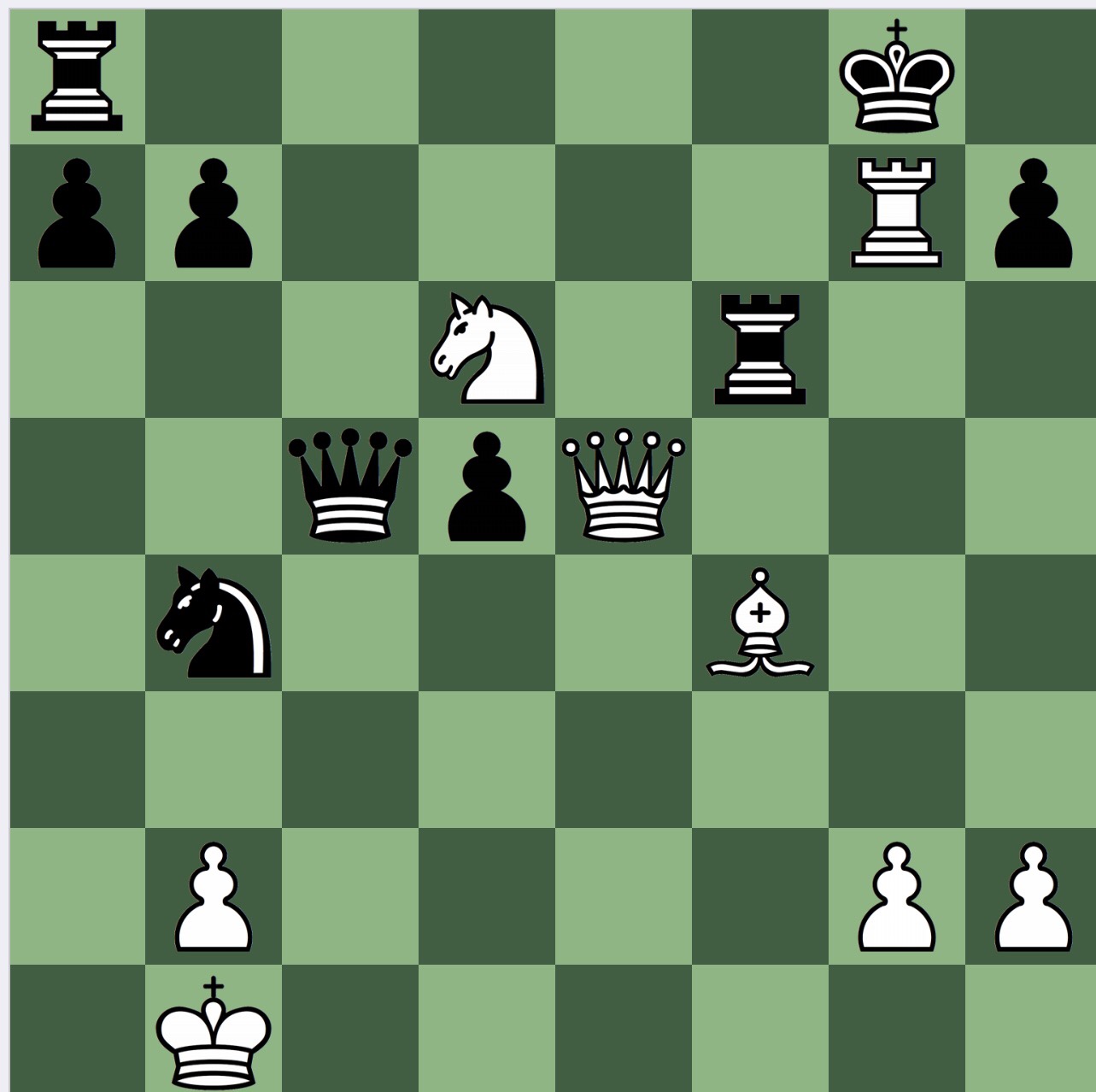
Then, 1…Kg7 2 Qg5+!! (2 Bh6+ Kh6 3 Qf6+ Kh5[] and Black’s threat of back rank mate (starting Qg1+) means it is only a draw) Rg6 (say: others are similar) 3 Qe7+ Kh8 (3…Kg8 similar) 4 Be5+ and mates.
Or 1….Kh8! 2 Rc7!
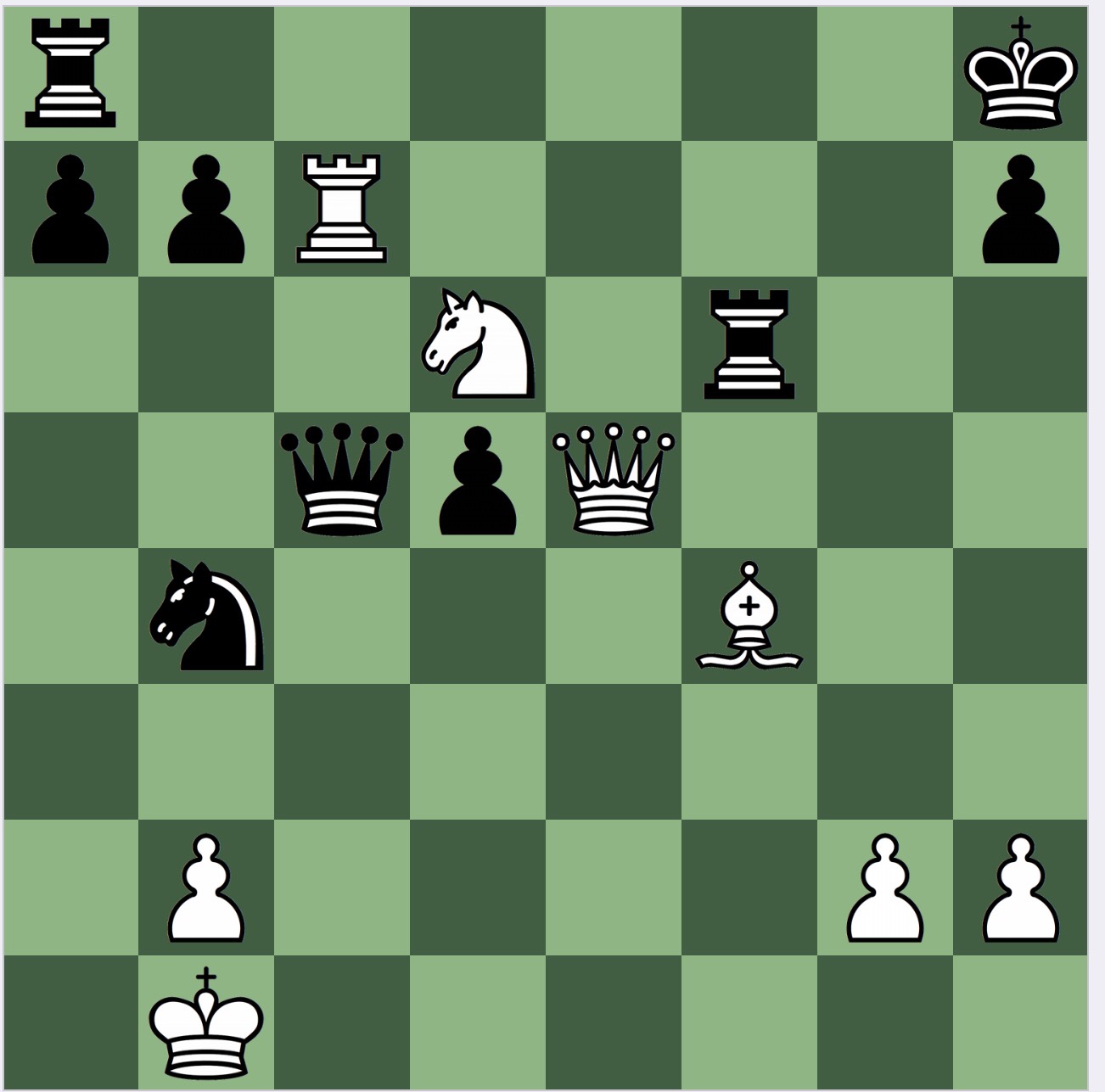
2…Qc7 3 Qf6+
And now:
A) 3…Kg8 4 Qe6+ Kf8 (4…Kh8 5 Be5+ 1-0) 5 Bh6+ 1-0; or

B) 3…. Qg7 4 Nf7+ Kg8[] 5 Nh6+ Kh8 6 Be5!! is a very pretty finale.
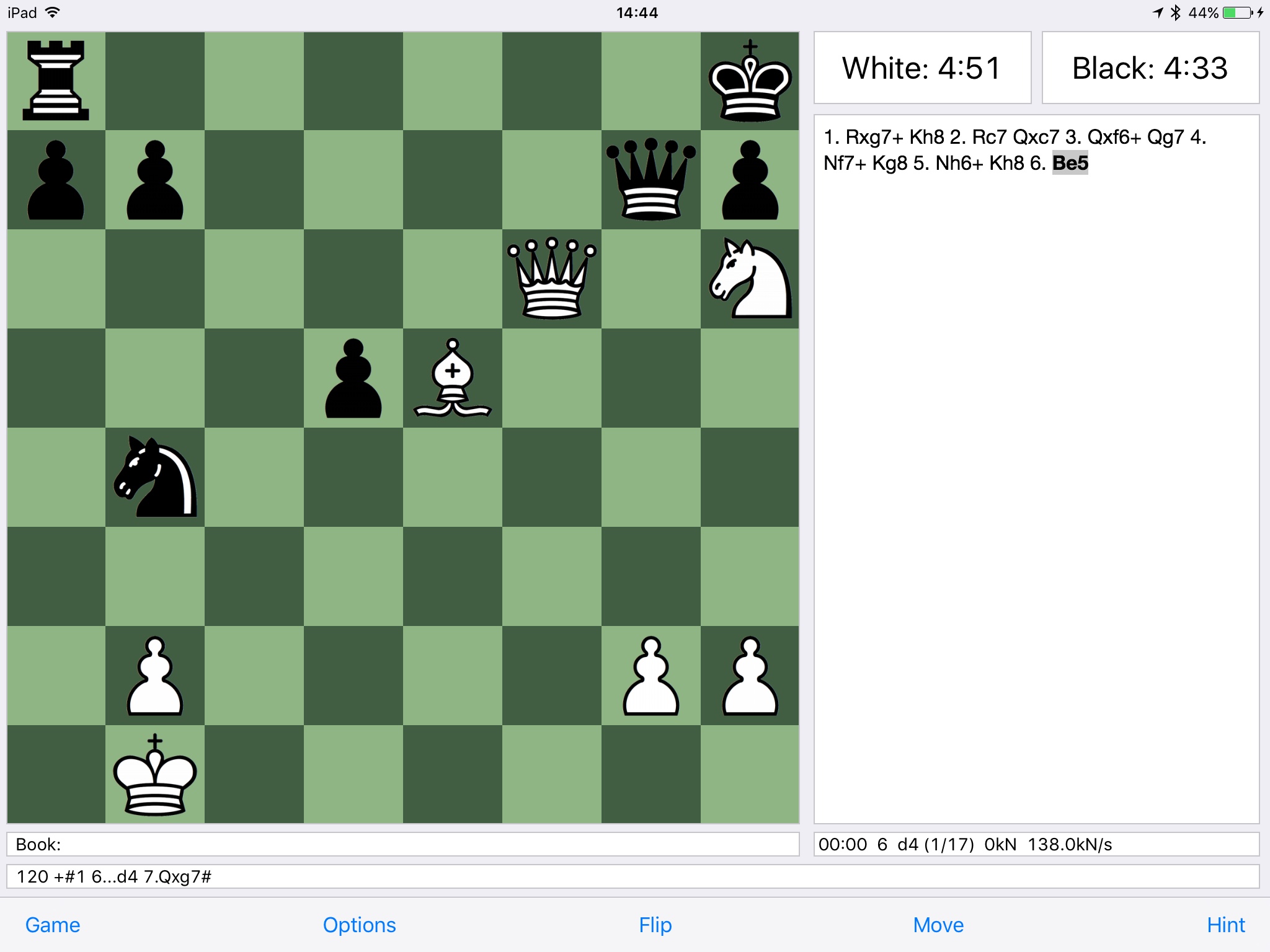
The cook
So far, so good; and the above are the lines given in the book, and the lines I found when solving the puzzle. But the Stockfish App on my iPad immediately flashed up only +1 in the opening position.
If you haven’t found why, have a look again, before reading on. It is rather deep.
Solution
As so often, mistakes in analysis are caused by automatic exchanges. In the diagram below, Black doesn’t need to play 2…Qc7.
Instead, 2….Qd6! and White is better, but the game goes on. In fact, after the natural line 3 Qd6 Rd6[] 4 Bd6[] Nc6 5 Rb7 is White necessarily much better after say 5..Rd8? At my standard of play, not necessarily so.

Objectively, White might well be much better, even winning: the Nc6 has no stability and if displaced, the b pawn will advance speedily, especially if Black swaps the a pawn for the g pawn, say. But, plenty of mistakes could happen in my practice.
This posting is made whilst watching the final stages of today’s third round at the Baku Olmypiad. I’ve been watching the England men’s team’s match vs Canada. In addition to watching England’s games, I watch certain others- typically the highest rated players, or those I can often count on being entertaining, one of whom is Andrei Volokitin of the Ukraine. Today’s game didn’t disappoint, Andrei beating Daniel Fridman in his typical style.
I have given some quick analysis in the attached link below, but one variation is worth setting as a puzzle.
White to play and win

variation from Volokitin v Fridman, Baku 4/9/16
(see attached file for game file, including the variation)
Solution
1 Nh5!! is the only winning move. Then if 1…gh 2 Rd7+ Ke8[] 3 Nf6 is a lovely mate. If insread say 1 Qc4 then White’s advantage vanishes.
My instant analysis is here.
Another puzzle from Dragoslav Andric's 1981 book “Matni Udar”.
Black to play and mate White
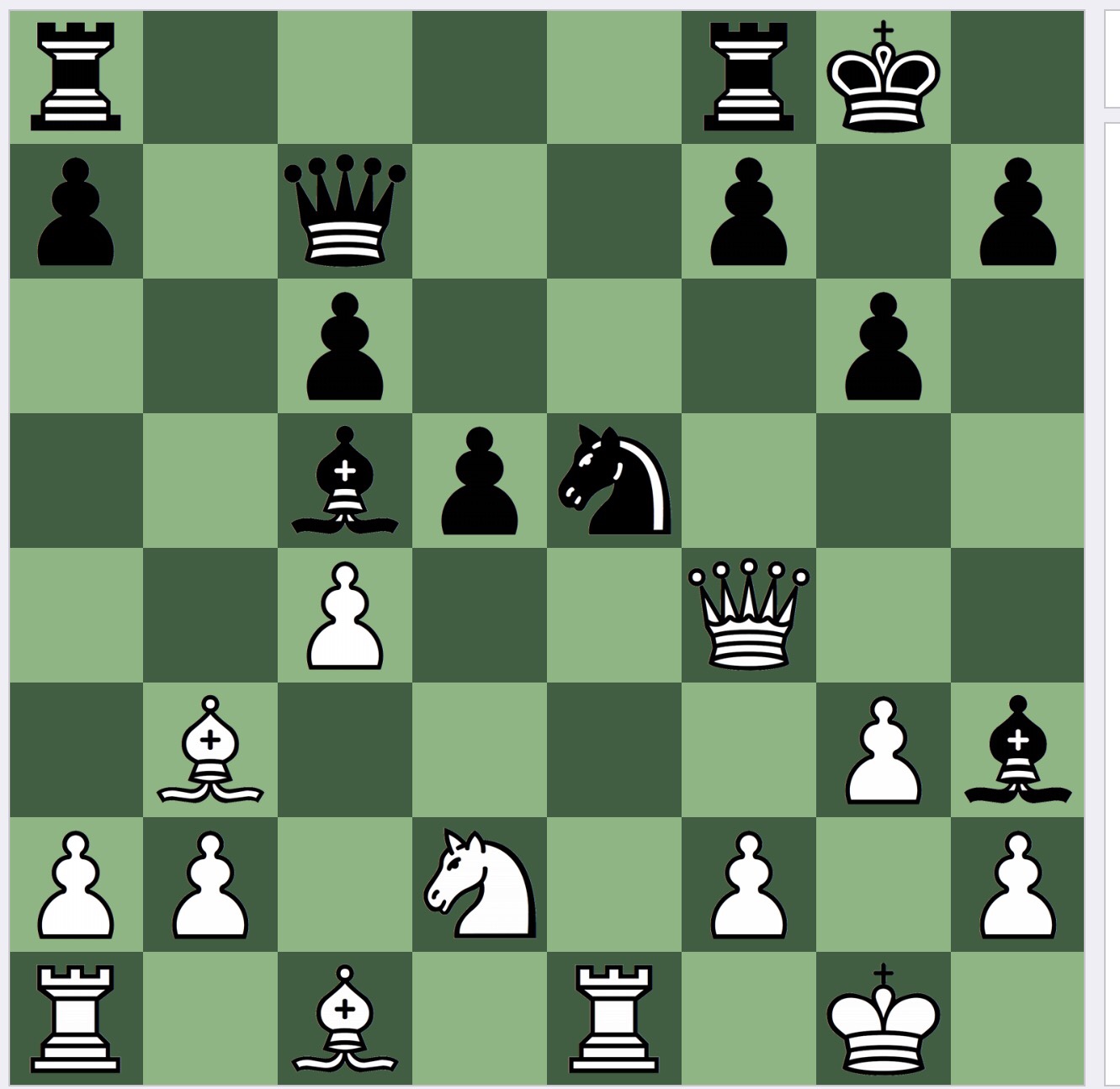
Orajevski v Bubnov, 1926
Solution
This took me a while: I saw the initial moves immediately, but couldn't see the denouement for a good while. I think the final motif is unusual:
1…Nd3 2 Qc7 Bf2+ 3 Kh1[]
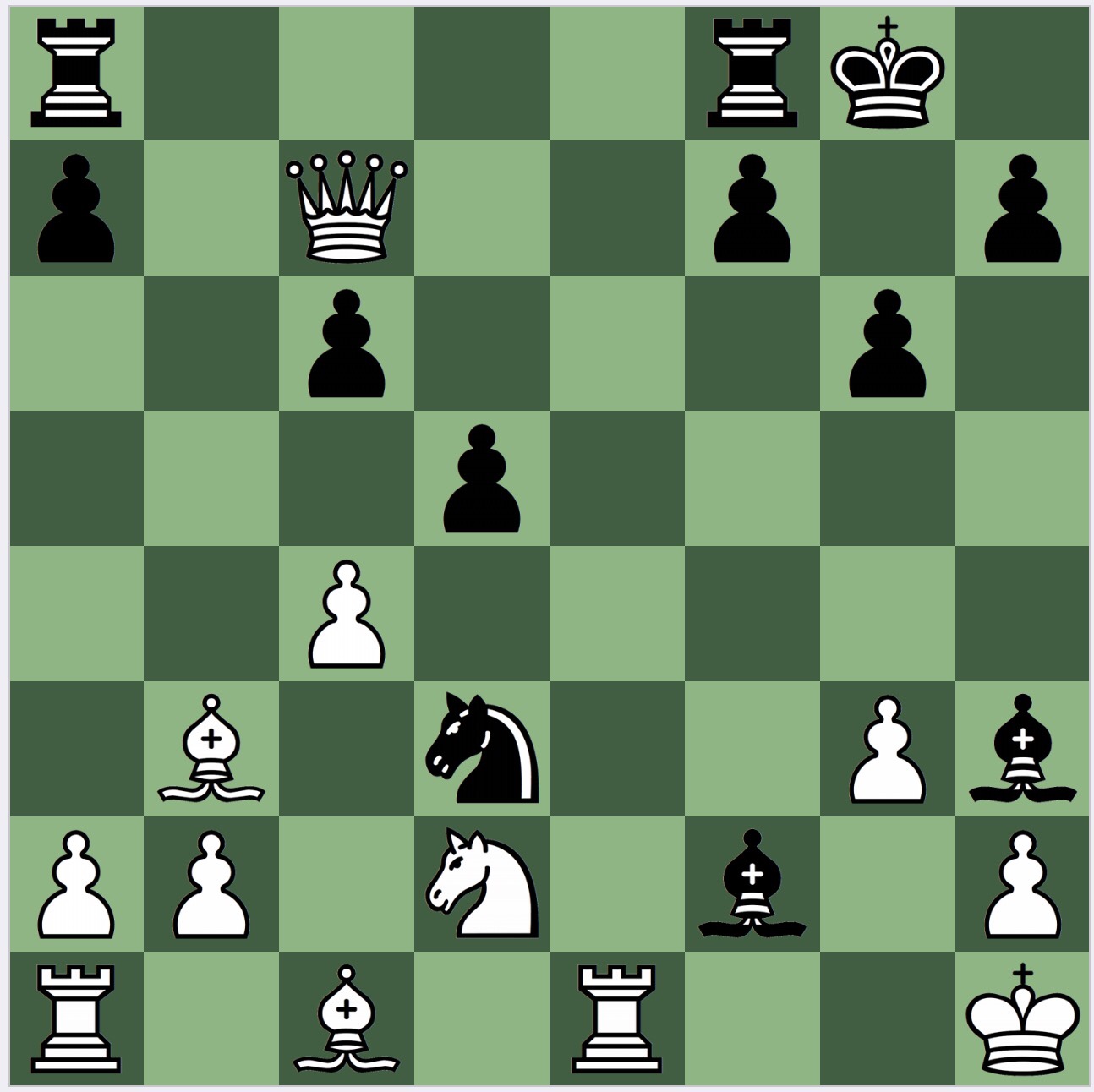
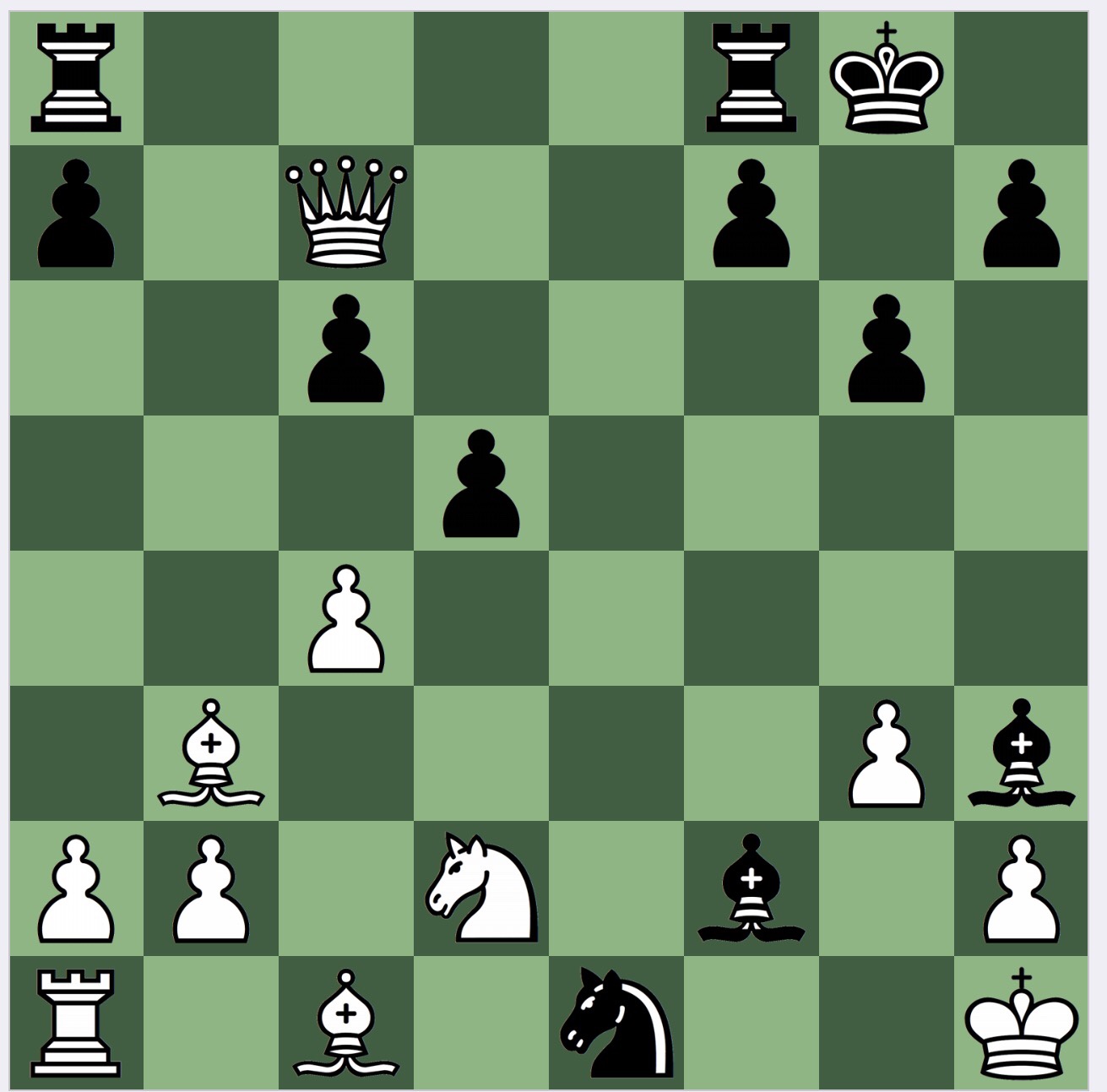
And now the idea which at first I struggled to see: 3…Ne1!, with the unstoppable threat of 4….Bg2 mate.
Another puzzle from Dragoslav Andric’s 1981 book “Matni Udar”.
White to play and mate Black.
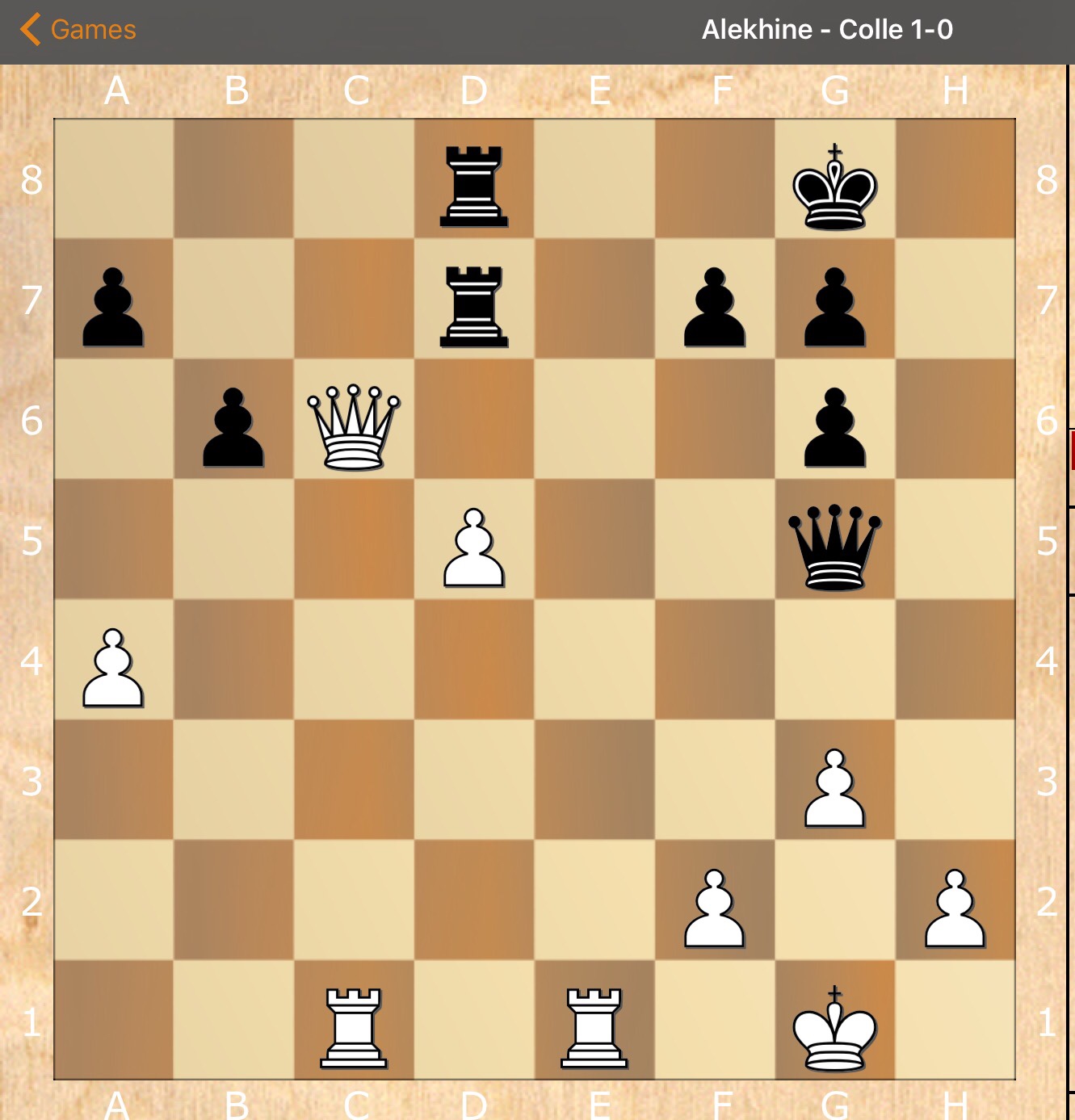
Alekhine v Colle, Paris 1925
Solution
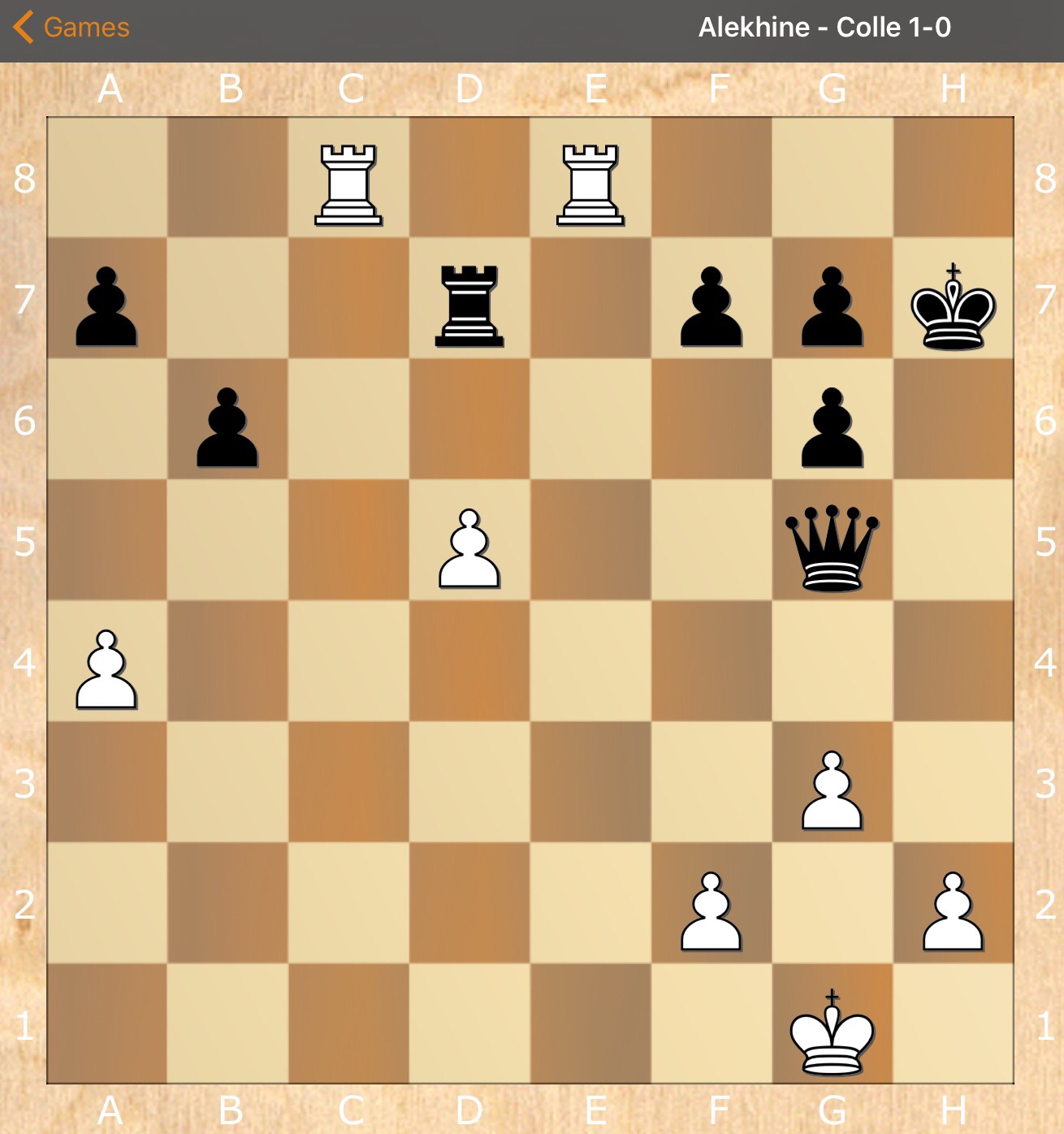
Not too hard today: maybe I have seen this one before, sometime over the years. 1 Qd7! Rd7[] 2 Rh8+
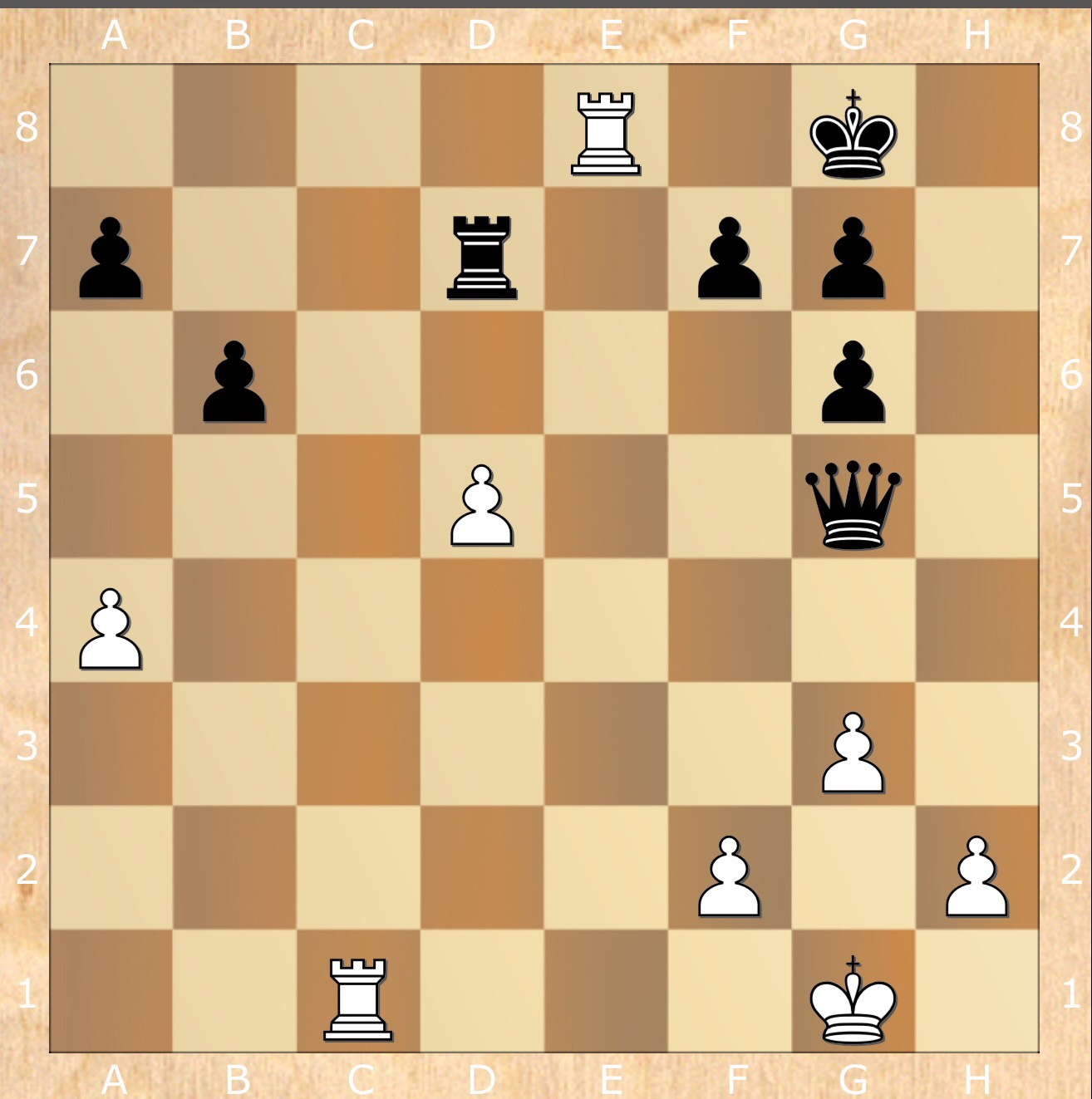
(2 Re8+) Kh7[] 3 Rcc8 and mates on h8.
To find the positions (I am writing this post on holiday, with only my iPad, and no Megabase) I used Chessbase’s online app: searching for the game, I saw that Alekhine had Colle’s ‘number’:
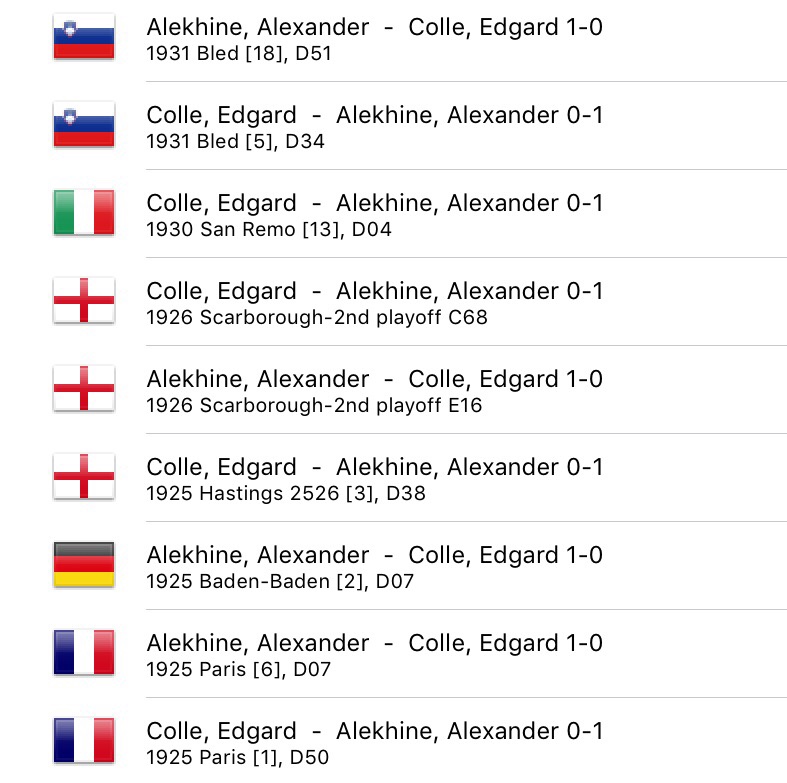
Another puzzle from Dragoslav Andric’s 1981 book “Matni Udar”.
Black to play and mate White.
(White could bale out with overwhelming material loss)
Unknown vs Nimzowitsch, Copenhagen 1925
Solution
Straightforward today, or at least a standard theme of double attack. 1…Rh1+! 2 Kh2 ef 0-1

Black threatens both Rh8 mate and fe(Q)+ so it is all over: if 2…Ree4 3 f1(Q)+ and 0-1.
Whenever I see such positions, with double attacks of a different nature (so not forks) I think of Levon Aronian. At the London Classic several years ago, having finished his game, he came to sit next to me, since I was sitting next to Viktor Korchnoi, helping Viktor ‘see’ the screens to know what was being played. At one stage, Viktor explained a line and said ‘and double attack’ to which Levon quipped ‘chess is double attack’; paused a moment to reflect, and said with stress ‘yes, chess is double attack’. This has always stuck with me and I have seen countless times when it is true.
 allanbeardsworth