White to play and win
A good puzzle today: especially if you both find white's winning attempt, and black's best defensive try.

S Lewis v I Bekerman 1953
Solution
After trying to 'get to' h7 by Qh5, Qh4, Qh3 and even Bh7+, and seeing that …g6 is normally the defence, trying 1 g6! deserves to be looked at. Once seen, it is quickly apparent that it is decisive: 1…fg 2 Bg6 and 3 Qh5 follows. Or 1…gf 2 fg+ Kf7 3 Bg6+ skewers the king and queen, and the final main line is 1…gf 2…fg+ Nf7 3 Bh7+! and mates, which was the game continuation. Random defences like 1…Rc3….
Black to play and win
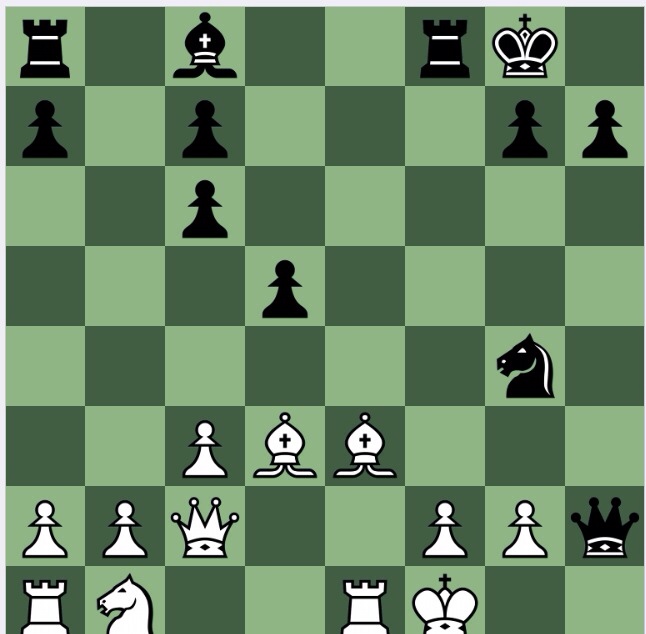
L Wilken v S Driman 1949
Solution
There are several candidate moves, such as Qh1+, Ne3+, Rf2+, but the one which stands out is 1…Nf2!
After 2 Bf2[] the obvious move is 2…Qh1+, but 2…Bg4! locks white's king in the box, with inevitable mate. In the game, black missed 2…Bg4, playing 2…Qh1+ and 3…Qg4+ and winning prosaically.
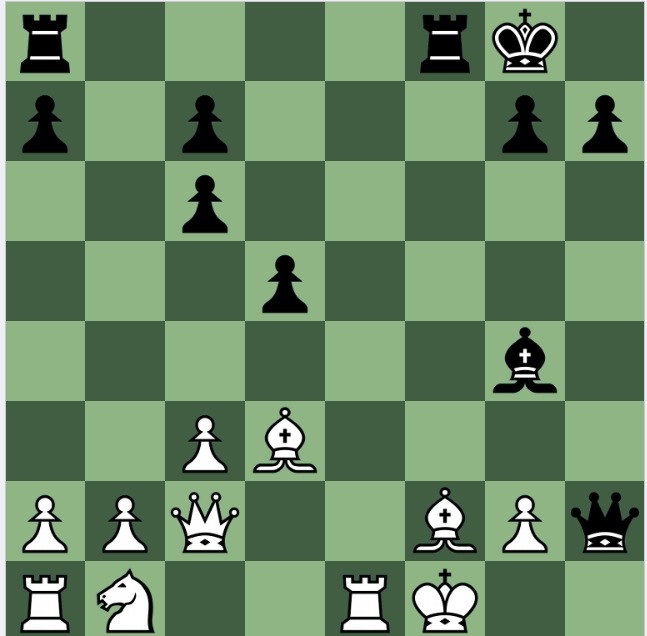
Black to play and win
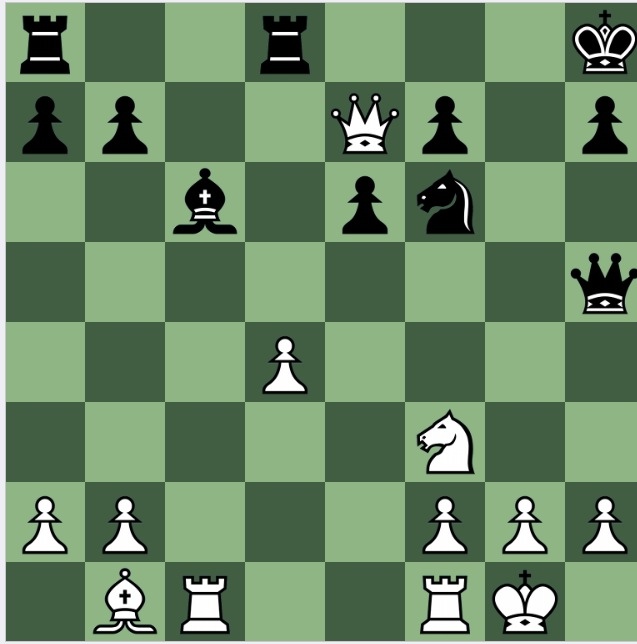
W Heidenfeld v J Wolpert 1959
Solution
1…Qf3! is a natural biff to try, with the point that 2 gf Rg8+ 3 Kh1 Bf3 is mate.
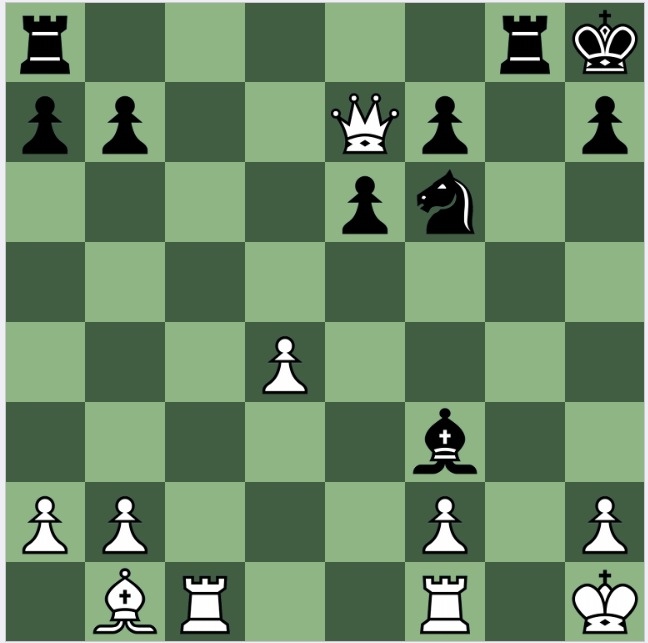
So, white has to play 2 Rc6[] when 2…Rg8! wins a piece and the game.
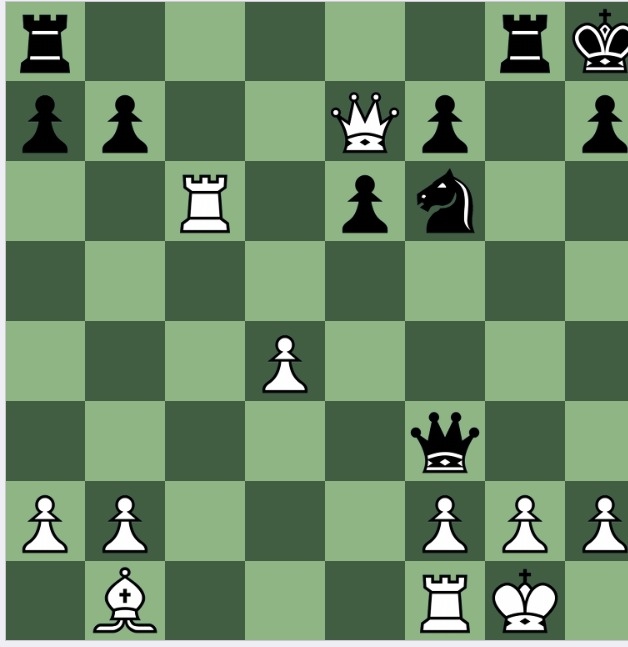
White to play and win
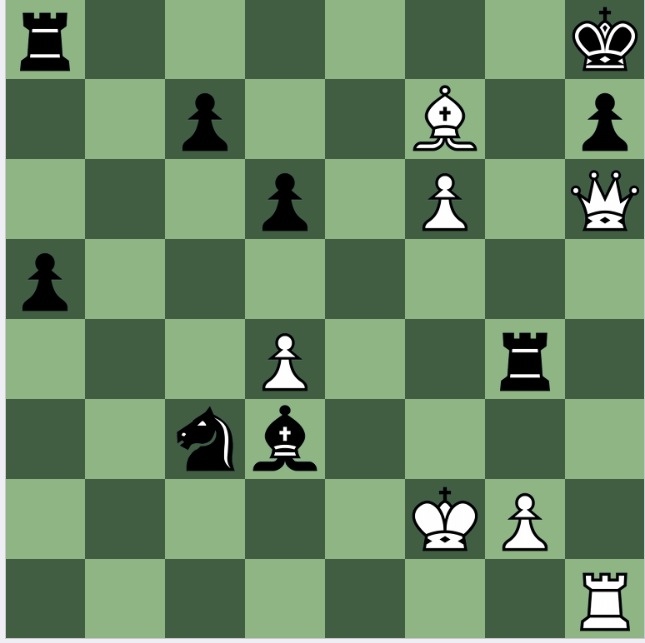
F Koronstenski v R Friedrich 1978
Solution
I suspect this is the type of problem you either see instantly or not all. On this occasion, I was in the former camp, recognising the Novotny theme move 1 Bg6! and it is nearly all over. The Bishop interferes with the intersecting R and B, and the spite check 1…Nd1+ fails to 2 Ke1.
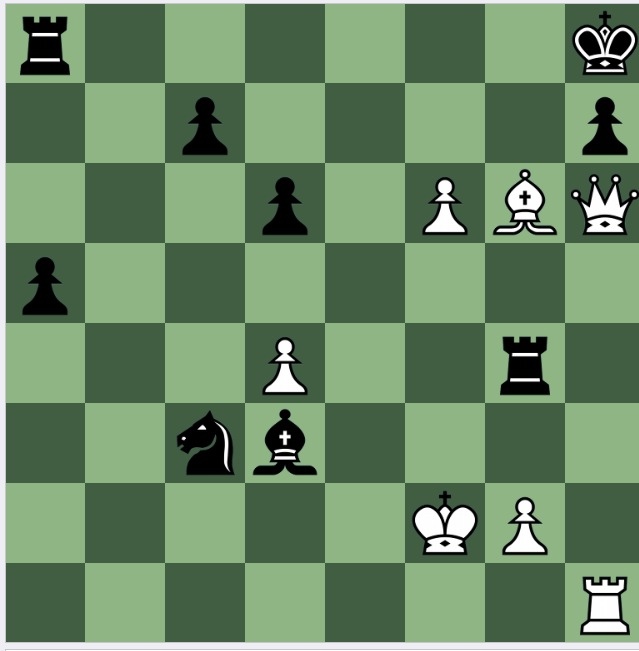
Black's only way of surviving is 1…Ne4+[]. This was played in the game and Reitstein only gives that continuation (only being an unfair word, since I have silicon engines to assist me). 2 Be4 (I could write ?! but since white is still winning, that too would be unfair) 2…Be4 3 Rh4 Rg2+ 4 Kf1 d5 5 Re4! Rg6[] 6 f7! and 7 Re8+ and the pawn queens.
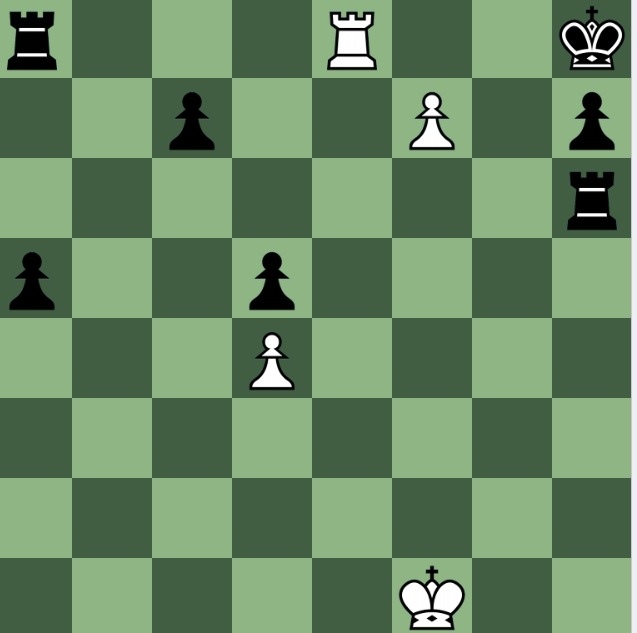
In fact, white has better. I chose 2 Ke3! which wins, but the engine says that 2 Kg1!! is mate in seven- really, less, because many of black's moves are desperadoes, throwing pieces away to defer the inevitable. All that needs to be seen is that after 2..Nf6[] 3 Bd3, black's Nf6 is LPDO and can't be defended. So mate on h7 follows.
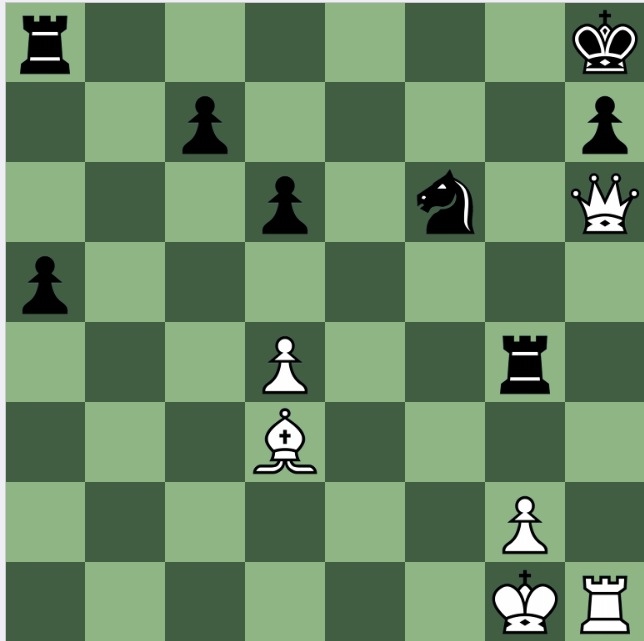
Black to play and win; or draw?; or lose?
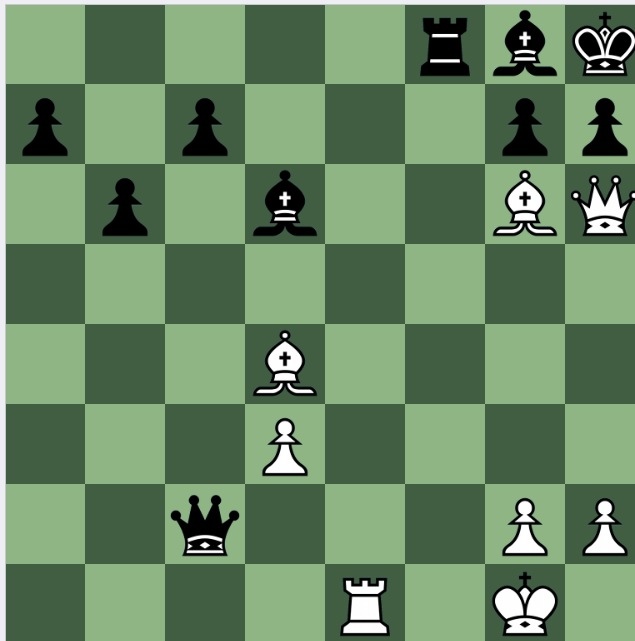
JF Smith v AE Motyer 1961
Solution
Not too hard today, but only because desperate times require desperate measures. Threatened with mate in two ways, and with checks doing nothing, and the Bc5 pin also failing, 1…Be5! is an only move, and, as it happens, wins.
If the rook takes the bishop, then. 2…Qd1+ mates. If the bishop takes, then 2…Qf2+ and 3…Qe1 mate. So 2 Qe3 is forced, when the bishops are exchanged, and then: hg; there is no mate, with Bh7+ always being possible after Q-h file checks.
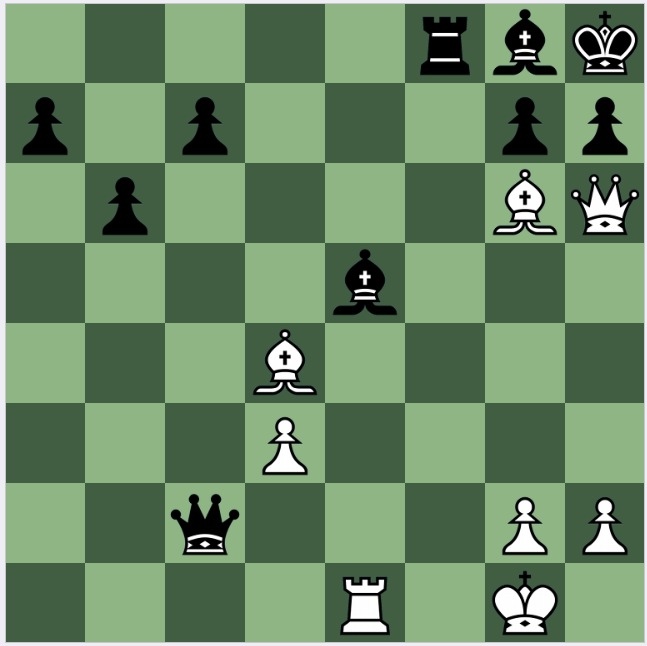
 Posted with Blogsy
White to play and win
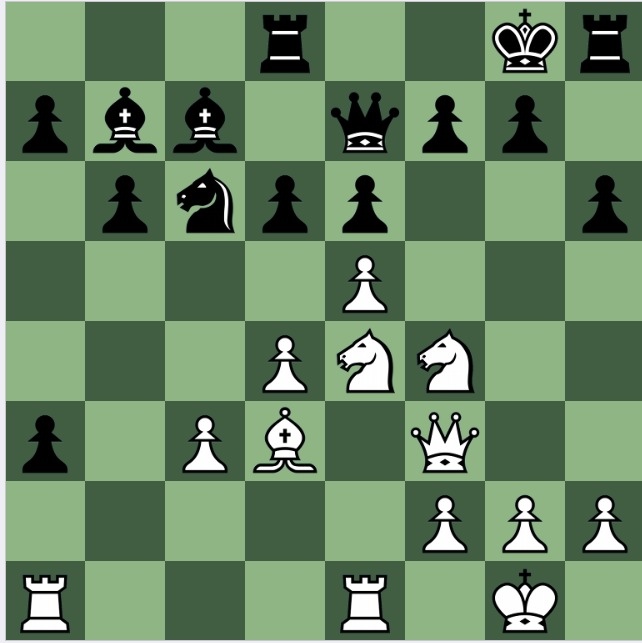
Yuri Kuzobov v Tania Sachdev, Dubai 2013
(game seen in Michael Adams' 28/6/14 Daily Telegraph column)
Solution
Introduction
A year or two back, my younger daughter gave me a present, 'Dear Dad, from you to me' , one of those gift shop gifts which are very well intentionedy, but, alas, time is so short that they can often gather dust and never be completed. I decided a while ago that I wouldn't let this happen, and would aim to complete it for Sophie, Alice and Tom, so whenever they want to, they could find out a bit more about their Dad. So, I have set up a private blog, to which only family have access, and have been posting to it during our summer 2013 holidays and subsequently. Many of these postings are personal, and best kept private for the family only, but those which are less private will also be posted on my main blog.
Last night, I went out for dinner with two of our closest friends, and also with the wife's mother. A widow, her husband was the reason that after a break of thirty years, a few years ago I got back into doing the Daily Telegraph prize cryptic crossword.
Thirty five years ago, when doing my A levels at Bolton School during 'study periods' (which we called 'free periods) I got into the habit of doing the cryptic crosswords Mon-Fri, and, after a year or so of learning, eventually progressing to the Saturday prize crossword. Eventually, I entered the prize competition more or less every week, and indeed won the prize on, if I recall, two occasions.
Eventually, boredom got in, and to stave off boredom, I changed to add an element of competition, aimed to solve each puzzle within ten minutes, and eventually aiming for within five minutes. Not always achieved, but achieved fairly frequently. (And, to show it is both a matter of habit, and a matter of complexity of the puzzles, I could never get more than a handful of The Times crossword).
Roll forward to a few years ago, when the couple told me that he was passionate about the Telegraph cryptic puzzle. So, I started again; didn't quite get into it, because at the time I was addicted to Sudoku (I am now a signed up member of Sudoku anonymous- the problem for me on these too was they became competitive, became compulsive, and I made every effort to solve the most intricate ones in the same five or ten minutes: the enjoyment vanished, and I realised they were just pointless puzzles).
Eventually I got back into crosswords, but only on Saturdays. Alas, the ravages of time and lack of regularity now means that 20 mins is typical, 30 mins not unusual, and on some occasions I can't solve them. Maybe things aren't the same nowadays? However, today for the third time this year I solved the puzzle in below five minutes, though alas 'not really'.
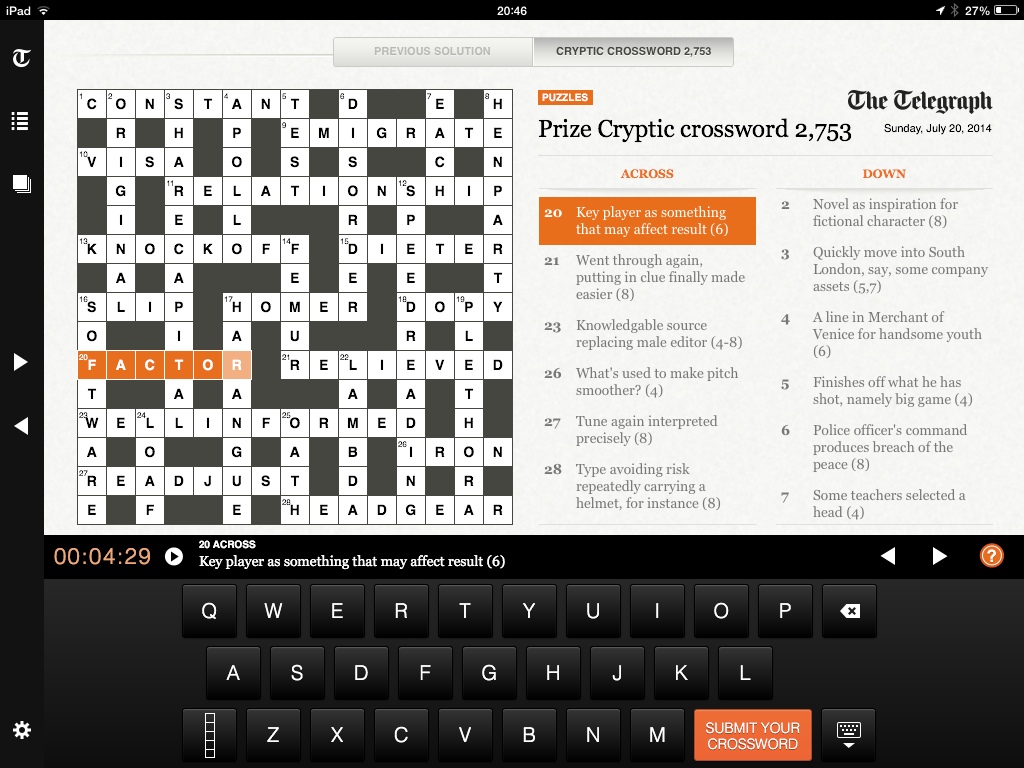
It took me four more hours (during which I was of course doing other things!) before the lightbulb moment occurred and I appreciated why FACTOR was indeed the answer to 20A: Key player as something that may affect the result (6). I was mis-directed by the well constructed 'surface' of the clue- the surface being how the clue reads plainly- and, of course, misdirection is one of the arts of compilers. Eventually, I twigged it: 'key player' should be scanned as two separate words, with key being the musical key F, and a player being a stage actor.
So, did I solve the puzzle in record time or not? Not really, but it is still nice to do on occasion.
White to play and win
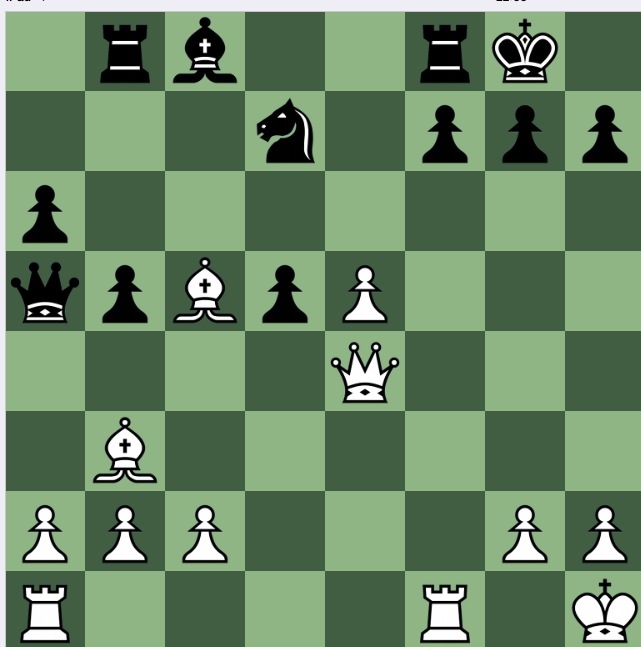
AA Ponelis v N Woodward 1973
Solution
Examine all biffs again, and after not seeing anything special with taking on d5, 1 Rf7! is a natural try, noting that if the queen is taken, there is 2 Rf8 discovered check, double check, mate.
So, all black can do is try and hold on with 1…Nc5:
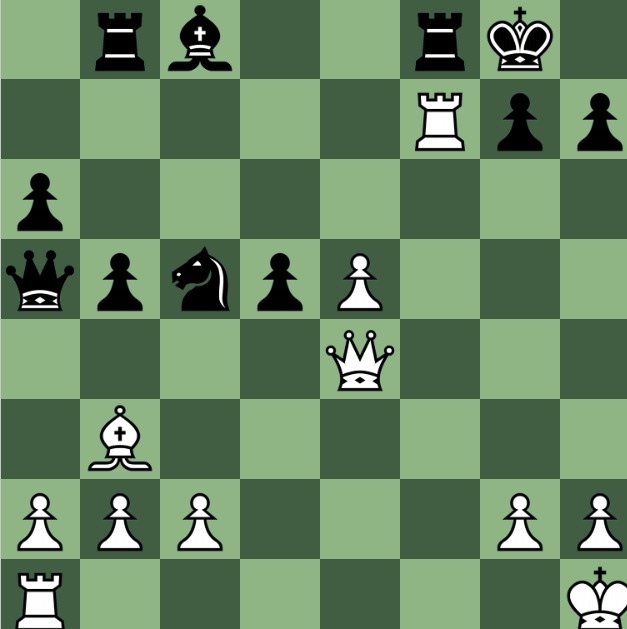
However, white simply exchanges rooks, and takes on d5, and if nothing else, the LPDO Rb8 wil drop off (with Nb3 being met with a Rf1+ zwischenschach). (In fact, Stockfish tells me to take on h7 rather than d5, with mate in 8, but taking on d5 and biffing the LPDO Nc5 and threatening the LPDO Rb6 is more human).
Black to play and win
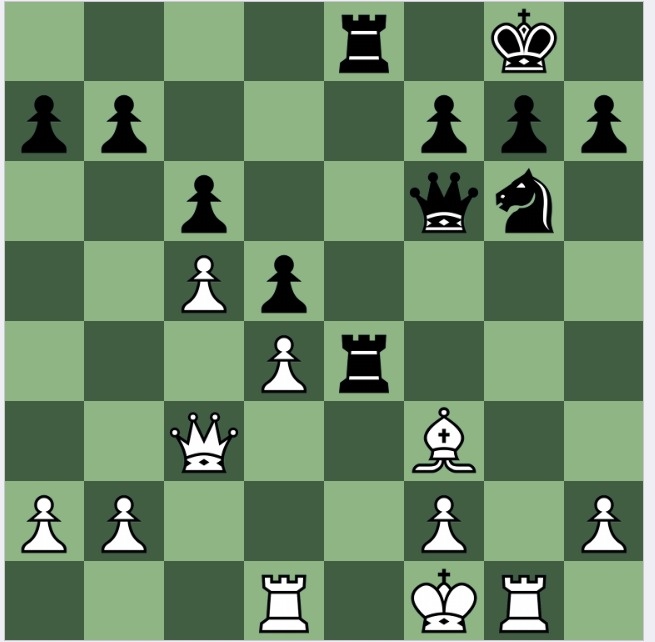
H Meihulzen v BE Siegheim 1911
Solution
In CJS Purdy terms, the Qc3 is tied to the Bf3, and examining all biffs leads to 1…Re3! and white's position collapses.

A good time to repeat my favourite Purdy poem.
Purdy on nets, pins and ties, Fine Art, vol 2, pg 205
Some things are hooey,
and most others lies;
But forks you mustn't miss,
nor pins, nets, ties.
White is forced to play 2 Rd3, when 2…Rd3 3 Qd3 Qe6! is a double attack- on e1, with Nf4+ threats, and Qh3+-Qh2
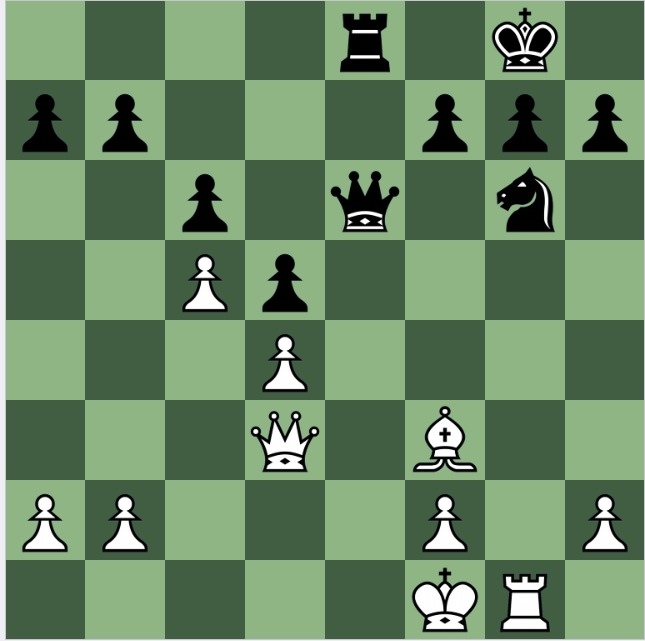
White to play and win
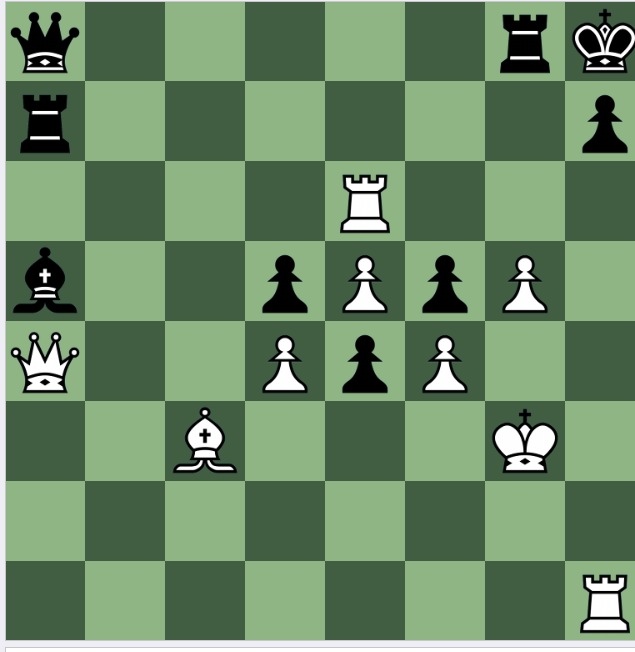
J Martins v ED Hill 1953
Solution
This is one which, being a problem, is easier: you know there is a forcing solution. So, consider all biffs and play 1 Ba5! Ra5[] 2 Rh7+!.
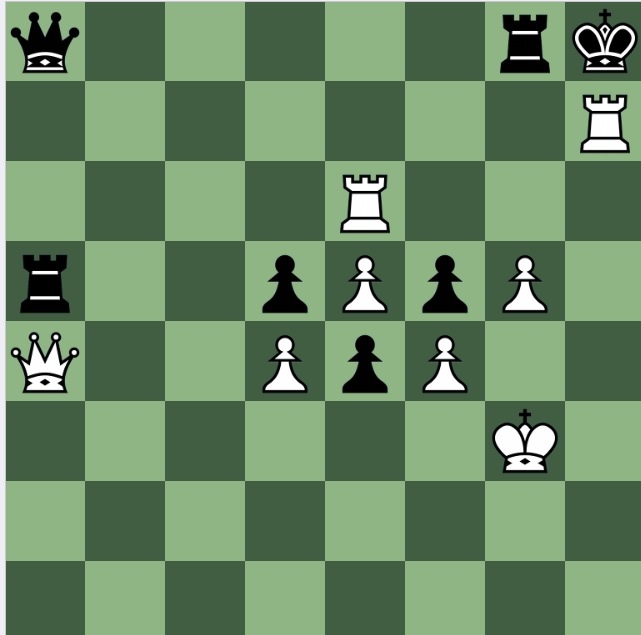
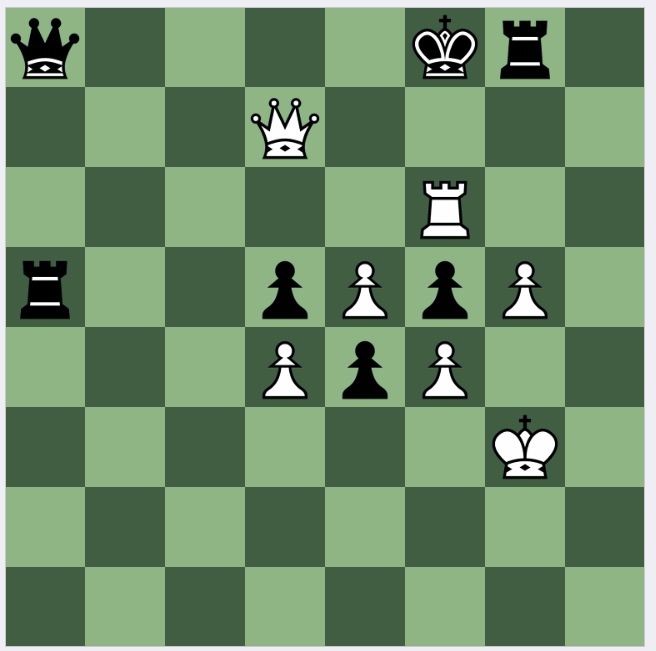
There is a single branch: 2…Kh7[] 3 Rh6+ (3 Qd7+ also wins, but slower: 3…Rg7+ 4 Rh6+ Kg8[] 5 Qe6+, shuffle the Q to d6, to protect a3, then play Rh6) Kg7[] 4 Qd7+ Kf8[] 5 Rf6 mate.
 allanbeardsworth