White to play and win
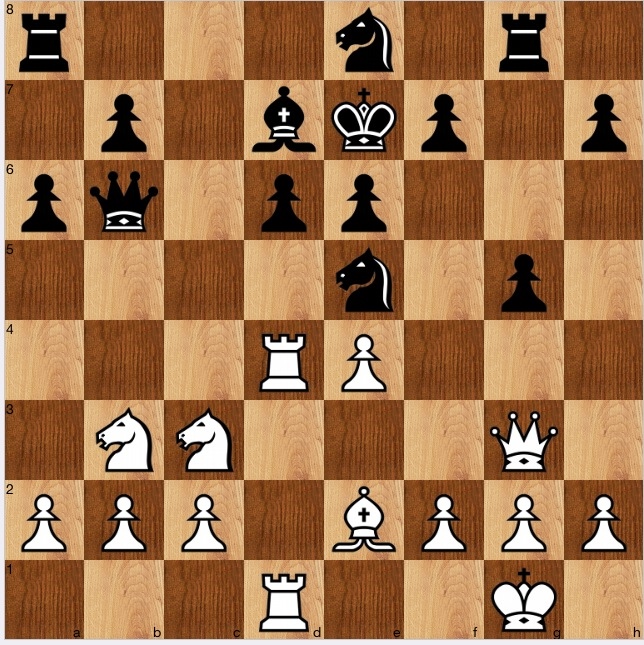
N Mamedov v Manolache, Al-Ain 2012
Source Chess Today issue 4430
Solution
If it were possible for a chess trainer to see how I solved this puzzle, I would have flunked the test. My process was:
Try to make 1 Qe5 de 2 Rd7+ Kf8 work;
Try again to make it work;
Note that there is a Nd5+ forking motif, and then notice the e6 pawn is pinned, but notice that a knight can't get to f5;
Try to make 1 Qe5 de 2 Rd7+ Kf8 work;
Having failed, see if 2…Kf6 can be made to work;
Count the LPDOs: Qb6, Ra8, Rg8: note that there is a Qg8 jump biff, so the g5 pawn is pinned; try to get f4 or h4 to work;
Try to make 1 Qe5 de 2 Rd7+ Kf8 work;
Think: should I give up?; no;
Think Purdy again: examine all biffs, Qg5+, Rd6, Ba6 and all threats to biff: Rb4, Na4; realise 1 Rd6! is the solution.
Not very impressive, but at least I got there in the end.
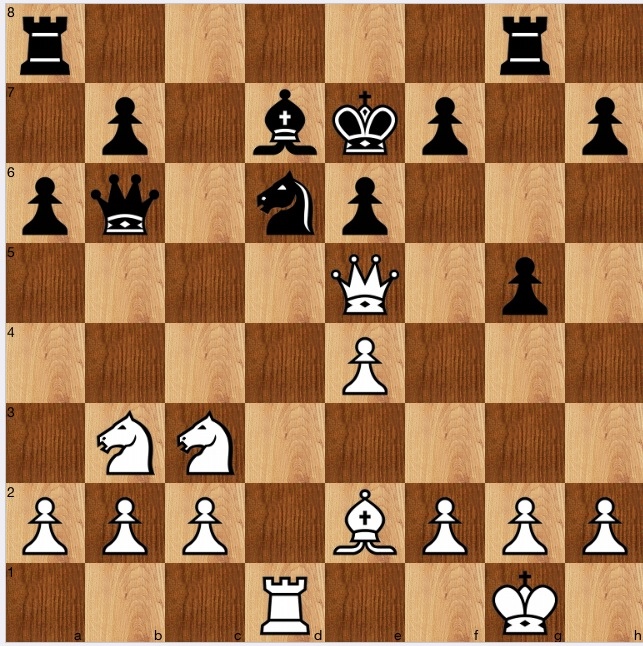
The threat of the Nd5+ fork means that the Nd6 falls, and black's game collapses. Key is 2…f6 3 Nd5+ Ke8 4 Nf6+, and otherwise the white pieces swarm in,
 Posted with Blogsy
White to play and win
Black has just played Rd5-d6
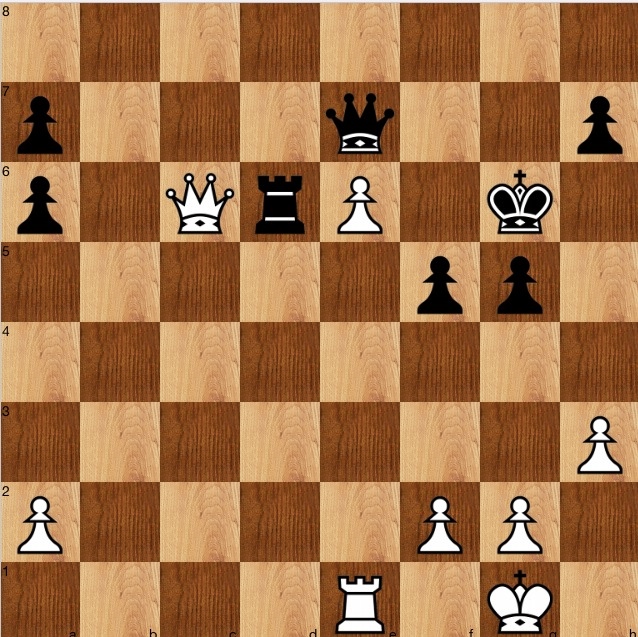
D Friedgood v A van Tets, 1978
Solution
A trivial one today: 1 Qd6, and the pawn promotes, or black loses his queen.
Black to play and win
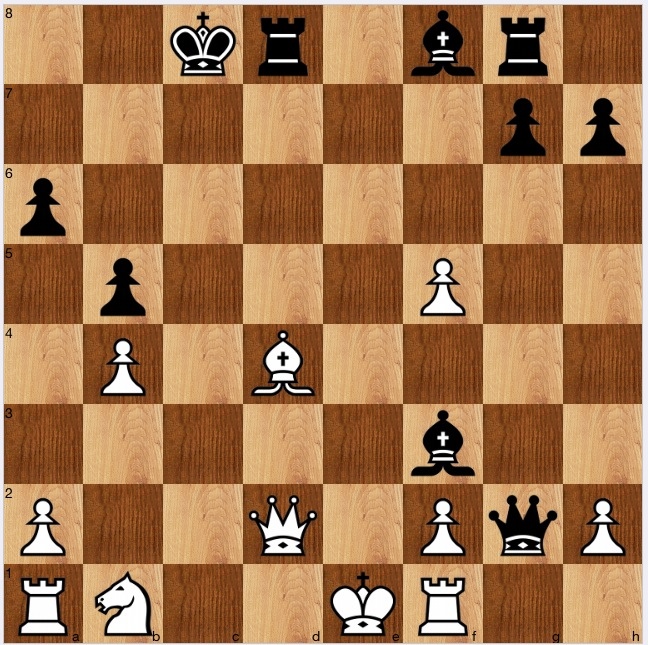
RF Griffiths v K van der Meyden, 1963
Solution
I got a B grade on this one. After quickly examining Qf1+ and Rd4, and ruling them both out, I knew the answer had to be to get the Bf8 out, and then play Rge8+. So I tried 1…Bb4! 2 Qb4 (2 Nc3 little different) 2…Rge8+ 3 Kd2 (3 Be3?? Rd1 mate) and when I saw 3…Rd4+! 4 Qd4[] Rd8, I turned to the solution. That was poor of me: whilst it wins, I should know that when a good move has been found, look for a better one. This is particularly the case for this daily Reitstein puzzle exercise, where part of the point is to be careful, to pretend, as much as it is possible, that it mattered as much as in a game.
So 1…Bc5! is stronger: one point being that (e.g.) in the line 2 Bc5 Rge8+ 3 Be3 Re3+! and after 4 fe Rd2 5 Nd2 Qe2 mate. Similar, if 2 Qc1 Rge8+ 3 Be3 Re3+ 4 fe Qe2mate- alas, Purdy taught me to look for jump checks, and in the original position there is the jump check Qe2, the result being that the f2 pawn is pinned.
White to play and win
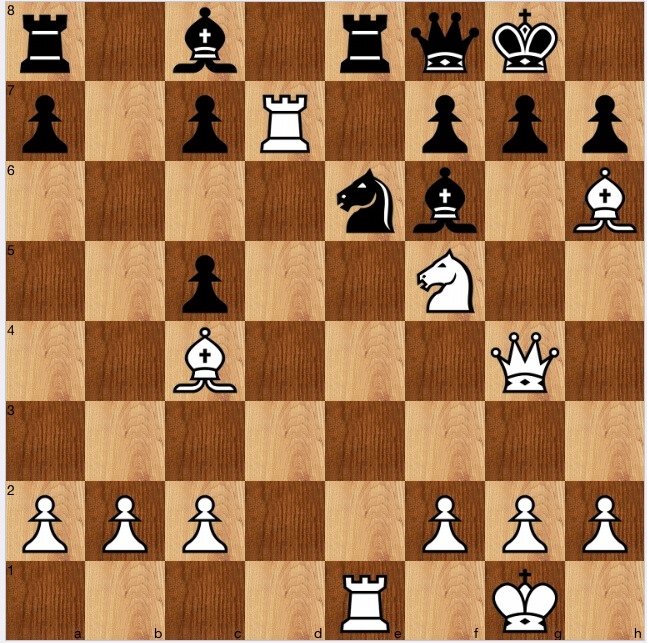
(A tough exercise: watch for Bg4, Re1, defences)
AN Rubinsztein v KF Kirby 1969
Solution
I got there in the end, but I find such positions, with lots of pieces flying around, hard to work through. I have to keep focussed and calm, and work things through line by line, and try to avoid confusion. I wonder if GMs find such calculations easy?
So, 1 Ng7 and 1 Bg7 are natural tries, and of the two, and as it turns out rightly, 1 Bg7! is the more natural: the N could be more useful than the B. Then there are two branches: 1..Bg7 and 1…Ng7. Against the former, which intuitively seems weaker, because neither the e file or c8-g4 diagonal are opened, 2 Nh6+ Kh8[] 3 Nf7+ is at least a perpetual, so can provide a stepping stone to look further with confidence. It (3 Nf7) is indeed no more than a perpetual, but 3 Rf7! Qd6[] 4 Rg7! wins, because 4…Ng7 5 Nf7+ forks king and queen! and takes the queen either with discovered check or, as you wish, after Re8+.
Therefore. 1…Ng7, when not 2 Nh6+ Kh8[] 3 Re8 Qe8 4 Nf7+ because 4…Qf7! 5 Rf7 Bg4 which, alas, opens up the eighth rank so that the Ra8 prevents Rf8! When I saw this, I panicked, and it took a while to regroup and find 2 Re8! Qe8 3 Bf7+! Qf7 4 Nh6+ Kh8 5 Nf7+ etc.
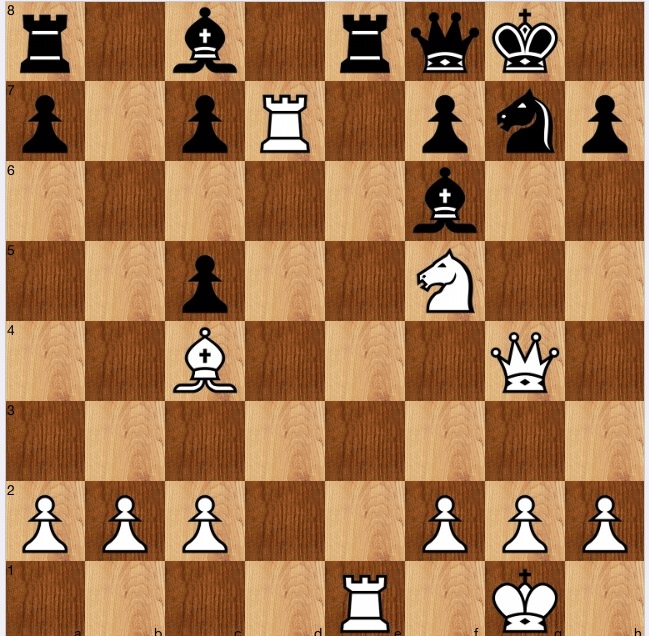
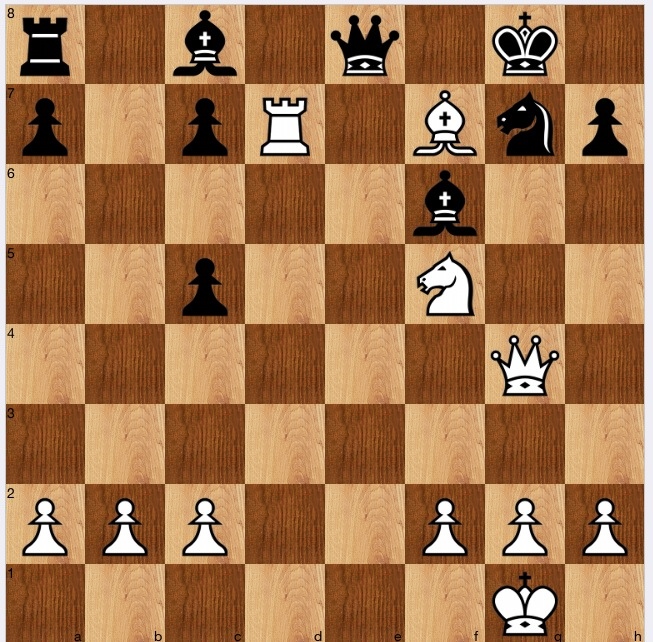
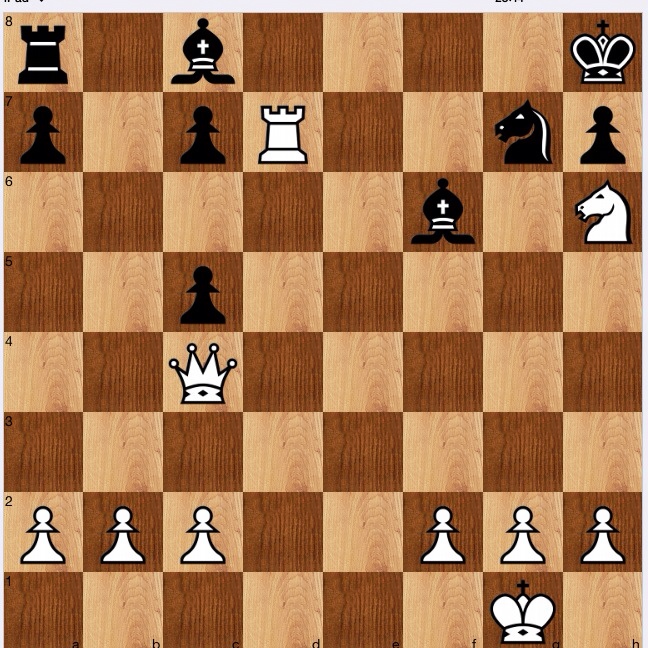
The toughest puzzle for a while, or at least I think it is.
Black to play and win
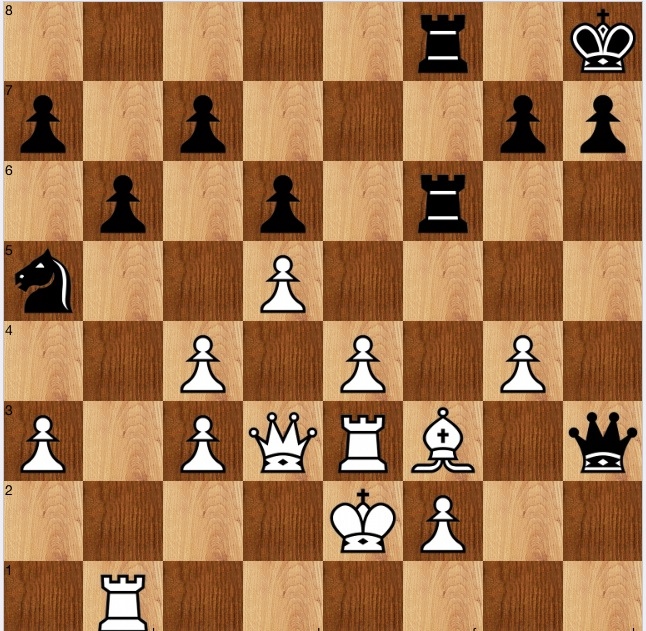
White's last move was 1 g3-g4, threatening 2 Rh1, winning the queen.
ED Hill v W Heidenfeld 1951
Solution
I doubt I would have found it in a game, but because of it being a puzzle, and because Reitstein's comment said the solution was brilliant, I quickly saw 1…Nc4!. If the N is captured, then 2…Rf3 and white's king side collapses. So, 2 Rh1, when 2…Qh1! and the next point emerges:
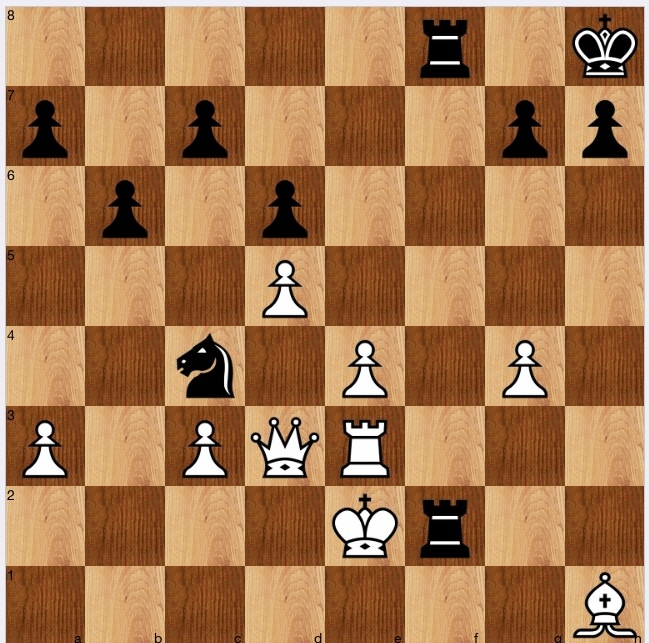
The above position is after 3 Bh1 Rf2+, when 4 Ke1 Rf1+ 5 Qf1 Rf1+ 6 Kf1 Ne3+ and the ending is won for black.
I haven't been following the current Siegman tournament until I saw this article on Chessbase that Axel Smith was leading it. Axel is an IM who wrote the excellent Pump up your rating published by Quality Chess. One of those rare, really well written instructional books where you feel the author really wants to help his readers improve their chess.
So, delighted for Axel, I logged onto Playchess to see how he had fared today, to see that he went down in flames against Nils Grandelius, one of the players he profiled in Pump up.
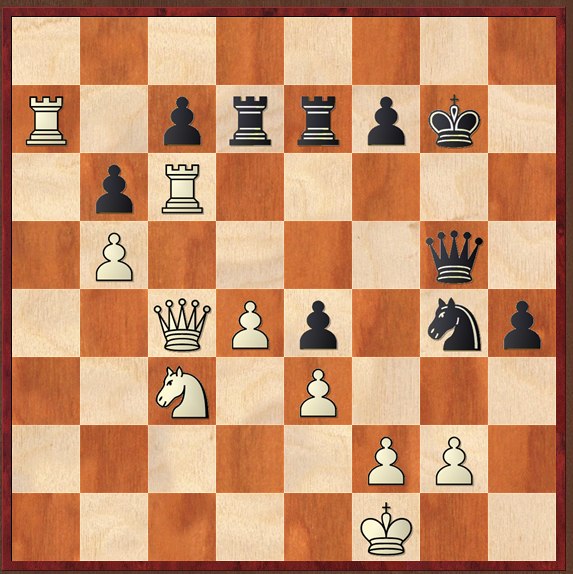
Up until now, this QGD game had remained more or less level, both players following their typical strategies. I have annotated the game in the file attached at the end of this blog. White here played the losing move 1 Ke2?? whereas 1 Ke1 holds, but the reasons are far from obvious, and the defence after 1 Ke1 is perilous.
Black played 1…Qf5! and the first point is revealed. With the king on e2, white can't retreat his Q to e2 or f1. (in fact, white's last move before the first diagram was Qe2-c4?! taking the Q away from the defence.
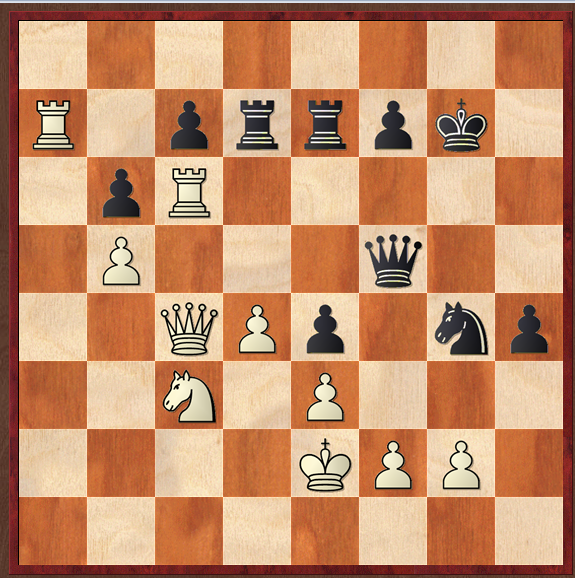
White is forced to play 2 Nd1 when the next point is revealed: 2…Ne5!! winning the exchange, with white's best being to retreat the Q.
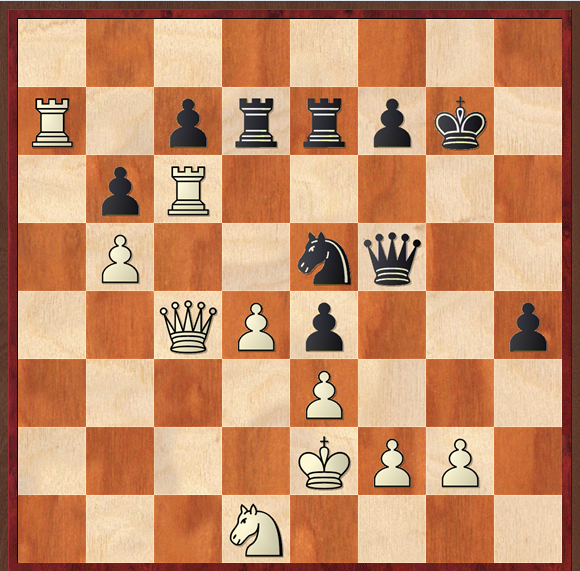
White though took the knight, to be met by the rocket 3…h3!!
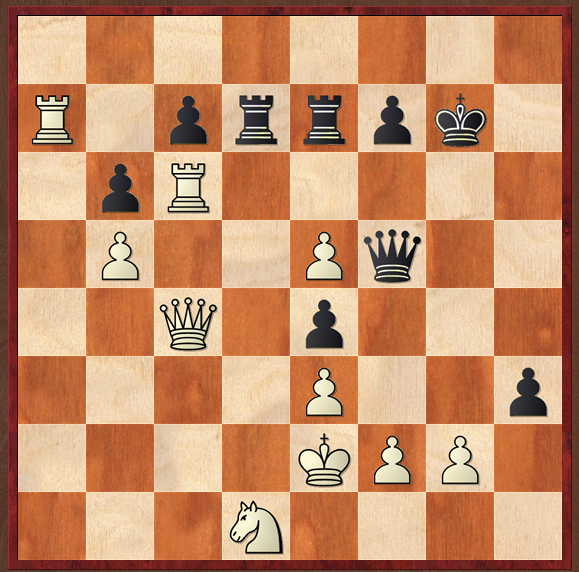
Instead, 3…Qg4+ is strong, but 3…h3 is a beautiful device, threatening either to promote the pawn, or instead decisively weakening the h5-d1 diagonal and in particular giving black control of f3. White tried to randomise with 4 e6! met with the continuation of beauty with the move 4…hg!! 5 ed Rd7! and white's king is in a mating net. Very cool, beautiful play by Grandelius. White played a couple of more moves, before resigning.
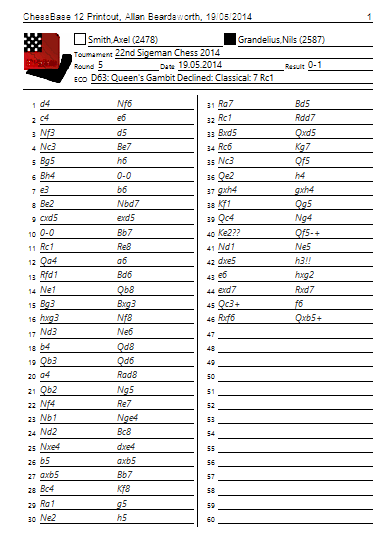
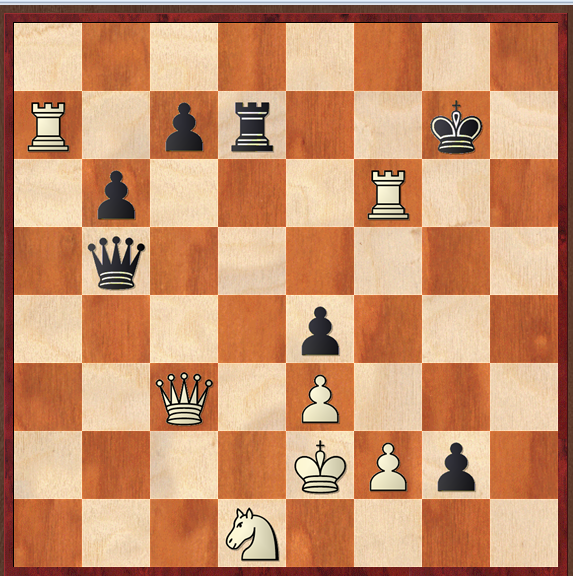
My annotations are here in a repayable game file, generated by Chessbase12. A pity for Axel, but a great finish by Nils.
Black to play and win
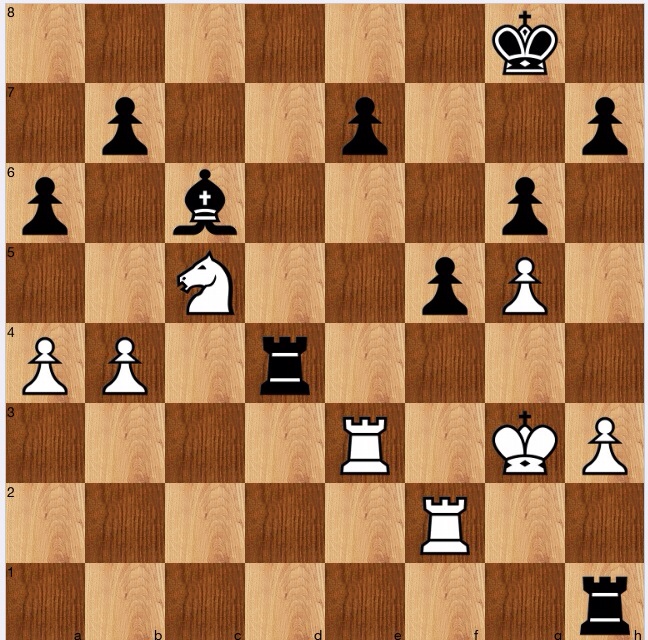
A O'Kelly de Galway v FJM Rodrigues 1962
Solution
Reitstein says that black offered black a draw in the above position, which white accepted 'with alacrity': the puzzle being why.
Not too hard, 1…f4+! which is an example of Purdy's potassium cyanide, forking Kg3 and Re3, so the pawn must be captured, 2 Rf4, when 2…Qg2 is mate.
White was Belgian GM Alberic O'Kelly de Galway, the author of two books which influenced by development when a teenager as a chess player.
His Wikipedia entry, extract below is interesting:

Black to play and win
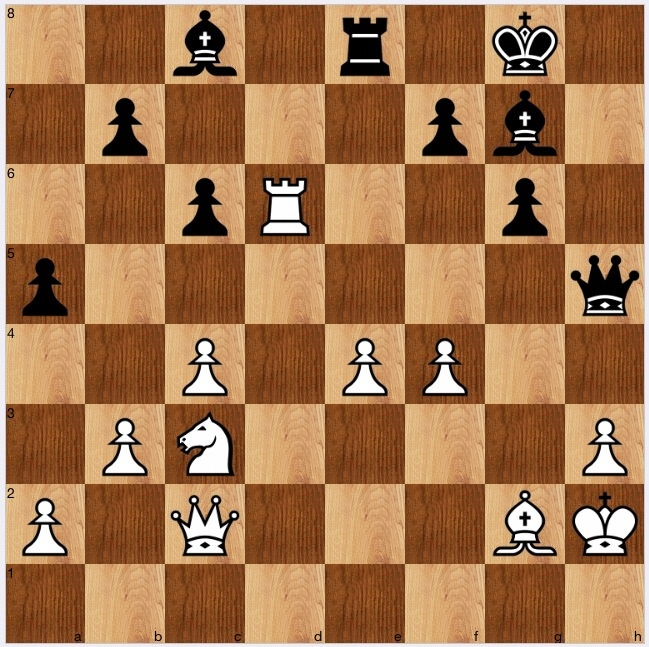
L Wilken v KF Kirby 1952
Solution
1…Be5! was a move I saw instantly, and in the same instance saw that it won: the Rd6 is LPDO, as is the Pf4, and all white can do is retreat his rook, say 2 Rd3, when his f4 pawn falls, with white having no compensation.
One of my interests for the last several years as being genealogy. After my mother died, I had a need to understand more of my history, and eventually got round to the task of finding it out some years back. For a while, it was an all consuming passion; then, when done, it became an interest, and an occasional maintenance task. And along the way it has given me, for the first time in my life, an interest in history.
This morning, I have been up bright and early, and the rest of the house, even our dog Charlie, are not up yet. Out of a whim, I thought I would try and see where someone famous was at the time of the 1911 census, and, who better to start with, then Winston Churchill.
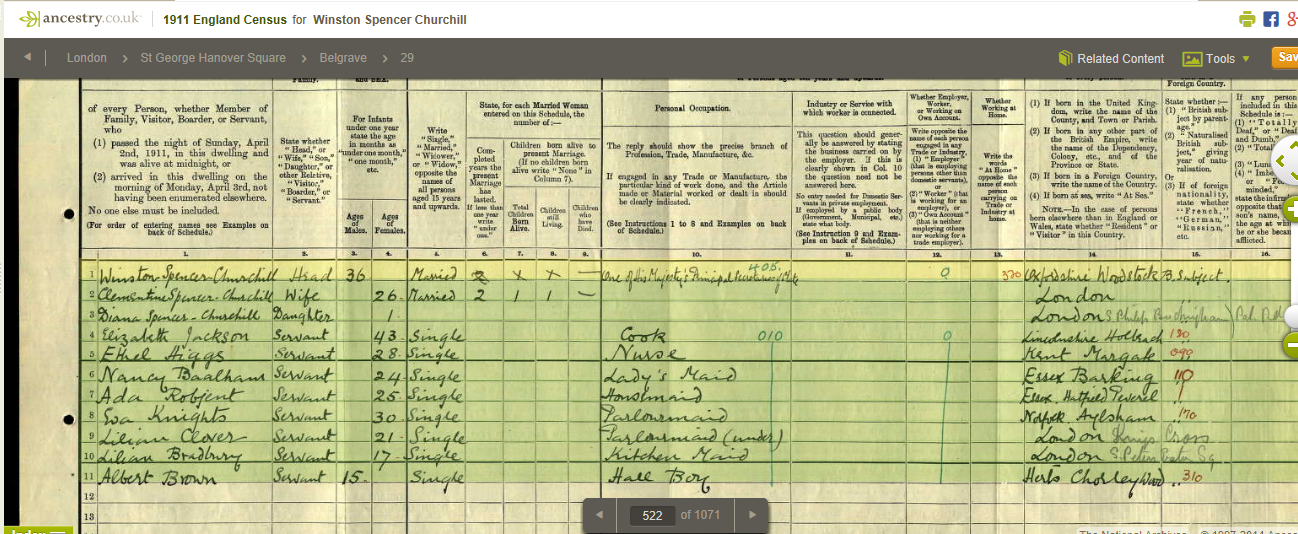
His occupation is stated as One of Her Majesty's Principal Secretaries of State. Fair enough. He and his wife of two years, Clementine, and their one year old daughter Diana, are in their house with their eight servants.
I also looked back and have shown below his first census, in 1881.
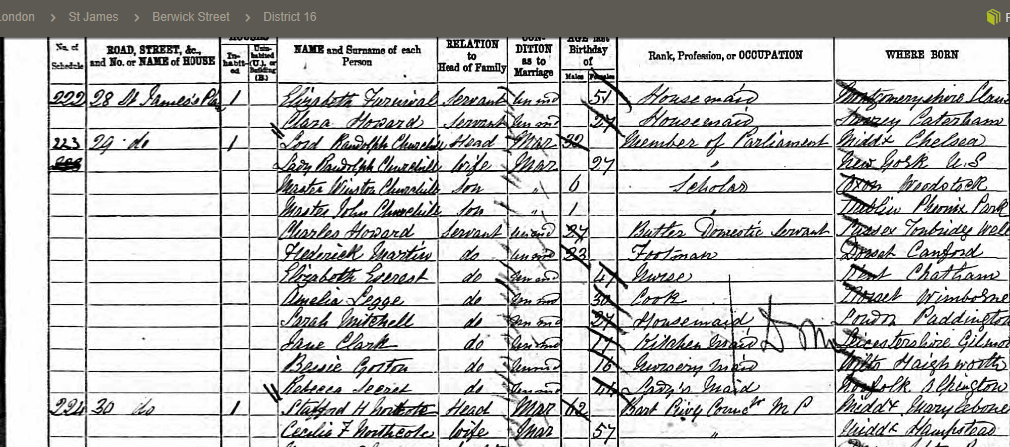
In 1881, he was a 6, a scholar, eldest child of Lord and Lady Randolph Churchill.
White to play and win
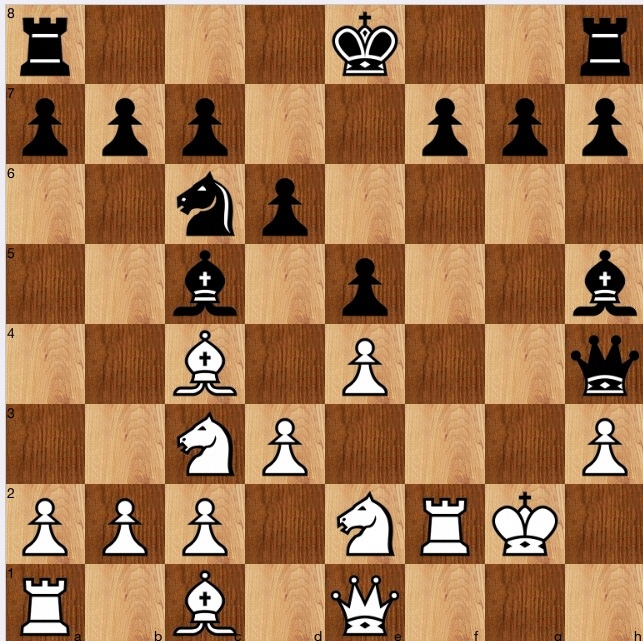
AA Ponelis v K Morris 1963
Solution
Reitstein's rubric says that black played the prosaic 1…Bf2 and won, and asks his reader to look for something more telling. With this clue, 1…Bf3+!! has to be tried (a Purdy player would look at it, following examine all biffs) with their not being many lines.
Firstly, 1 Rf3 loses the LPDO queen by 1…Qe1: again, a Purdy player would note in the initial position that white's Q is a LPDO and that there is a jump biff Qh4-e1 (so the Rf2 is pinned).
Next, 1 Kf3 Qh3+ 2 Ng3[] Nd4 mate. Or 1 Kg1 Qh3, and white is helpless with the Rf2 being pinned; and K elsewhere leaves the Rf2 en prise.

 allanbeardsworth