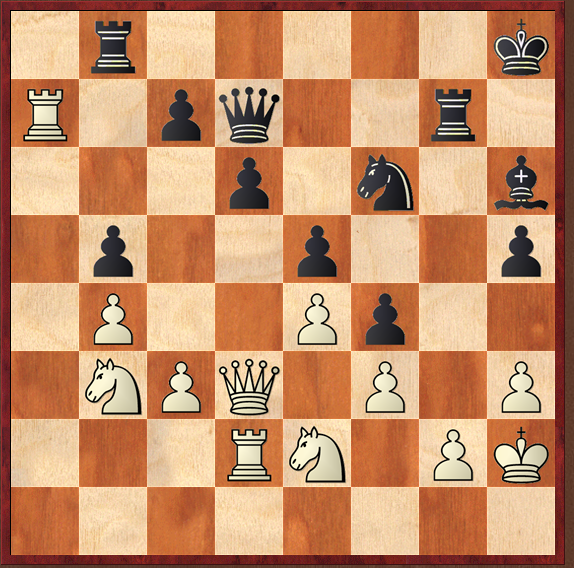
Black to play and win
Solution
The position is from a few moves earlier in game 228. When I do my daily Cordingley puzzle, I typically like to play through the whole game, just for the sake of interest. It is nice to get a quick impression in such a way.
In looking at this game, with the help of Houdini ticking away in the background, it flicked up that in the above position, black overlooked 1…Rg2+ winning. The lines are fairly straightforward. After white captures, black checks on g8, and then plays either Qh3 or Qg7+ depending on where white moves his queen.
 Posted with Blogsy
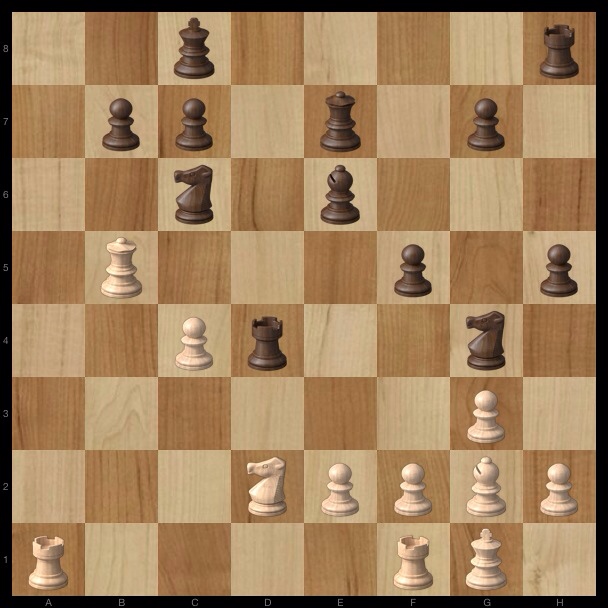
White to play and win
Solution
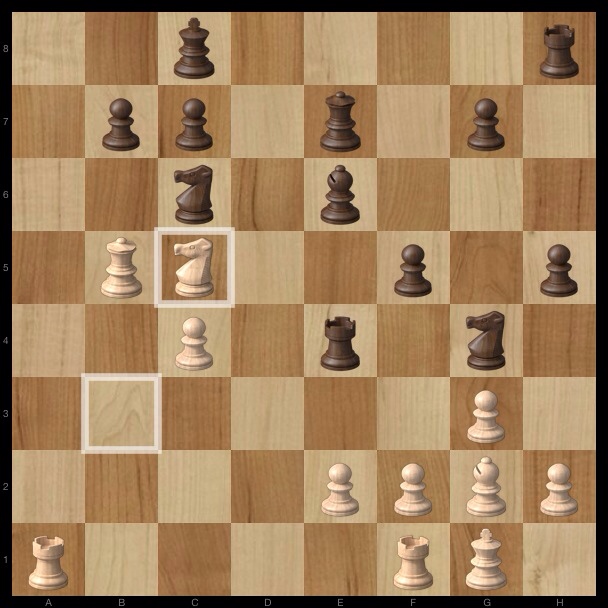
I goofed this one royally: missing not only one very strong but prosaic move, but also an 'obvious' (because it is a puzzle book) queen sac, which I really should have seen. Had I seen it, I would have been able to evaluate it, but clearly I had a bad day.
A good question would be 'how many ways to win did I fail to spot'.
I saw a fancy win, calculated a few lines, felt pleased with myself, and then checked the solution. And then found the refutation of my line. Alas, it is a fairly common mistake of mine to not check carefully enough.
My solution was 1 Qc6!! (actually ??) bc 2 Bc6 Kd8[] 3 Ra8+ Bc8[] 4 Rc8+!! (not !! actually) Kc8 5 Ra1, with the idea of Ra8 mating, but, alas, 5…Qb4! defends and refutes the line: black wins.
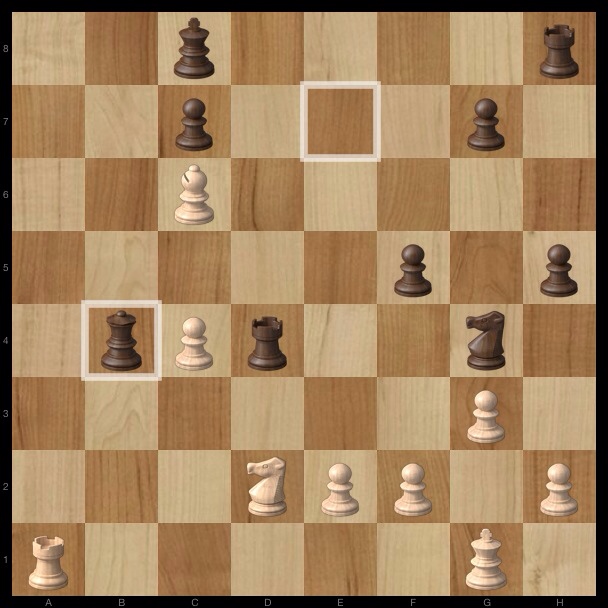
Had I been more professional in my approach, I might have found 1 Nb3!! with similar ideas. If 1…Bc4 then 2 Bc6!
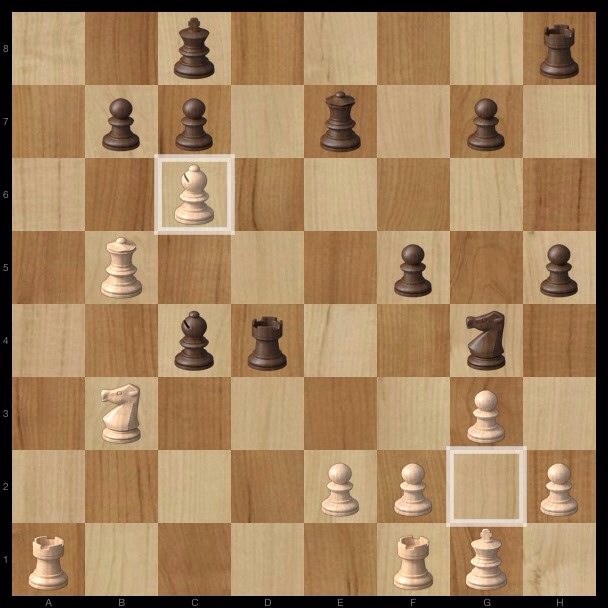
Therefore, black is lost: if e.g. 1…Re4 then 2 Nc5 wins.
A good puzzle, and a pity that I goofed it.
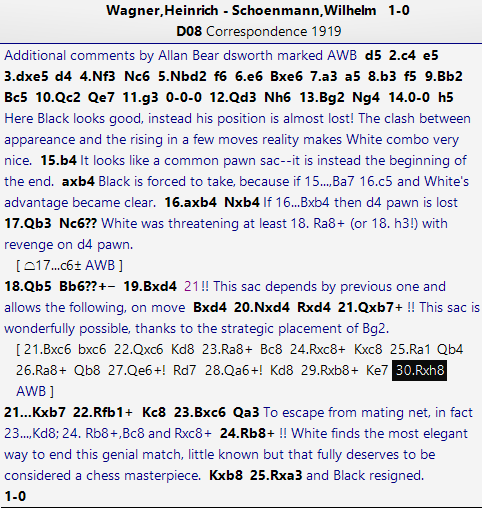
The game, being a correspondence game, is not in Megabase, but was found online. When I found it, I realised I had also missed 1 Qb7!!, the move played in the game, and a move I should have been able to see. Houdini tells me though that the strongest move of all in the position is 1 Bc6!!, assessed as +24- it is basically the same as 1 Qc6?? but keeps the queen on, so that after the Qb4-b8 defence, white is clearly winning. The reason is actually quite neat. After 5…Qb4 6 Ra8+ Qb8 white doesn't take the queen, but instead plays 7 Qe6+! forcing Rd7 when both the Q and R fall. Neat.
The final thing to say is that the penultimate move in the game, 24 Rb8+, is a very neat, precise, finish.
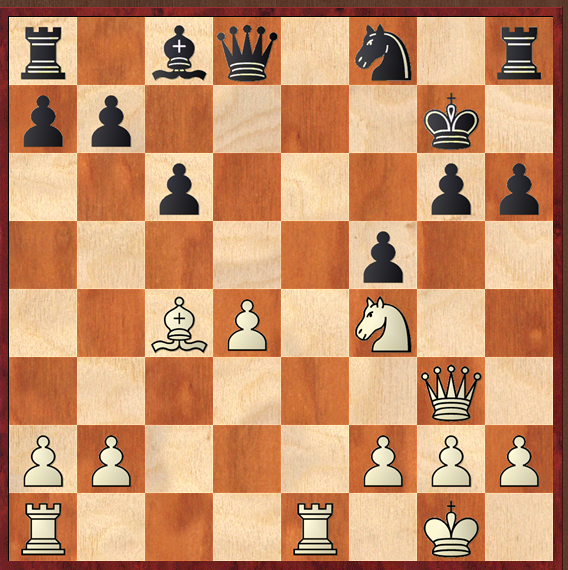
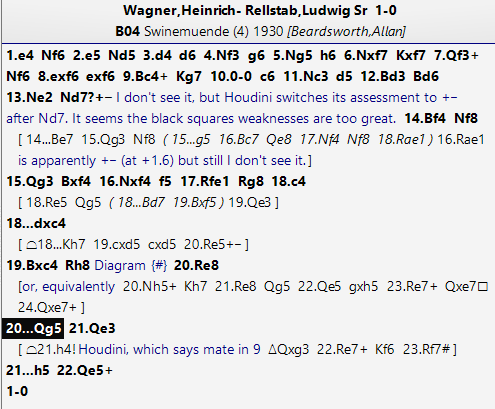
White to play and win
Solution
White has two more or less equivalent ways to win. 1 Nh5+ 2 Re8 or 1 Re8 2 Nh5+.
I chose the former, but the latter is better, for a cute point which the players missed in the game: 1 Re8 and if 1….Qg5 2 h4!! for if 2…Qg3 3 Re7+! Kf6 4 Rf7 mate.
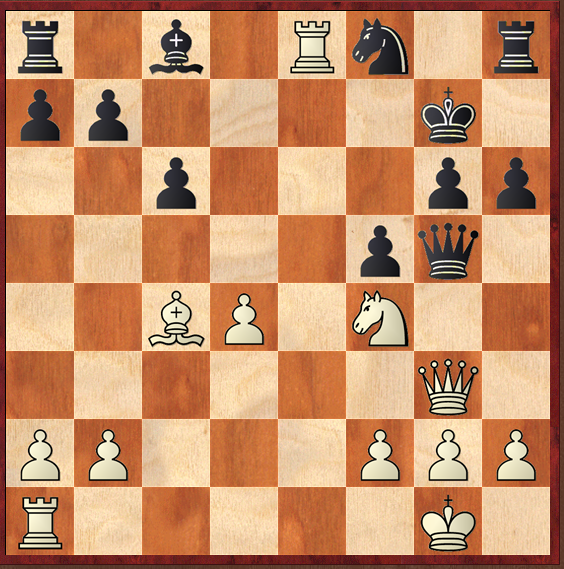
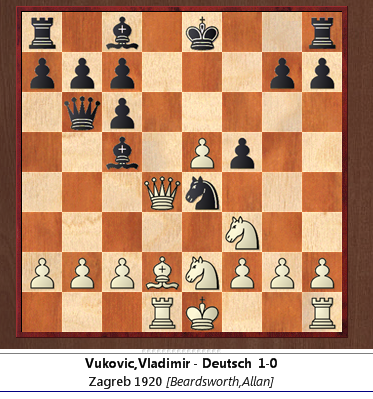
White to play and win
Solution
A calculation exercise. The only question is 'does 1 Qd8+ win?', or, rather, 'how does 1 Qd8+! win?'.
If black doesn't take the queen, his LPDO Rh8 drops off, and taking on f2 doesn't succeed: or maybe 2 e6+ wins regardless. So only 1…Kd8 2 Bg5++ Ke8 [] 3 Rd8+ Kf7 [] needs to be calculated. I fixed this position in my mind as a stepping stone, and once so fixed, continued. 4 e6+ is natural, more to free e5 for the Nf3 than to check. If 4…Ke6 5 Nf4+ Kf7[] 6 Ng5 is mate, or 4…Kg6 5 Nf4 is again mate.
A nice puzzle: not simple, but not hard either.
The game can't be found either on Megabase or online.
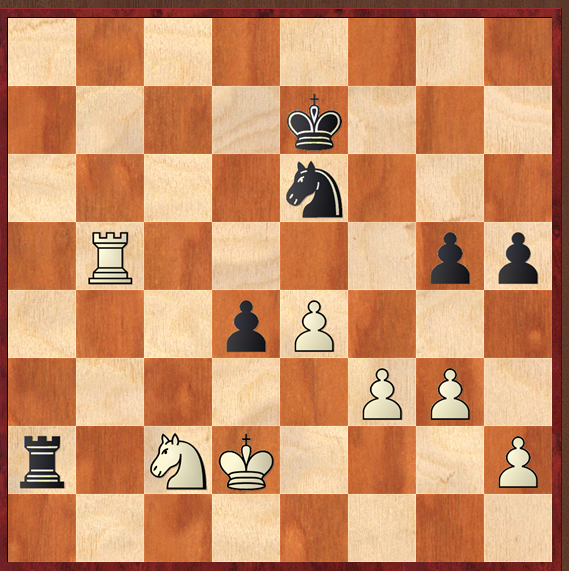
Black to play and win
Solution
Fairly obvious today: 1…d3!! is a natural biff, and has to be looked at. If 2 Kd3, then 2…Rc2 3 Kc2 Nc5+ and if white plays Rb7+, then Nc5+ is a different fork.
As with many Munich Olympiad 1936 games, the score appears to be not available.

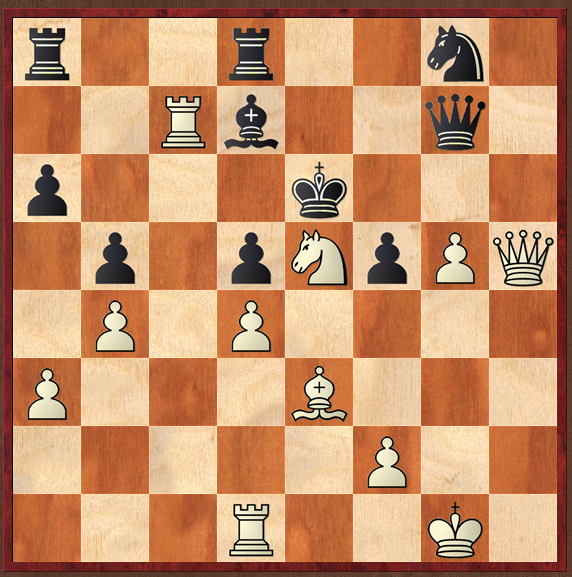
White to play and win
(one to try hard on: it will repay studying, looking for hidden depths)
Solution
A really tough, good, puzzle: a gem. I spent a good whole on it, got two good enough solutions, one of which is the prophylactic 1 Kf1! preventing 1…Nf6; the other, 1 Rdc1! being the move I plumped for 'since it was a puzzle' (I think I would play prophylactically in a game). Both of these win, as does the move Vidmar saw (as I did) 1 Nc6, when Tarrasch could have struggled on with 1…Nf6 sacing the exchange- the reason why I didn't opt for Nc6.
Houdini, by contrast, suggests two even stronger first moves. 1 Re1! and 1 Bf4!!- both have the same idea, to sac on e4 when black plays Nf6-e4, the idea I missed.
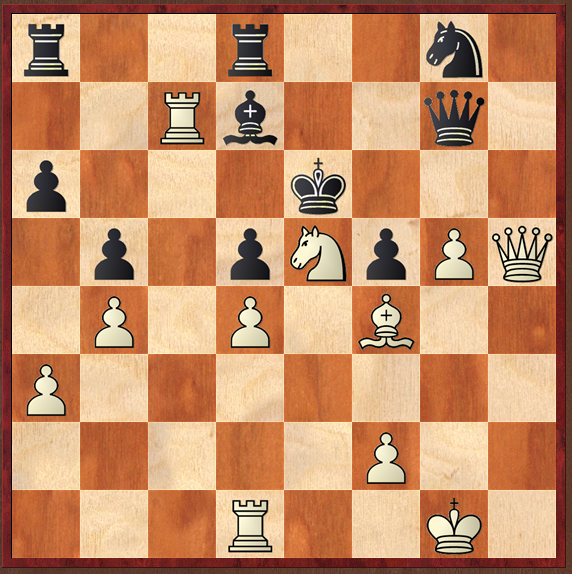
Houdini's preference 1 Bf4!!
After 1 Bf4 Rdc8 2 Re1! Nf6 3 Nc6+ Ne4 4 Re4+!! was the move I missed and why I didn't opt for 1 Bf4. It wins after 4…de 5 d5+! and 6 Qd1+.
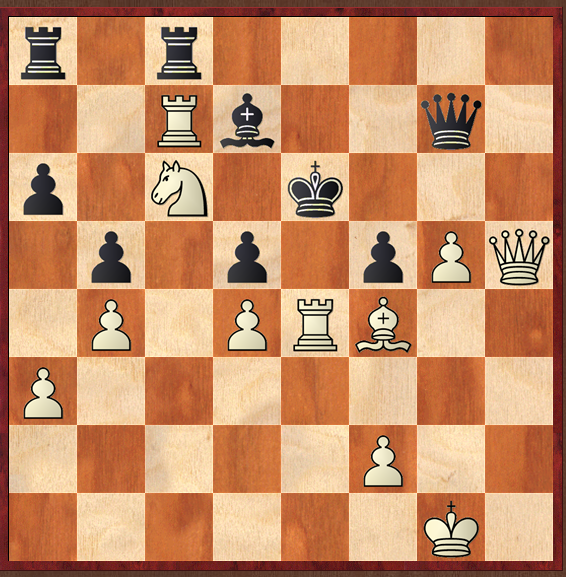
Extensive analysis
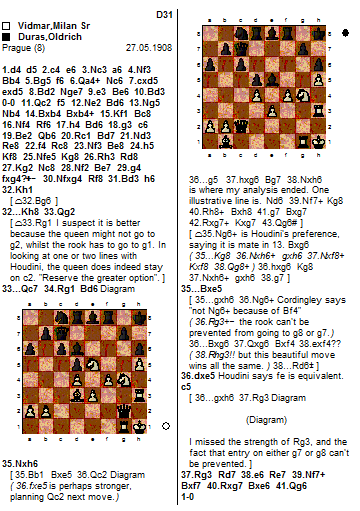
I give some fairly extensive, and at times beautiful, analysis in the attached PDF. The geometrical motifs are very noticeable. The pieces are used to best effect, for instance with moves like Qh2! eyeing c7/d6/e5; Qh3! pinning the f pawn and also threatening to swing over to b3; Qd1! also heading for b3.
I was pleased with my attempt at this puzzle, not that I saw everything, and upsetting that I didn't see the Re4+!! biff which is central to many of the lines. But I saw a good amount, including the prophylactic move Kf1, and Makagonov's 'improve your worst placed piece' principle which led me to two strong moves.
My analysis also makes brief comments on earlier parts of the game (a Tarrasch defence, played by the man himself). Houdini gives various earlier improvements for white.
White to play and win
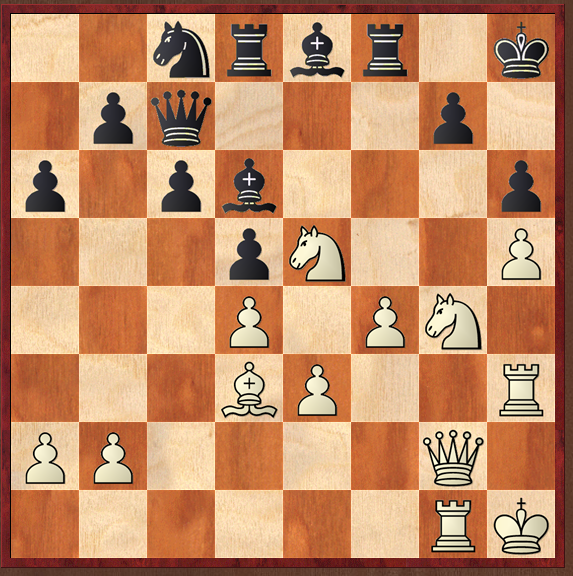
Solution
I really enjoyed this puzzle, despite the fact that once I analysed it later with Houdini, it showed me many things that I had not seen.
Had it been a game, I would have looked at 1 Nh6+! , rejected it because of 1….Be5!, and no doubt played 1 Ng6+, and won prosaically. As it was a puzzle, I rejected Ng6+! for something better, 1 Bb1!. They all merit exclamation marks because they all give overwhelming advantages.
Looking at the game continuation first, 1 Nh6+!, I missed how strong white's attack was even after 1…Be5. White can recapture either way, and then play Rg3 with overwhelming threats to come into g7 or g8. I am slightly disappointed that I could not calculate this.
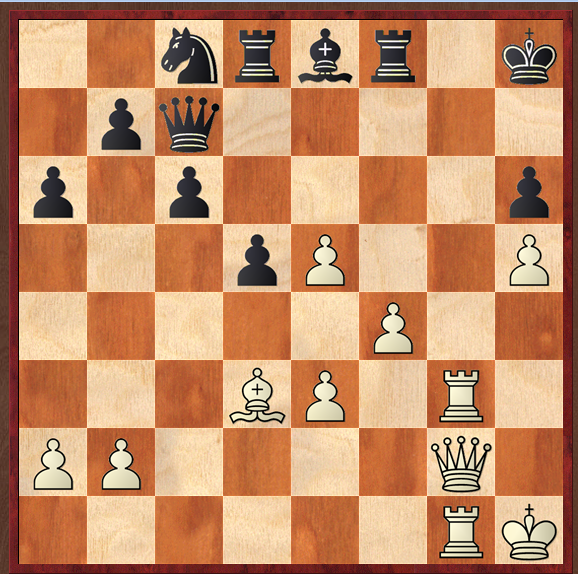
Instead, 1 Ng6+ wins easily since one day there will be a sac on h6 followed by (typically) g6-g7: precisely how depends on black's response. I saw this, but because I was 'into' this position, I looked for something better and found the very nice retreat 1 Bb1! threatening 2 Qc2 with an unstoppable battery on the b1-h7 diagonal.
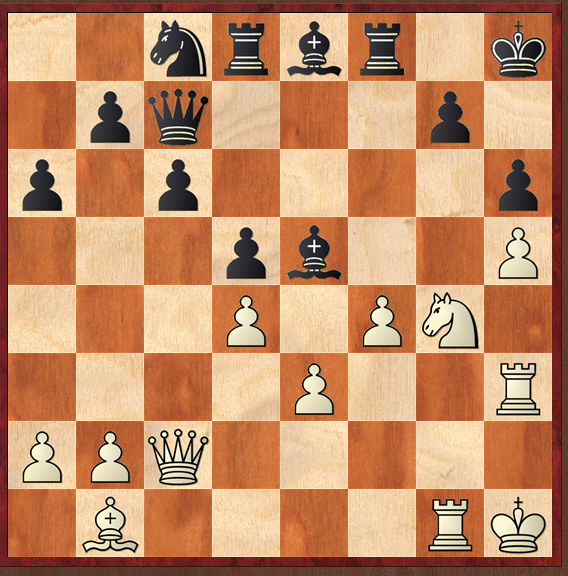
The analysis below gives some further lines, including some pretty ones.
The above is a standard probability question- there are different precise framings, one of which is 'how many people need to be in a room to have greater than 50% chance that at least two share a birthday' the answer being a surprisingly low 23.
So I thought I was on fairly safe grounds this morning when giving a talk at a primary school…
I never work on the 8th November. No tax, no clients, no Deloitte. Of course, that is not entirely true- I act for two national retailers whose shops are on every high street; and I listen to the business news, so can't help think of tax…but 8th November was the day my mother died, now eleven years ago, and I swore to myself I would never work on that day, day, and just do nice things. There are 364 other days in the year. Today has started really well. Some weeks ago I was asked by one of the teachers at my children's former primary schools if I would come to speak to their assembly, as one of their series of outside 'inspirational' speakers, and I was glad to accept: if a bit frightened of speaking in front of c 300 children, never having done so before. But it went really well, and I feel exhilarated having done it.
I has been told by the organising teacher that might be a good idea to ask the children questions, which I decided to do [Jane's sum total of her advice, despite her being a primary school teacher, was 'don't look scruffy': thank you, darling].
So, I asked them 'what is the capital of Iceland' (one person knew the answer, and then I asked them did anyone have a birthday on 9th December (no); 22nd July (no); 17th July (no). I explained to the children that I would come back to Reykjavik, and these dates later, as I did- they were respectively the date [1980] I beat Viktor Korchnoi, the date [2012] of the Allan Beardsworth 50th birthday tournament in Reykjavik, and the date [1976] that my school won the Sunday Times chess tournament – three significant dates.
Fortunately, it didn't matter- hands shot up with answers like 'mine is the 10th December' so it didn't matter one jot, but what is the probability of this happening: that no-one in audience of 300 have birthdates of and of three random dates?
I am not sure of my answer, but think it is (364/365)^300 * (363/365)^300 * (362/365)^300, or about 0.7%. In other words, there was a greater than 99% chance that at least one child would have had one of the three dates as a birthday.
Greater than 99%: but it didn't happen.
Postscript
I doubt my above maths- 99% just doesn't seem right, and asking a colleague, he thinks, probably correctly, that the true odds are 1- (362/365)^300, which is 92%. More likely.
I never work on the 8th November. No tax, no clients, no Deloitte. Of course, that is not entirely true- I act for two national retailers whose shops are on every high street; and I listen to the business news, so can't help think of tax…but 8th November was the day my mother died, now eleven years ago, and I swore to myself I would never work on that day, day, and just do nice things. There are 364 other days in the year.
Today has started really well. Some weeks ago I was asked by one of the teachers at my children's former primary schools if I would come to speak to their assembly, as one of their series of outside 'inspirational' speakers, and I was glad to accept: if a bit frightened of speaking in front of c 300 children, never having done so before. But it went really well, and I feel exhilarated having done it.
I got a lot of good questions- so many, in fact, that the head/the organising teacher extended the assembly so that sufficient children could ask what was on their mind- though there were so many hands up, that some had to be disappointed.
One question was:
What's your favourite piece?
My answer was easy: it is the knight, 'the piece that moves in a funny way'. It has always been my favourite.
In my previous post, I listed my shortest victories. Whilst I was working on the Chessbase file sorting them in shortest first order, I also looked at my longest game, and it was my game at the Chorley Open in August 1975 with Stewart Fishburne, a game I remember well, for the difficulty of the struggle, and the joy of my last move, Nh8.
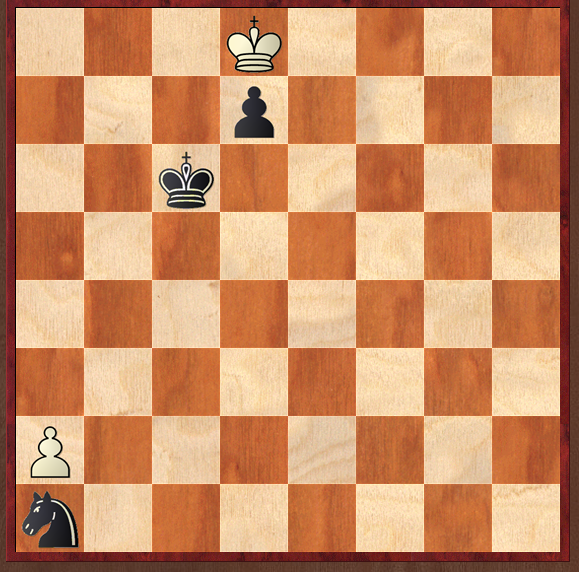
Position after 71...Nh8
There is a saying 'chess is the game of one tempo'; and another, 'chess, like love, like music, has the power to make men happy'. That was certainly true for me in the above game.
I never work on the 8th November. No tax, no clients, no Deloitte. Of course, that is not entirely true- I act for two national retailers whose shops are on every high street; and I listen to the business news, so can’t help think of tax…but 8th November was the day my mother died, now eleven years ago, and I swore to myself I would never work on that day, day, and just do nice things. There are 364 other days in the year.
Today has started really well. Some weeks ago I was asked by one of the teachers at my children’s former primary schools if I would come to speak to their assembly, as one of their series of outside ‘inspirational’ speakers, and I was glad to accept: if a bit frightened of speaking in front of c 300 children, never having done so before. But it went really well, and I feel exhilarated having done it.
At the end, there were plenty of questions, all very good, all from different angles. One question threw me: what was your shortest game of chess? I answered it in a different way, telling them what my longest game was (my victory on 9th December 2010 against Viktor Korchnoi, three years ago, which lasted seven hours). So, when I got home, I fired up Chessbase, and found my shortest victories.
My shortest victory
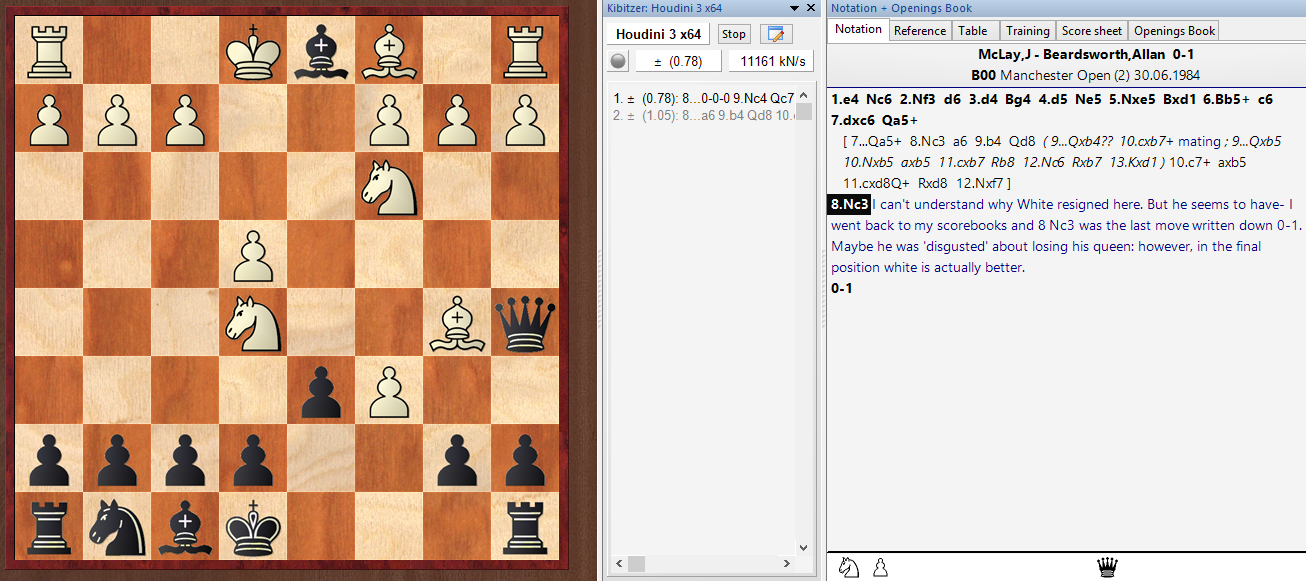
I don’t remember this game, which was played just after I graduated from university. Oddly, why did white resign? I was unsure of the accuracy of my Chessbase file, so checked my original scoresheet book, and it does appear white resigned here. Most odd, because in fact white is better in the final position.
Another short game
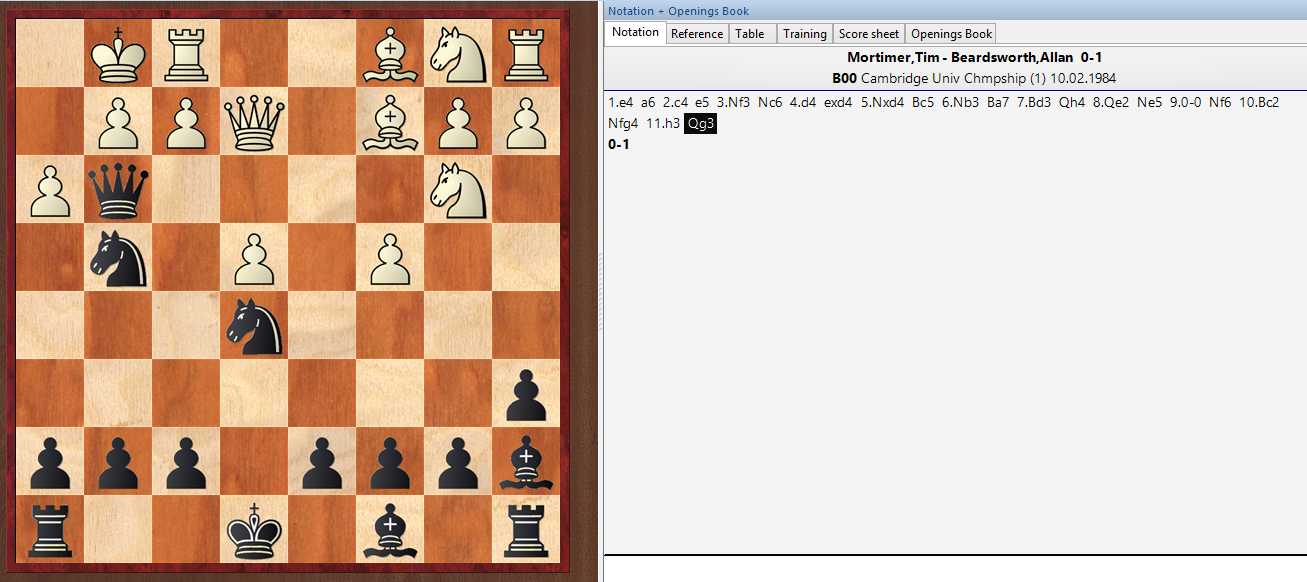
A far ‘better’ game. I recall I played 1…a6 on occasion, inspired of course by Tony Miles’ victory over Anatoly Karpov with it in 1980 [one of Tony’s only two victories, both as black, vs Anatoly: Anatoly beat Tony thirteen times, all as white].
This game was played in my third (and therefore final) Cambridge University championship…the one I failed to win, having won the title in my first two years.
Most memorable short game
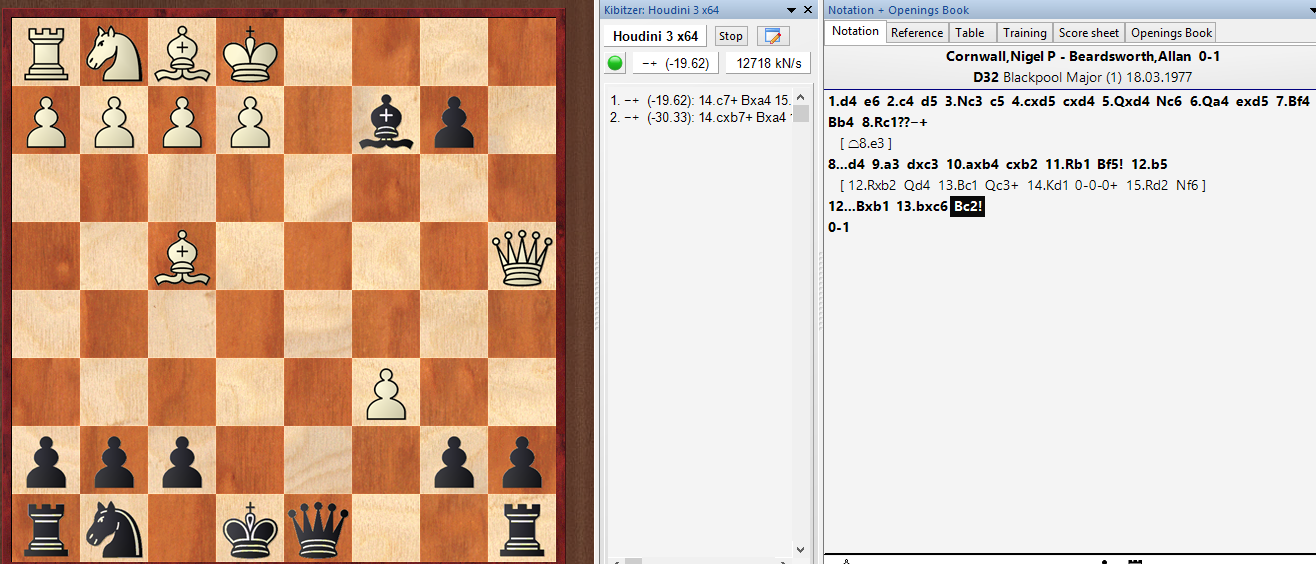
I clearly remember this game; I played Nigel on other occasions, and we had proper length fights. Here, Houdini tells me I played two only moves in Bf5! and Bc2!: but both are quite natural moves. For a whole, I liked the opening I played in this game, the Von Hening-Schara variation of the Tarrasch defence: partly inspired because one of my fellow Bolton School players liked it: I had studied the main lines of this variation quite thoroughly, but never got the chance to play them: and here, white played weakly.
Tailpiece
 allanbeardsworth