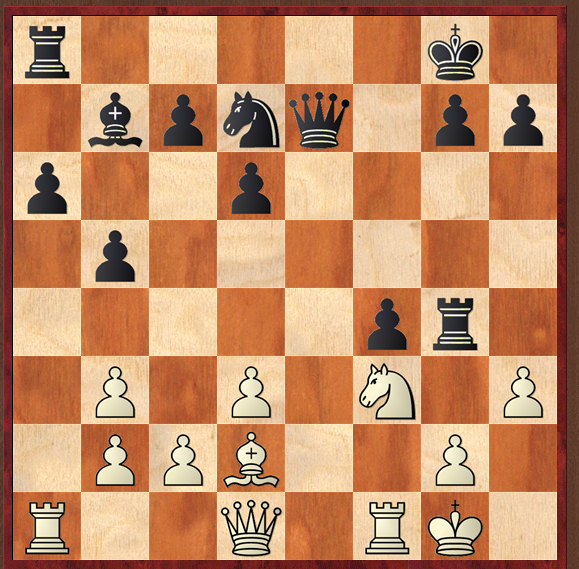
Black to play and win
Solution
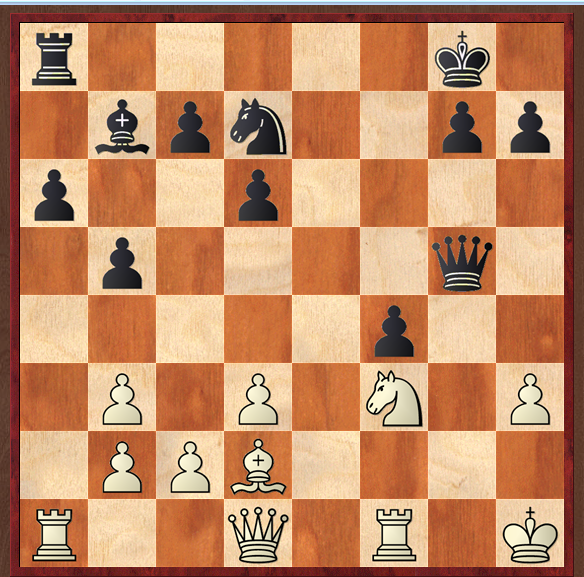
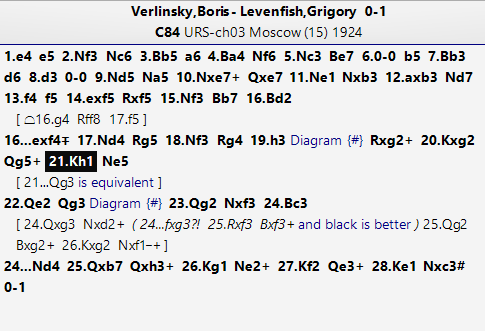
Fairly straightforward, especially knowing it is a problem. The first move, 1…Rg2+, is obvious, as is the follow up 2…Qg5+, and the only thing to think about is what to play after 3 Kh1. I chose 3…Qg3, but it is equivalent to the move played in the game, 3…Ne5: it is move order only. Then the white's defences are overpowered, and the end result is a simply winning endgame.
 Posted with Blogsy
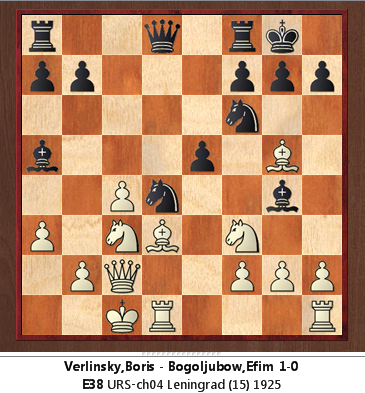
White to play and win
Solution
I goofed this one. It is though Aagardian, by which I mean capable of endless analysis. Rather than try to summarise it in a few sentences, the attached gives my present analysis. Whilst I had the moves of the solution, or at least the concepts, I didn't put them in the correct order.
One to study.
An experiment. Get a grape, and a satsuma [mandarins will do fine- an occasional row chez Beardsworth is whether what we buy are mandarins or satsumas, or even tangerines: no one really knows the difference, but we can still argue], and put them just over a metre apart. Then find a brightly coloured man on stilts (a baby giraffe will do- you can probably buy a stuffed giraffe at Harrods- or maybe even a real one) and ask him to stand around four hundred meters away.
Then, look at them. If you put your eye by the satsuma and stare past the grape, in the distance you will see the man on stilts, and he will appear to be ever so slightly large than the grape. (If he doesn't, he has cheated when counting out his strides to get to 400m).
Get hold of the satsuma and grape, and walk in a big circle, four hundred metres radius, around the man on stilts. It doesn't matter if your circle is not accurate, ever so slightly squashed will do. As you walk your four hundred meter circle, spin round, much faster, spinning the satsuma and grape around as you do: do one full swivel for every single degree you walk round the big circle.
Oh, and slightly tilt yourself as you swivel. On some swivels, you will be able to see the man on stilts more than others: and he seems to be moving, though you know he is still.
And, roughly, you then have an idea of the moon's, Earth's, and Sun's positions and scale.
Of course the moon is not a grape, it is made of cheese: so use a cheese ball for greater accuracy. And look after the mandarin, and remember it is rude (and dangerous) to stare directly at the man on stilts.
Black to play and win

Solution
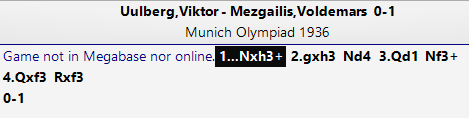
Fairly straightforward, when you see the alignment of the two queens, and the fact that the white Qc2 is LPDO. Then 1…Nh3+! 2 gh Nd4! and it is game over- Nf3+ follows, either mating with Qh2, or winning the queen. Note that 1…Nd4?? loses to 2 Bf4.
As with several other games from the Munich 1936 Olympiad, the game score is not available.
White to play and win
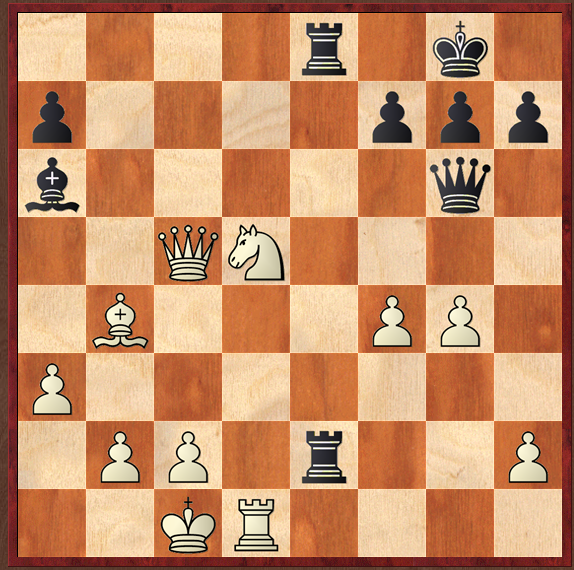
Solution
1 Nce7+ is the obvious first move, the only question being 'does it win'? It is simple to see that if 1…R2e7, 2 Qe7 is terminal- black might be able to grovel by. 2…Qe6, but the only realistic try is 1…R8e7 when 2 Qe7?? loses to 3 Qc2 mate, so 2 Rd8+[] Re8[] and now 3 Qf8+!! and it is game over.
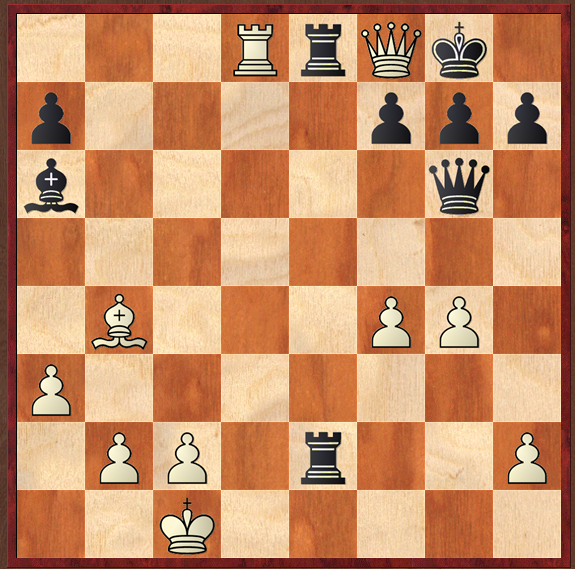
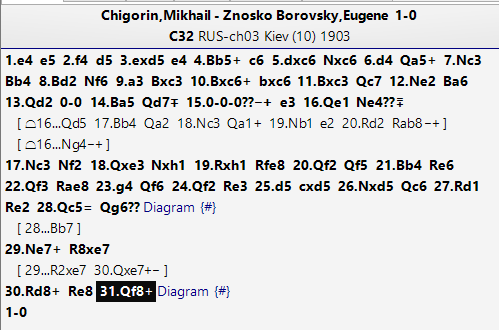
Quite a nice puzzle: Qf8+ came to me fairly easily, but had it not done so, then following Purdy's maxim of consider all biffs' which includes 'consider all checks' then the solution would have been found anyway.
During the last couple of years or so, I have become interested in the movement of the Earth and moon around the Sun, trying to visualise or really understand things. So far, I am failing dismally. Yes, I can understand the movements in a general sense, but not with any rigour.
Take for instance the position of the Sun at sundown at our villa in Turkey (the villa is aptly named Sundown):
July
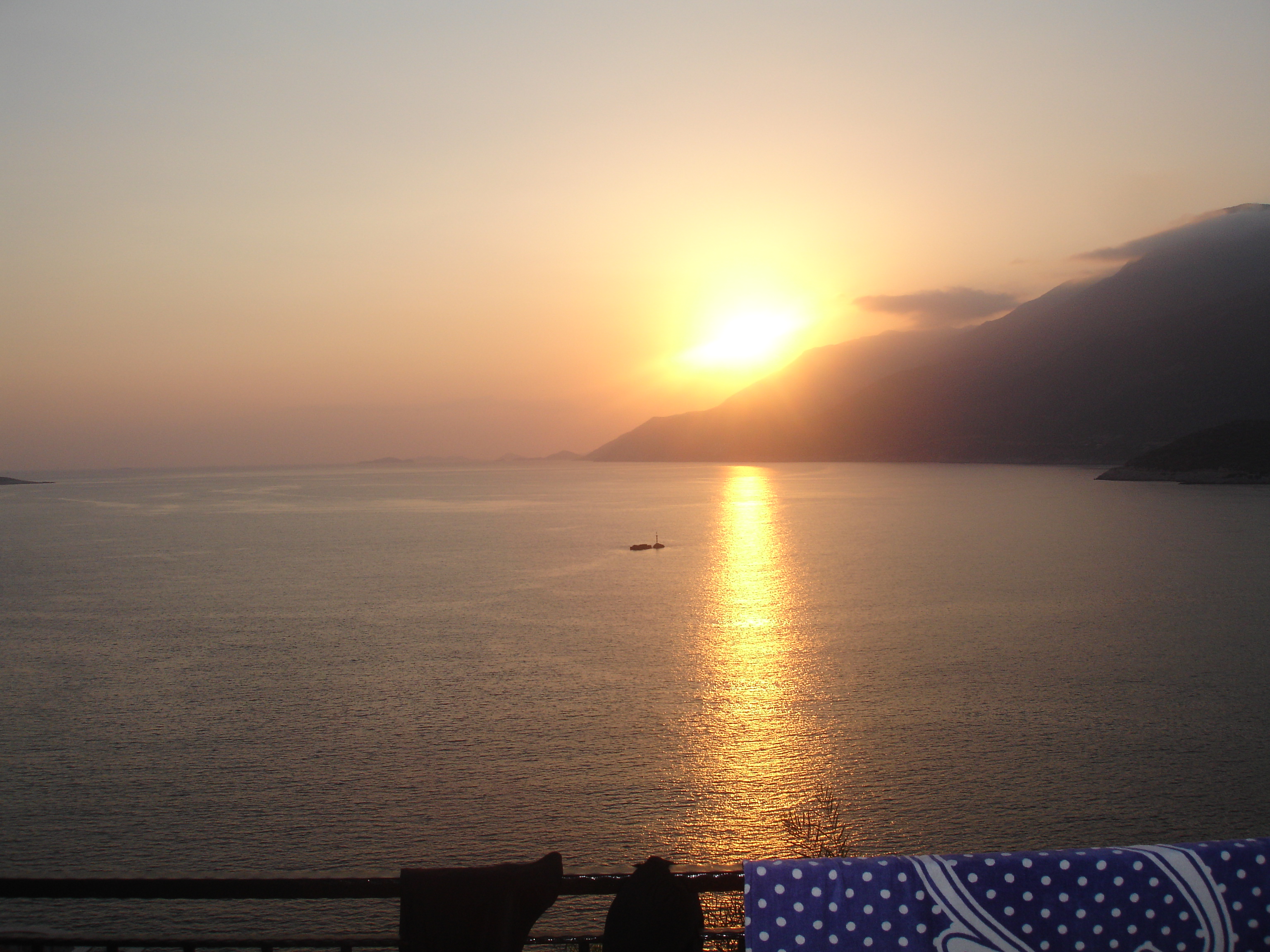
Looking westwards at sundown, July 2013
October
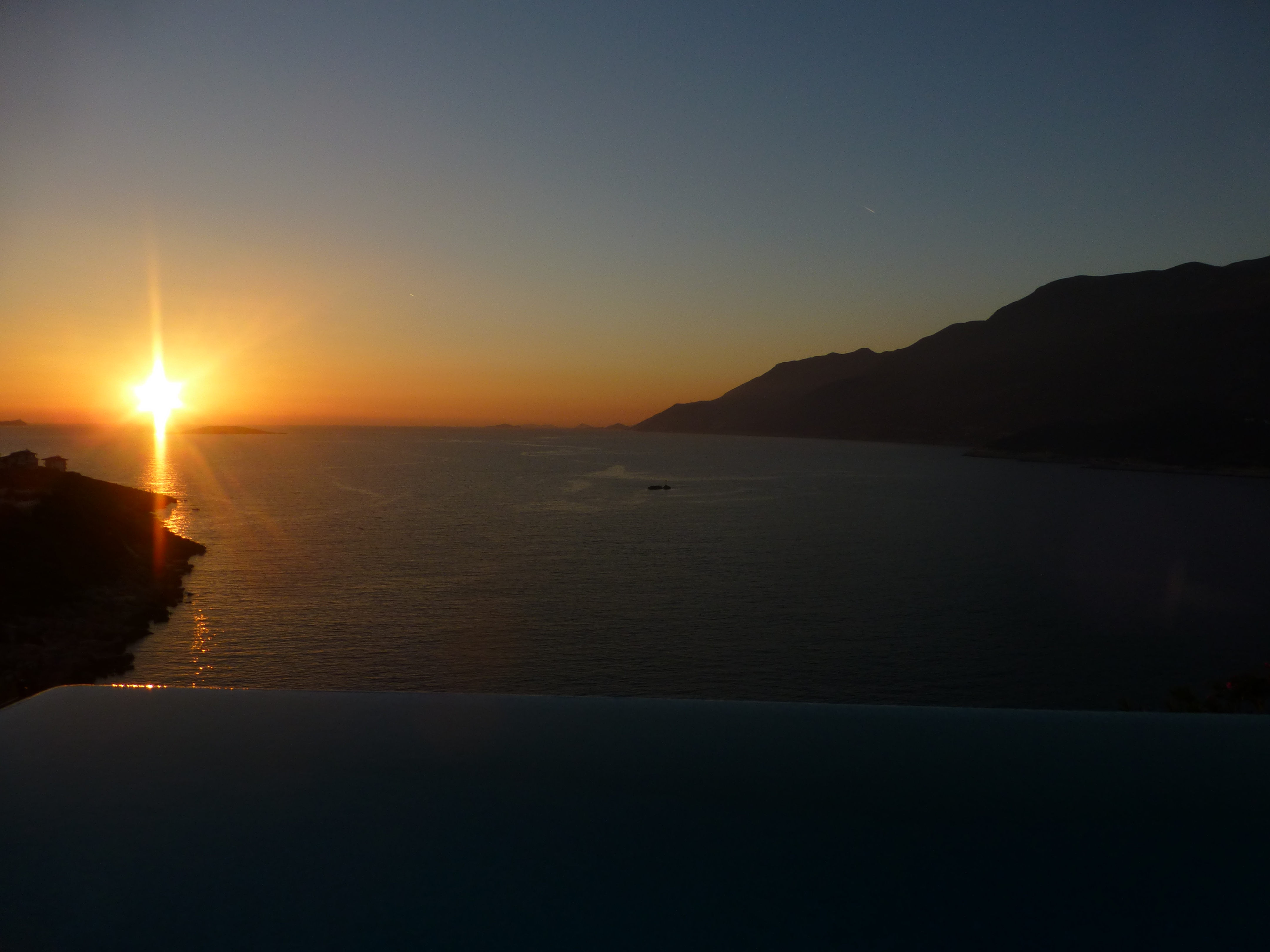
Looking westwards at sundown, Oct 2013
The views look westward, of course, so that North is to the right, South to the left. In Manchester there is not such a thing as sundown (well, not a frequently visible one) and the 'noise' from all the buildings etc disguise the view: so this is for me the first time I had seen the movement so clearly.
It is 'commonsense' that the Sun 'moves' southward towards winter [or, the Earth moves northwards]: and so if it were viewed across the year, the Sun would oscillate right to left, left to right through the year. But seeing how this is caused by the rotation of the Earth, and on particular the Earth's tilt, and the position at the solstices and equinoxes is beyond me.
Hopefully, a combination of google and YouTube will help, and maybe one day it will click, but my spatial awareness is mainly on a 8*8 flat board, and I am struggling to get a proper understanding.
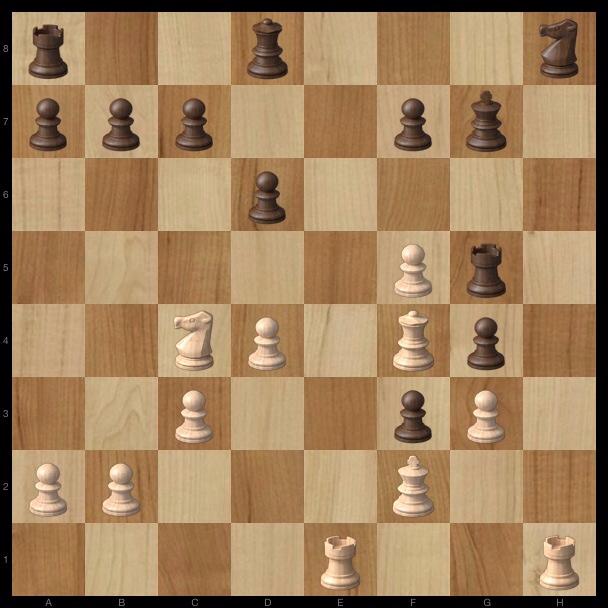
White to play and win
Solution
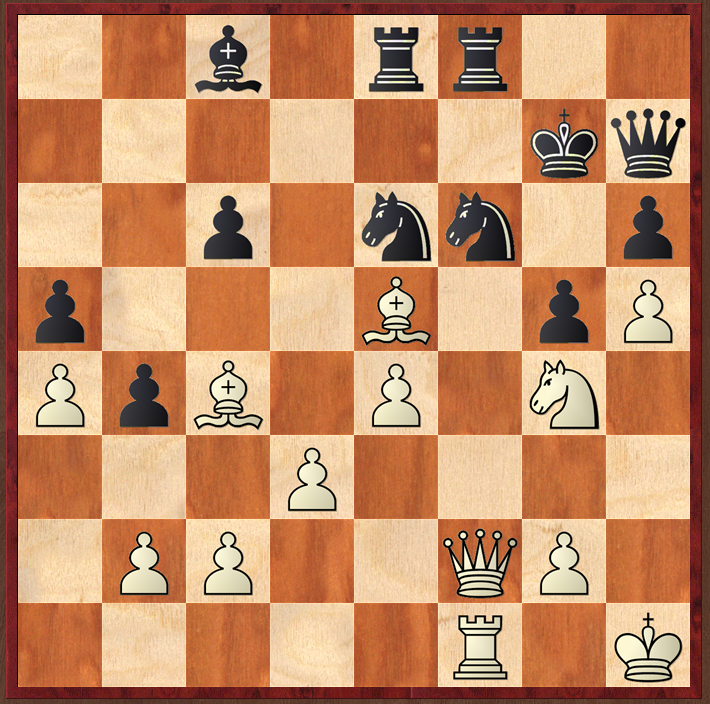
Two moves come immediately to mind: 1 Re8 and 1 f6+. Both win.
The move I preferred was 1 Re8! which wins the Ra8 after Qf6, or the N after 1…Qe8 2 Qg5+ Ng6 though in fact, because black is threatening Qe2+ and Qg2 mate, white instead of taking the N plays 3 f6+! Kg8 4 Rh8+! Kh8[] 5 Qh6+ and Qg7 mate.
However, since 1 Re8 Qf6 2 Ra8 isn't an immediate finish, and since on too many occasions during this Cordingley daily programme I have found a good move, but missed a better one, I also looked at 1 f6+ Kg6 [] when I found 2 Re5!!. If the rook is taken then 3 Ne5+ Re5[] 4 Rh6 is mate, so 2…Qf6 is forced, when 3 Rh6+ wins the queen and the house.
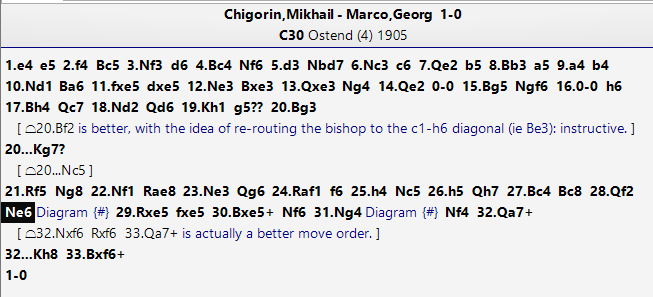
In the game. Chigorin found another way to win, 2 Rh7!!: same idea, just a slightly different execution.
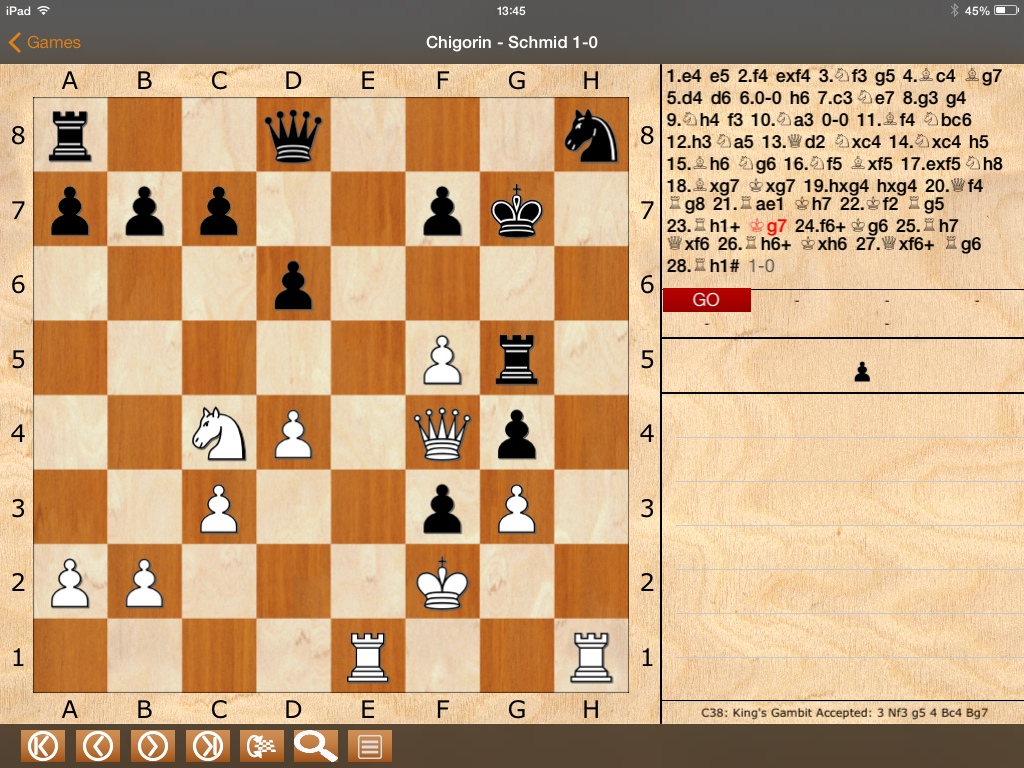
A nice puzzle: not too hard, but also not trivial.
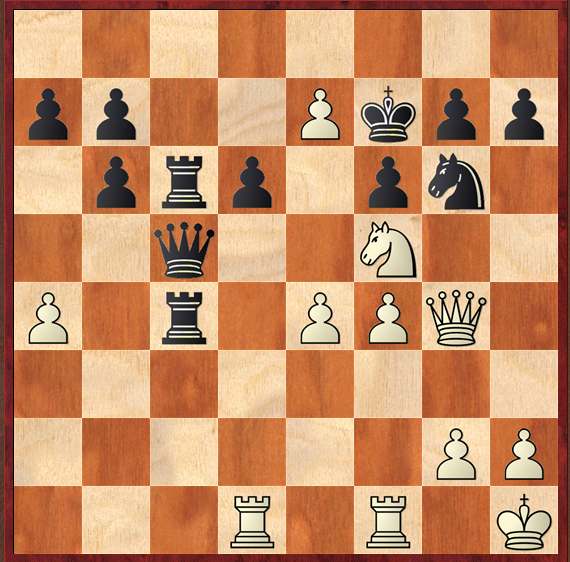
White to play and win
Solution
Fairly straightforward, since most moves win. I chose the move which Houdini thinks is strongest, 1 Ng7, though to be fair, if I were to give it a long time to think, its assessment of rankings of all the winning moves could well change.
1 e5, 1 Ng7, 1 e8(Q), 1 Rfe1 are all more or less equivalent. White's position is overwhelming and he just needs to break through.
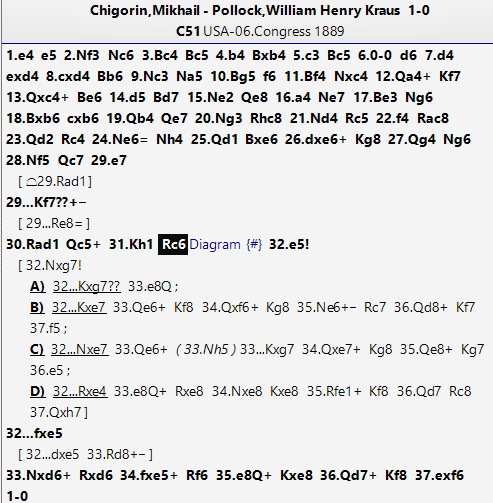
White to play and win (perhaps)
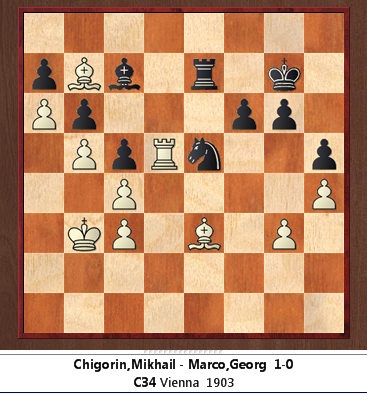
Comment: a good exercise, despite some imperfections. It is a good one to spend time on, looking both at how white can seek to win, and how black might best defend.
Solution
Knowing it is a puzzle, I instantly looked at 1 Rc5: whether I would have considered it in a game, I do not know. I knew it was the likely solution, but also looked for other possibilities, found now, and so returned to 1 Rc5. If Black doesn't capture the rook, then it is game over, perhaps long windedly, so the starting position is really after 2 Bc5.
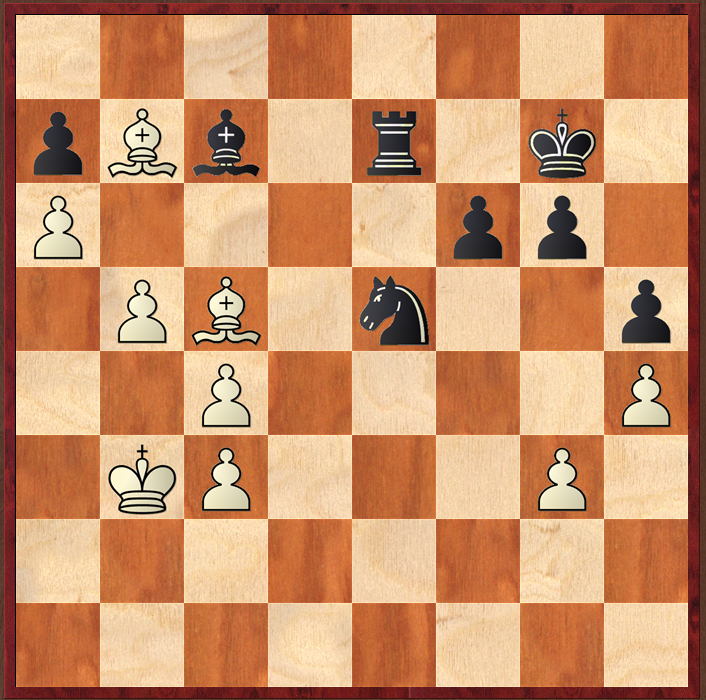
Firstly, it is worth noting that the sacrifice succeeds (if if does succeed) by the fact that the Bc5 now attacks two LPDOs- for the Pa7 is a LPDO, and black's last move, Rde7 made the rook a LPDO too. So 2….Rf7 3 Ba7 and then I had to make an assessment of whether the pawns could be stopped; and similarly if 2…Kf7 3 Ba7 when one of the minor pieces will be exchanged for one of the pawns…but I could see that the remaining pawn(s) were unstoppable. And this is how the game proceeded, and white won.
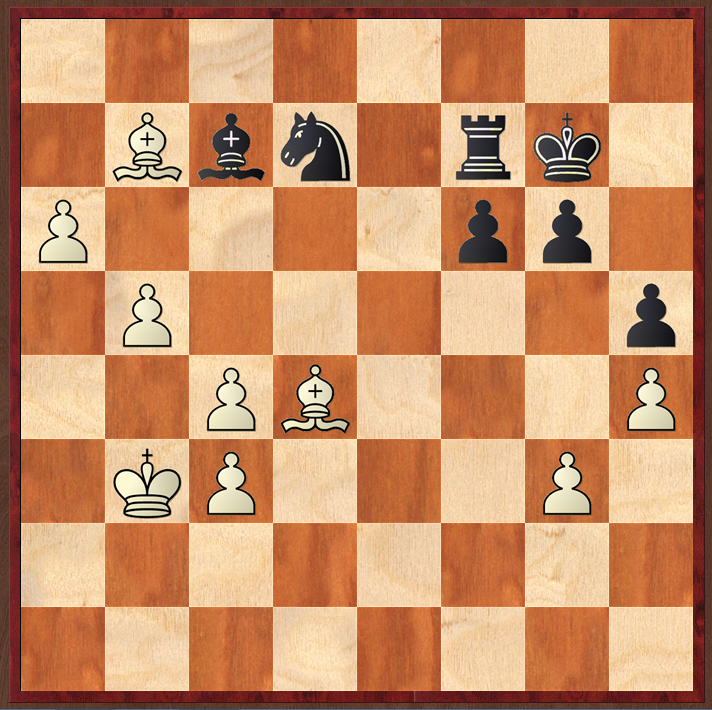
But Houdini found a problem. Not Harry Houdini (1874-1926), who would have been in his late twenties when the game was played, but the engine Houdini, aged 3, who suggested instead the great defence 2…Re6! 3 Ba7[] Rb6!! which might just hold.
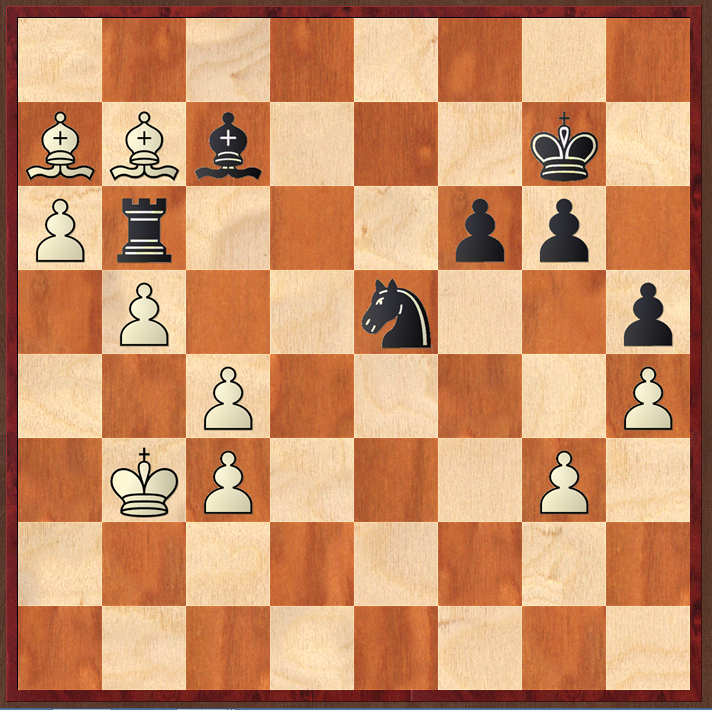
Black now has defensive possibilities based on control of the a7-g1 diagonal, if white takes the rook, and also the move Nd3+ in response to Kb4, keeping the king out. When I played it on, I exchanged the pieces on b6, and then played Bd5 in order to retreat the bishop, so as to be able to advance the pawns, and to place the bishop on a stable square, where it also restricts black's king from coming to the centre. However, Houdini tells me Bd5 is a mistake for subtle but instructive reasons: and that Bg2 is better. On d5, the bishop also blocks the white king from advancing, and it slows his own king down more than black's, who is then able to reach e7/d7 in time. Really instructive: it shows a lazy, seemingly safe (in fact unnecessarily safe) move can ruin an ending. Chess is of course the game of a single tempo.
White may be able to win after Bg2, but only Karsten Mueller could tell us for sure.
I give a lot more analysis in the attached PDF, but below is the final position after white's last move in the game, Kd5c6. Houdini, good to the very last, says this is weaker than Ke6! which has the same effect, but also blocks black's king into a mating net: it is mate in eleven, apparently.
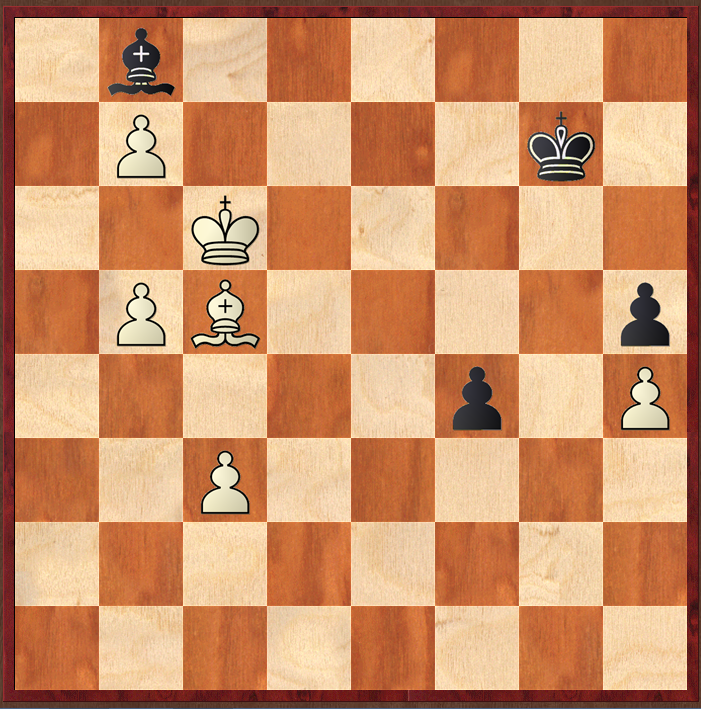
A really interesting puzzle: the alleged solution is fairly obvious but the defensive possibilities and white's way to make progress are highly interesting.
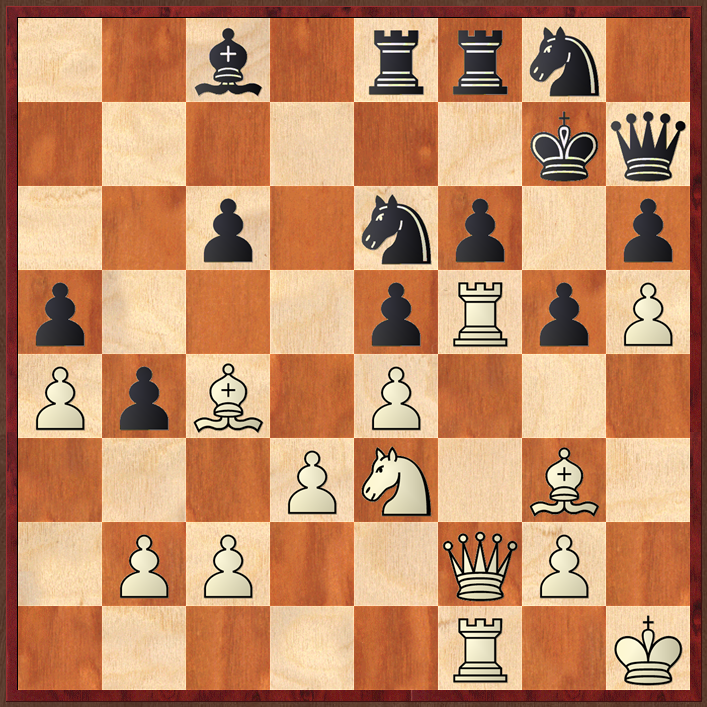
White to play and win
Solution
The first thing to look at in this problem is whether Nf5+ would work, if the rook were not on that square, and once you appreciate it is good but not sufficient, then you look at other means of breaking through, with such moves as Rg5 Rf6 and Re5, of which the last, 1 Re5! is clearly the best, and after 1…fe [] 2 Be5+ Nf6 3 Ng4 is where calculation can end: white is winning.
A bit of a rest day today, I think.
 allanbeardsworth