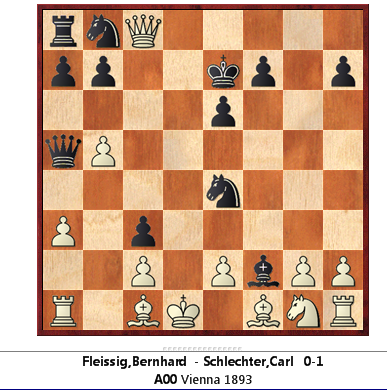
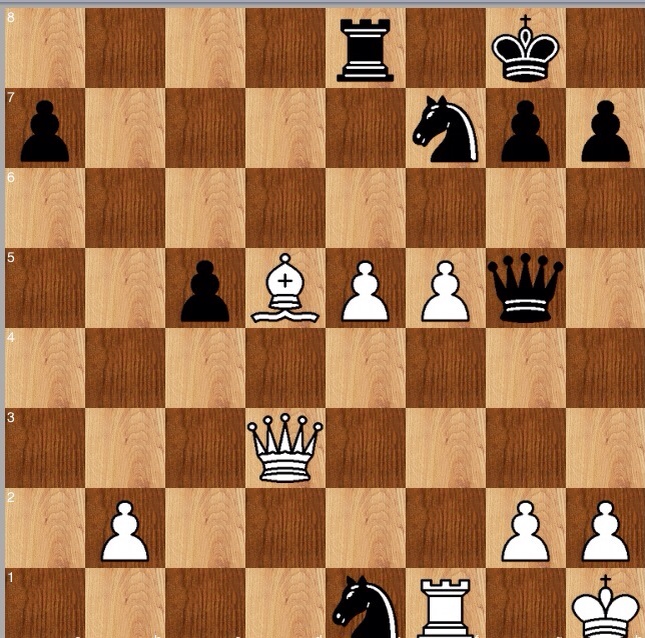
Black to play and win
Solution
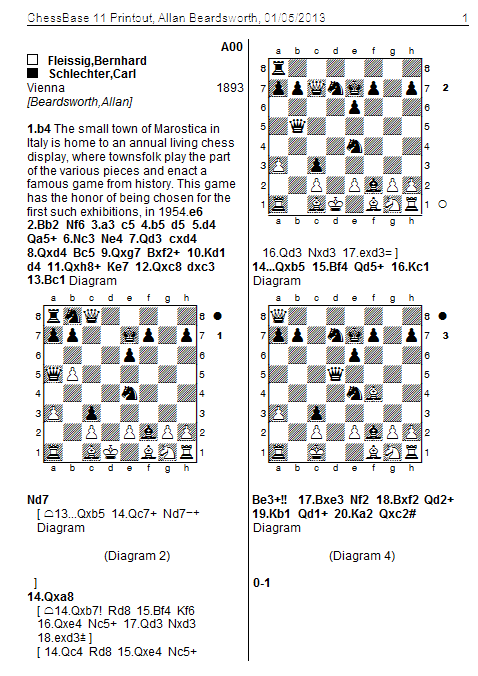
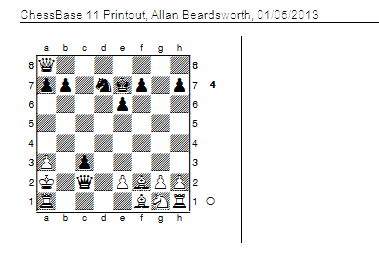
I think there are three candidate moves: 1…Nc6, which is quickly ruled out, 1…Nd7 and 1…Qb5. I saw no advantage in 1…Nd7, so played 1…Qb5, and was pleased to see it was Houdini's first choice. The move played in the game (and I see from Megabase that the game was a 'living pieces' demonstration game) was 1…Nd7, which transposes except for the fact that the natural 2 Qb7, which was the reason I preferred 1…Qb5, permits white to swap his queen for a number of pieces, when the evaluation is slightly better for white. If I gave Houdini longer, it is the type of position where its evaluation could change, but I suspect 1…Qb5 is truly the better move: it cuts down white's options.
The game continuation, and especially the spectacular Bf2-e3, is very pretty.
 Posted with Blogsy
One of my favourite writers is John Allen Paulos, who writes with great clarity on maths, especially linking maths to the real world.
Today, I read this https://math.temple.edu/~paulos/troops.html and his related article (follow the link).
Googling Lanchester's law shows Wikipedia and other articles- in a nutshell, the proposition is that the strength of an arm increases with the square of its size.
I suspect this might be true for chess too, though it is not something I have thought of before. There is a fairly elementary principle of counting the number of attackers and the number of defenders; and principles such as 'bringing more pieces to the party' about reinforcements. Perhaps, though, if white has 3 attacking pieces, and black 2 defenders, white's superiority is more 9:4 than 3:2. It can seem like this, sometimes.
Back to real life, John Allen's article ends with the sobering thought that Lanchester's Law is exemplified in the attractiveness of guerrilla tactics: weight of sheer numbers compared with advanced weaponry.
Bank Holiday in Rosthwaite, after a walk on a glorious Lake District day. [ for which read: should have taken a sun-hat]

[ Charlie, on Thornythwaite, looking down into Borrowdale.]
A nice thing about Bank Holidays, and about having two children who subscribe to the Spectator, is the ability to catch up with some reading. I recommend the attached article to anyone interested in economics. Alas, it is not an enjoyable article, there is no silver-lining, but it excellently written, and, again alas, I agree with the writer whole-heartedly.
http://www.spectator.co.uk/features/8874941/the-great-savings-robbery/
Forget Cyprus, the real savings robbery is in Britain
What’s happening quickly and loudly in Cyprus is happening slowly and stealthily here
56 CommentsLouise Cooper 30 March 2013
By chance, two of the puzzles which I had with me today were victories by Ian Nepomniachtchi.
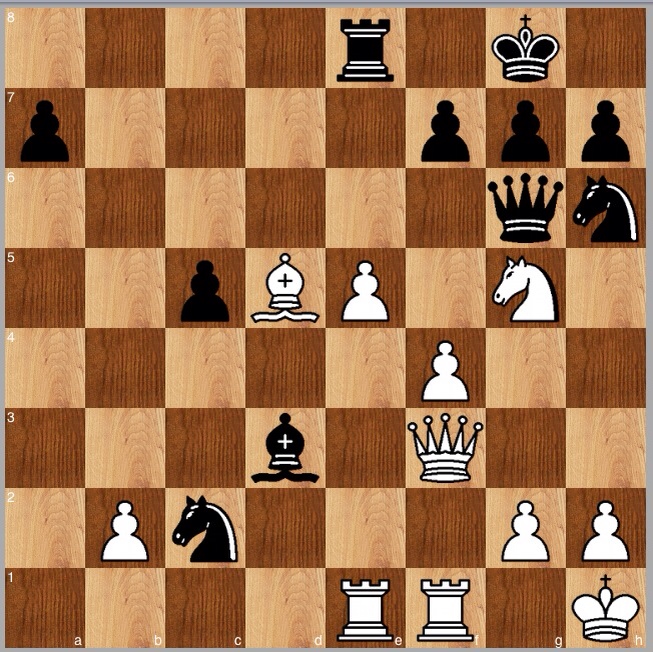
White to play and win
Solution
The first move wasn't what made me cut out and keep the puzzle: and if it weren't an obvious move, then the very same first move as in the previous puzzle is also the solution.
Black must take the knight, so 1 Nf7 Nf7, but then what? It didn't take me too long to find 2 f5, but then there were lots of lines to calculate, of which the main ones are 2 …Ne1 (3 fg +-), 2…Qg5 and 2…Qa6.
I tried the latter first, seeing as it defends the now LPDO Bd3. But it wasn't too hard to find 3 Bf7+ Kf7 when 4 Qh5+ followed by f6 is murderous: probably f7 and e6 follow. After 2…Qg5, white exchanges of f7, to draw the king out, and then takes the Bd3, restoring material parity: but black's king is far top open.
When in a magazine there is a puzzle I can't solve, I often photocopy it, and keep it for a rainy day: or, in fact, here at our home in Borrowdale, Lake District, a gloriously sunny day.
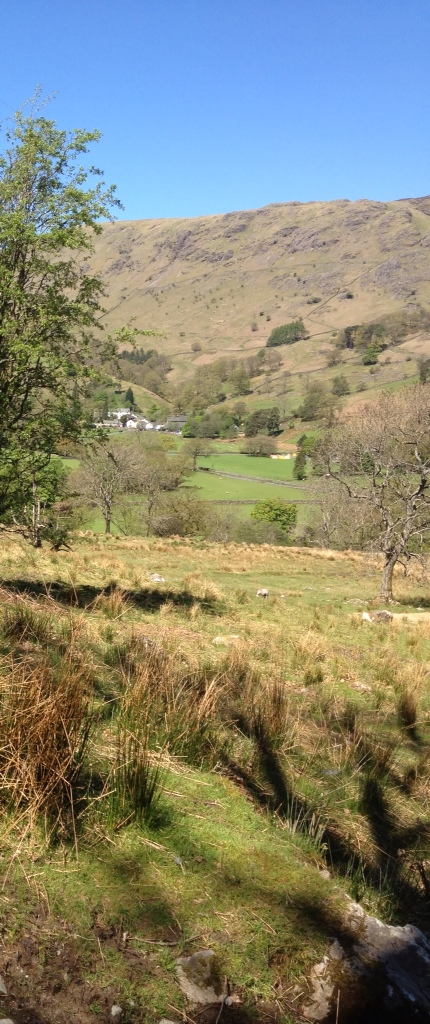
Out walking, sometimes we keep in a group, some time we became a line, sometimes we stretch out: and on such occasions, sometimes I like to think about things, and for things, read chess.
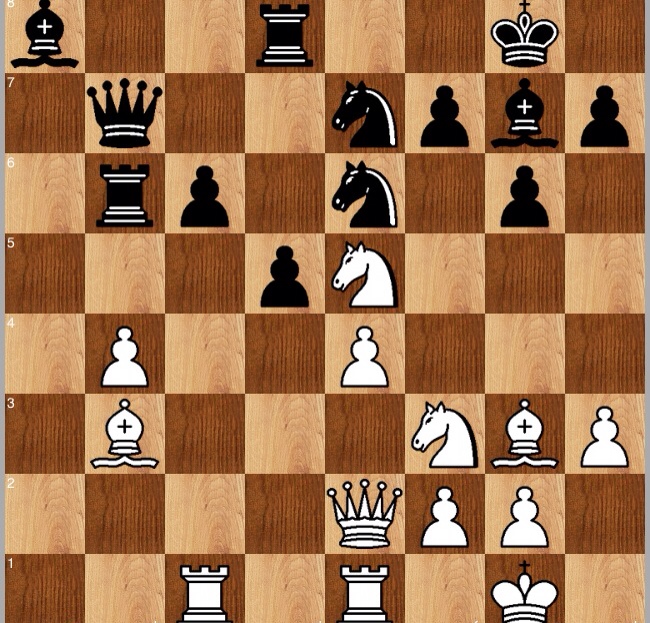
Today I looked at Nepomniachtchi-Inarkiev, European Individual Championships, 2010, a puzzle I saw in the May 2010 edition of Chess magazine. I had tried to solve it before, the first move being obvious, but not had the tenacity or imagination to solve it. Today, I succeeded.
Solution
Using my Cordingley techniques, I looked for follow ups to the obvious 1 Nf7!; if not obvious, a review, Purdy style, for all smites, would have found it. It is easy to see that black must capture the knight, and that after 2 ed Nd5 loses trivially- 3 Qe6+- but what after 2….cd, when the Rb6 defends the Ne6. At first I tried to find an alternative to 2ed, and then a way of interfering with the Rb6's 'jump protection' of Ne6; to no avail. But then I noticed the horizontal alignment of Qb7 and Kf7, and also that 2…cd opened c7 for the rook.
So 3 Rc7 Qa6, and then what? With the Ne6 pinned, the Ne7 triple attacked/ jump attacked, the first move to look at is 4 Ng5+, and when you see that 4… Kf6 5 Qe5 is mate, it is more or less analysis over: just need to check say 4…Ke8, when white can if nothing else exchange queens and take on e6, with an overwhelming advantage.
Very nice.
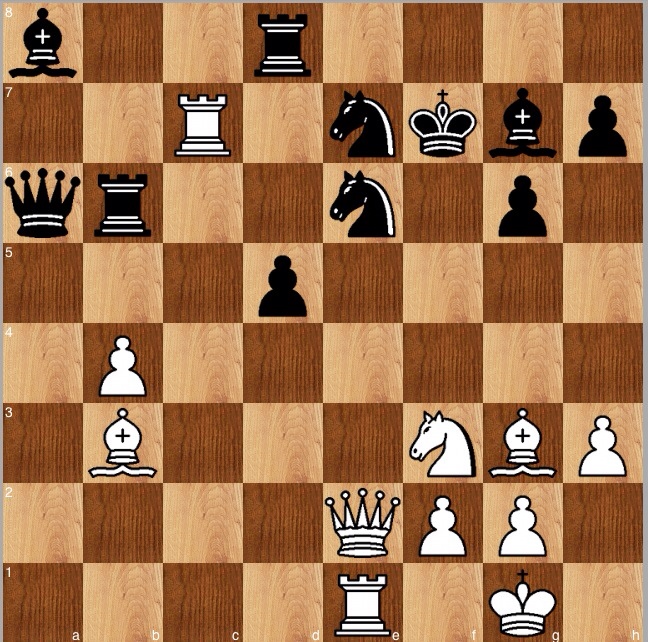
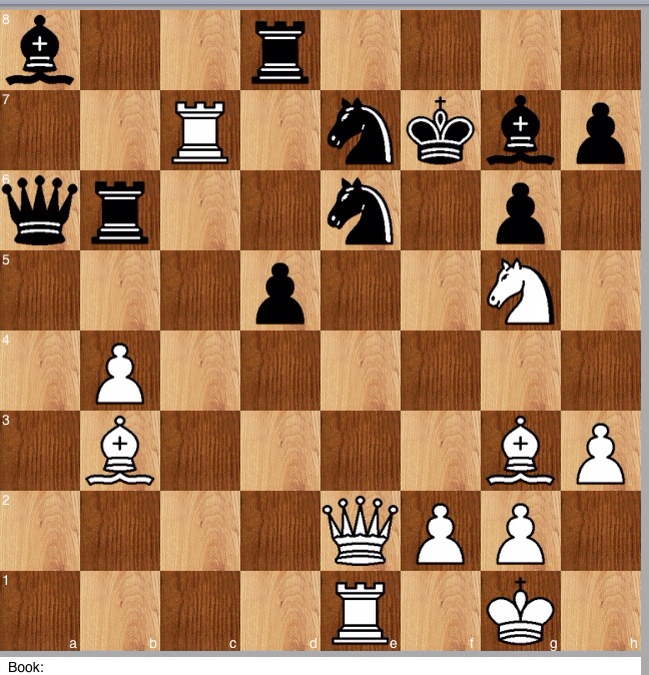
In the game, Ernesto played 3…Rd7, when white is +-.
White to play and win
(a very interesting puzzle: worth setting the pieces out for, and working on, including finding defensive resources)
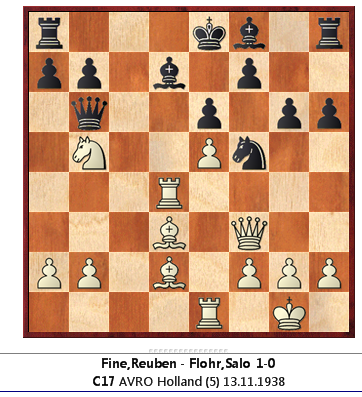
Solution
After yesterday's cooked puzzle, this is a corker. I suspect the more time spent analysing it, the more will be found.
Here is how I solved it, and what happened when I checked Houdini. In brief, Houdini– I tell you no lie- laughed at me, or maybe the entire human race, finding unforeseen depths.
My first thought was 1 Rd7, but couldn't see that white had enough. Seeing nothing much else, I turned to process. There are only two checks, with the N, and both can easily be discounted: white's position is hanging by a thread: black only needs a few moves to push back white, and one can easily see black might then have an advantage. So time is of the essence,
Next, LPDO: both black's rooks, and particularly his Rh8, due to the weakness at f6. Smites like Ba5 seem insufficient, because 1 Ba5 Nd4 hits the queen, though 2 Qf6 might be something: worth holding in memory, and noting that (1 Ba5) 1…Qa5 leaves the b7 pawn en prise, which, if the king were on d7, would be a double attack, and the LPDO rook would fall off: though from a5, the black queen hits white's LPDO Re1.
Then jump checks, and this led me to the solution: Qf7+ is a jump check, so the knight is pinned. So 1 Rd7! d7 2 g4 Nh4 and we are on to something. A bit more analysis, satisfaction, look at Cordingley's solution, further satisfaction, find in Megabase, load Houdini, and…disaster. I had missed so much, and I wonder if the player's ever knew what treasures lied beneath?
First shock: 2 g4 is only fifth choice.
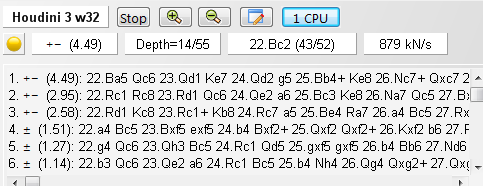
Second shock: black's Nh4 is not one of black's top replies. There is a lesson here, which I have seen before. Just because a piece is threatened, doesn't mean it has to move. In a similar way, it is not always best to respond with a capture after a capture- auto pilot re-captures are I think a fairly common mistake.
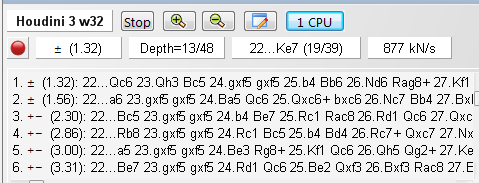
Third shock: g4 creates a weakness on the g file, especially after gf gf, when the Rh8 can spring to life.The diagram below shows the position after the far better 2 Ba5!, and after studying it, it can be seen how strong the retreat 3 Qd1! is. I wonder how many humans would see this? I wonder if Reuben Fine or Salo Flohr saw in the post mortem or later that the play could have been greatly improved?

Position after 1 Rd7 Kd7 2 Ba5! Qc6 3 Qd1!!
I think it is really special how much play there is in this. In the above line, a discovered check is threatened; if Qd5 is played to block the d file, then there is a mate by Be4!! Qd1 Rd1+- or maybe black can squeeze out with ruinous loss of material.
The attached PDF gives more analysis: though I suspect I haven't found all the depths, by far. One thing to note is that Reuben missed an even stronger line a move or two earlier: there are themes such as 'the threat is stronger than the execution' exemplified here.
Not that the puzzle is worth commenting further, I decided, as part of my project to create a database with all the puzzles in, to google Fleischmann-Duras.
I found it: it turns out that white's full name was Leo Fleischmann Forgacs; and the game is in Megabase, as Forgacs-Duras.
There are a few more of the previous fifty or so puzzles which aren't in Megabase: or aren't under the names Cordingley gives. I intend to try to see if others can be tracked down.
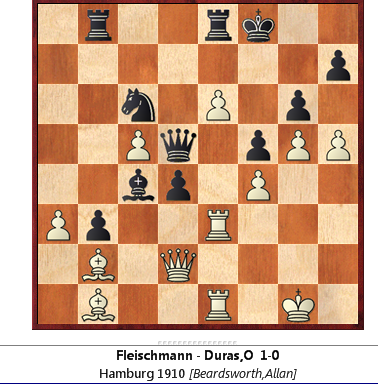
White to play (and not win, as it turns out)
Solution
Oh dear. The game continuation is shown below, and whilst 1 hg would be the move I would play ( almost an only move), I think all modern black players would capture back: when it is equal, or more or less so.
Fortunately I didn't waste any time on this puzzle: intuitively 1..de was bad, with gh! being not too hard (and Qc3? failing to Nd4).
Duras was one of the top players of his time; I wonder whether at that time one was still obliged to accept sacrifices? Of course, there can be other reasons for playing poor moves.
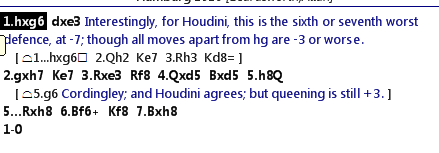
Oddly, the game is not in Megabase. Cordingley tells us the previous two moves were Rge3 Kf8: I had a quick look, and the position before Rge3 is also level; and Qc5 would have been better than Kf8, with equality.
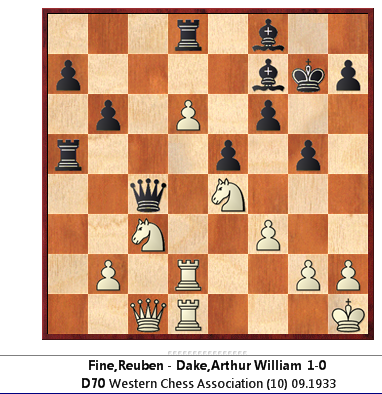
White to play and win
Solution
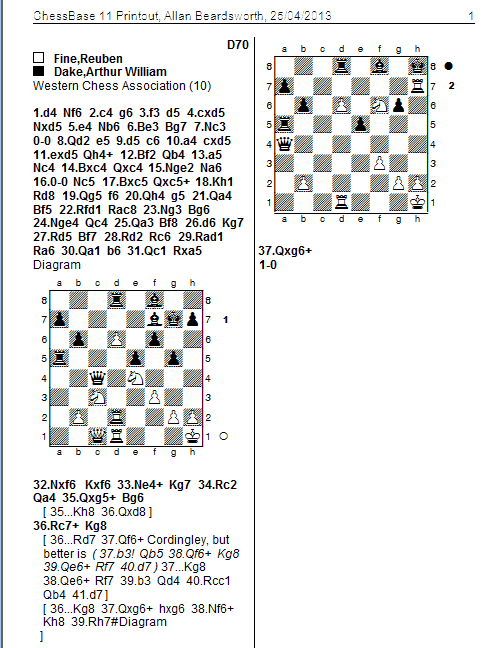
I saw the solution immediately: 1 Nf6+ is an obvious candidate move, followed by 2 Ne4+, noting that when Qg5+ the rook is LPDO. So all that had to be found was 3 Rdc2, and there is no retreat square which protects d8: and no back rank mate trick, so in practice I would play up to 3 Rdc2, then take on g5, and then see how black has responded.
White to play and win
Solution
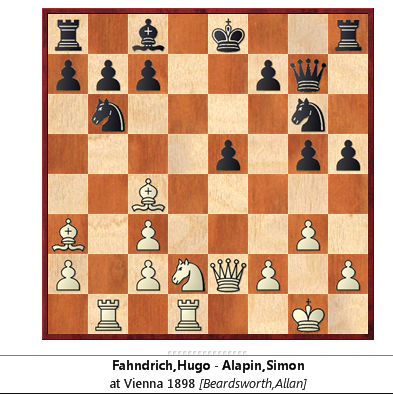
For a while, this puzzled me. I tried complex moves, like 1 Rb6+, thinking control over d7 would be useful; until I decided to go through a process, and first look at checks…and saw that 1 Bb5+ was murderous.
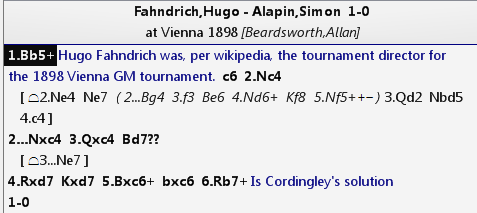
If black interposes a piece, white exchanges, and takes on b7: game over. So 1….c6, and 2 Ne4, with threats of Nd6+- Nf5+-Ng7: and white gets a strong, winning advantage. This turned out to be Houdini's preference; it is winning, but not a clean cut win. Cordingley's solution is 2 Nc4, which is good but weaker; the game continuation relied on black then playing a losing move, Bd7?? which changes the evaluation to -29.
Not a great puzzle. It was clear that black's king was stuck in the centre; there was a discovered check hitting the Qg7; and the Rb1 hits b7.
 allanbeardsworth