Over the years – no, over the decades- I have cut and and kept numerous cuttings to ‘read later’. And they pile up, and up, and up.
I have decided the clutter is too much, and will, on an occasional basis when I have time, take a bundle, flick through them, discarding what is no longer of interest, and enjoy the rest, blogging some of them. Here is one of them
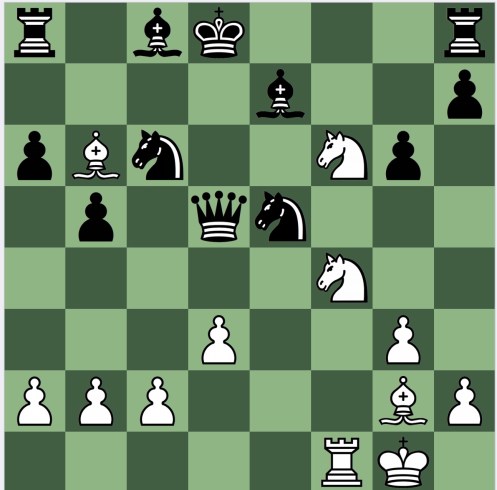
White to play and win

Wen Yang v Artemiev, Aeroflot Moscow 2/3/16
Solution
1 Bc5! examine all biffs and if 1…Qd5, 2 Bb6 mate.
FEN
r1bk3r/4b2p/p1nq1Np1/1ppQn3/5N2/3PB1P1/PPP3BP/5RK1 w – – 8 20
Source
Malcolm Pein’s column in the Daily Telegraph
Over the years – no, over the decades- I have cut and and kept numerous cuttings to ‘read later’. And they pile up, and up, and up.
I have decided the clutter is too much, and will, on an occasional basis when I have time, take a bundle, flick through them, discarding what is no longer of interest, and enjoy the rest, blogging some of them. Here is one of them
White to play and win

Movsesian v Saltaev, Bundesliga 23/4/2016
Solution
Reminiscent of Morphy v Duke of Brunswick & Count Isouard, Paris Opera 1858
1 Rd1 Qe4 2 Rb8+! Rb8 3 Qb8+ Bb8 4 Rd8 mate.

FEN
r3k2r/1R3pp1/p1pbp3/4nnBp/2BqN2P/PQ6/5PP1/5RK1 w kq – 2 18
Source
Malcolm Pein’s column in the Daily Telegraph
My ‘book of the year’ for 2018 may already be decided, or at least there is a contender which will prove hard to beat.
I am writing this blog whilst on holiday in Turkey, and I had great pleasure during it reading Jan Markos’ new book ‘Under the Surface’, publishes by Quality Chess.
It is one of those books which merits a re-read, and I think if I do so, I will gain fresh insights. Markos, a Slovakian GM who before learning of this book I had not heard of, writes really well, insightfully, and has ‘something to say’ to his readers. Highly recommended.

Today’s puzzle is from the book
White to play and win

ansa v Geller, Budapest 1970
Solution
A really interesting position from page 176 of the hardback decision, in which Markos talks about chess culture. I didn’t know the concept of ‘Lasker’s stairs’, so doubt If I were in practice faced with this position I would have solved it. I would have fairly aimlessly checked and checked and hoped.
Out of respect for the newness of publication, I won’t give the solution. Either buy the book, or look at the game in Megabase or similar. Or, the game is here
The solution is both memorable and pretty.
My ‘book of the year’ for 2018 may already be decided, or at least there is a contender which will prove hard to beat.
I am writing this blog whilst on holiday in Turkey, and I had great pleasure during it reading Jan Markos’ new book ‘Under the Surface’, publishes by Quality Chess.
It is one of those books which merits a re-read, and I think if I do so, I will gain fresh insights. Markos, a Slovakian GM who before learning of this book I had not heard of, writes really well, insightfully, and has ‘something to say’ to his readers. Highly recommended.
Today’s puzzle is from Sam’s new book.
Black to play and win
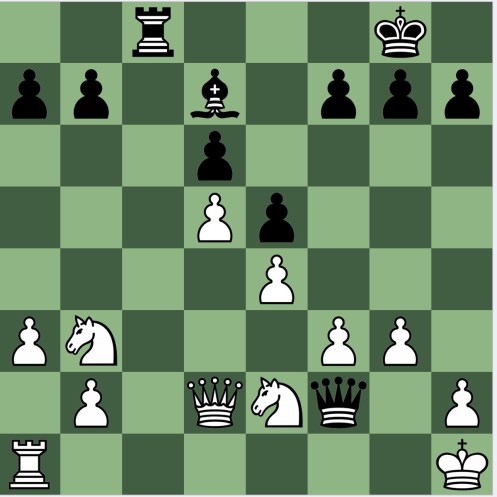
Poobalasingan v Markos, Zurich 2011
Solution
1….Rc2!! since if instead 1…Bh3?, 2 Nf4 defends. The insertion of 1…Rc2 forces 2Qc2 when the Q is LPDO, and 2…Bh3 now mates.

Either 3 Rg1 Qf3+ and 4…Qg2 mate, or 3 Ned4 Bg2 mate.
My ‘book of the year’ for 2018 may already be decided, or at least there is a contender which will prove hard to beat.
I am writing this blog whilst on holiday in Turkey, and I had great pleasure during it reading Jan Markos’ new book ‘Under the Surface’, publishes by Quality Chess.

It is one of those books which merits a re-read, and I think if I do so, I will gain fresh insights. Markos, a Slovakian GM who before learning of this book I had not heard of, writes really well, insightfully, and has ‘something to say’ to his readers. Highly recommended.
Black to play and draw
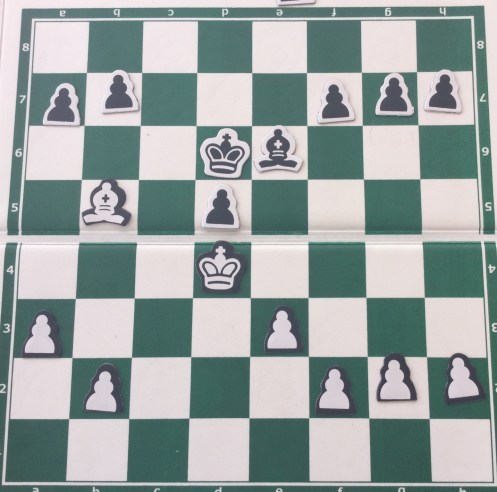
Markos v Rausis, Kallithea 2008
Solution
One of my favourite pieces of writing from the book; though I could have chosen many.
Because the book is recently published, I won’t give the solution, but what I will say is: if you have found the solution, and know why it is the solution, then well done! Markos’ explanation of what his opponent missed is exemplary. (Page 79, hardback edition).
Today’s problem is from the 1972 book “Chess Combination as a Fine Art”, a book based on articles published in the 1950s-1960s by Kurt Richter.
Since the start of 2018, I have decided to adopt the style of only saying which side is to play: and not giving an idea if the move wins or otherwise, unless on occasion I think signposting would be helpful. Instead, the problems are posed with the instruction to decide what you would play, as in a game.
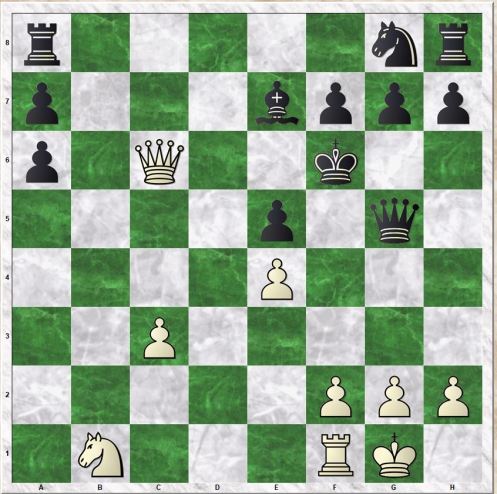
White to play
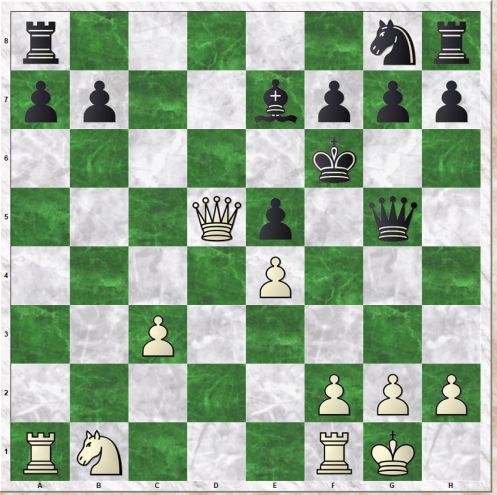
K Richter v anon, Berlin 1957
Solution
Fairly unusual, but not hard: 1 Ra6+! and after 1…ba[], 2 Qc6 mate.
FEN
r5nr/pp2bppp/5k2/3Qp1q1/4P3/2P5/5PPP/RN3RK1 w – – 0 1
Today’s problem is from the 1972 book “Chess Combination as a Fine Art”, a book based on articles published in the 1950s-1960s by Kurt Richter.
Since the start of 2018, I have decided to adopt the style of only saying which side is to play: and not giving an idea if the move wins or otherwise, unless on occasion I think signposting would be helpful. Instead, the problems are posed with the instruction to decide what you would play, as in a game.
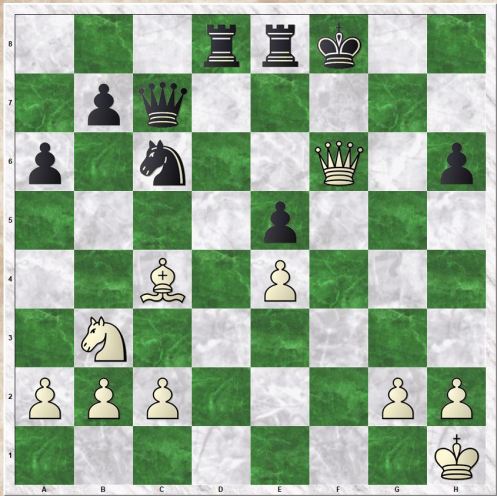
White to play
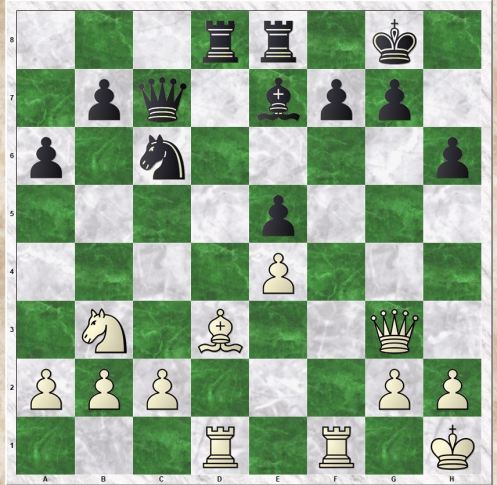
Hartston v Penrose, London 1963
Solution
White took a draw in this position (per Megabase, Bill Hartston never beat Jonathan Penrose, losing three times, the rest drawn) whereas he is winning.
1 Rf7! Kf7[] (1…g5 is hopeless) 2 Bc4+ Kf8
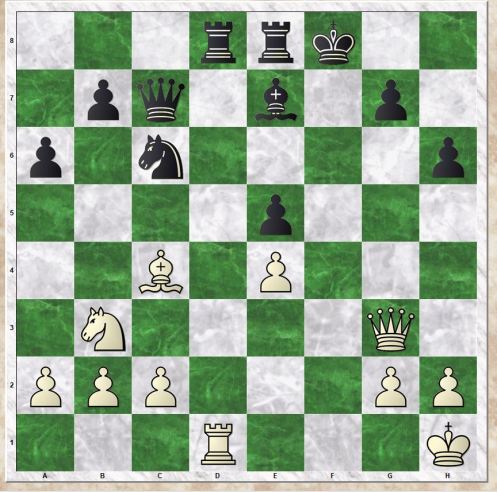
3 Rf1+ Bf6[] 4 Rf6+! gf[] 5 Qg8+ Ke7
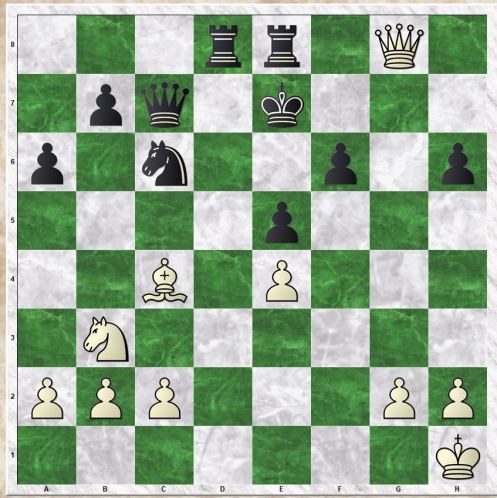
This is about as far as I can see clearly from the initial position, but from here I could see 6 Qe6+ and 7 Qg8+ with repetition, so I think if I were White, I would have played 1 Rf7, thinking I had the safety of a draw.
Having reached the position, it isn’t hard to see that instead White has 6 Qe6+ Kf8[] 7 Qf6+ and 1-0: mate next move after 7…Qf7 8 Qf7 mate.
FEN
3rr1k1/1pq1bpp1/p1n4p/4p3/4P3/1N1B2Q1/PPP3PP/3R1R1K w – – 0 1
Today’s puzzle was prepared whilst travelling, so is in a different format from those published when at home.
Black to play
(1…Rg2 loses, as shown yesterday)

Hartoch v Spassky, Amsterdam July 27 1970
Solution
1…Be8! removes the threat of Qf8+ whilst keeping the pressure on g2. Hartoch played 2 Rg1 but resigned after 2…Qg1+., since 3 Kg1[] Rg2+ 4 Kf1 (4 Kh1 Rge2 is also trivial).

4… Bb5+ (the attacking point of Bf7-e8) and mates.
Today’s puzzle was prepared whilst travelling, so is in a different format from those published when at home. This puzzle was seen in John Littlewood’s instructional book on the middlegame.
Evaluate 1…Rg2

Hartoch v Spassky, Amsterdam 1979
Solution
1…Rg2 is a mistake (Spassky didn’t play it-see tomorrow’s puzzle) since White wins after 2 Qf8+ Kf6[] 3 Qh8+ Kg5 (3…Ke5 4 Re1+ releases the threat of mate by Rh2+ and Rcg2 mate) 4 Rf5+! (again, releasing the mate) gf (say) 5 Qd4 and there is no mate.

(Not saying it is easy to win, there is plenty of scope to mess up, but the engines say White is winning).
Today’s puzzle was prepared whilst travelling, so is in a different format from those published when at home.
White to play and win
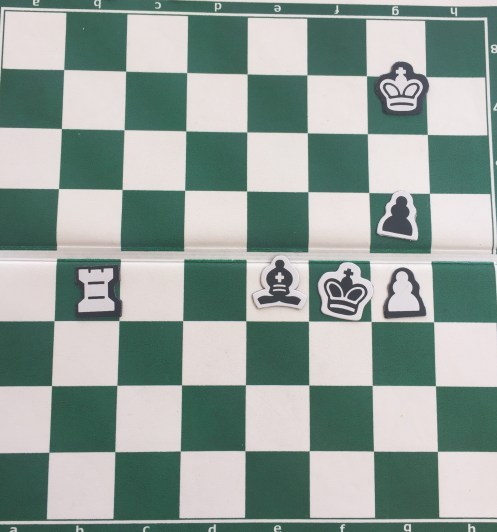
Aronian v Dubov, FIDE World Cup, Tbilisi, September 2017
Solution
The culmination of a wonderful endgame by Levon.
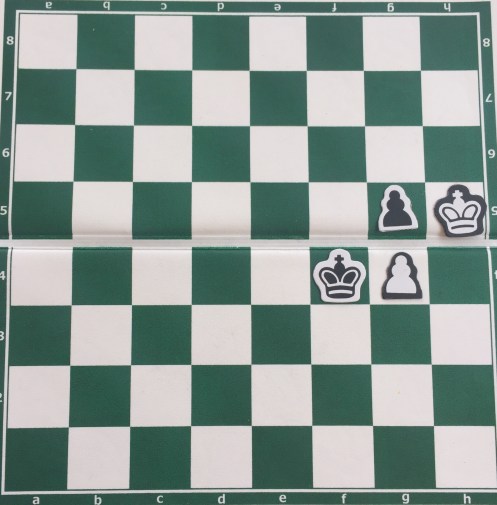
1 Re4+! Ke4[] 2 Kg6! 1-0, since 2…Kf4[] 3 Kh5 wins the pawn, and in a way that the g pawn queens.
 allanbeardsworth