White to play and win
Position after Ka7-b8
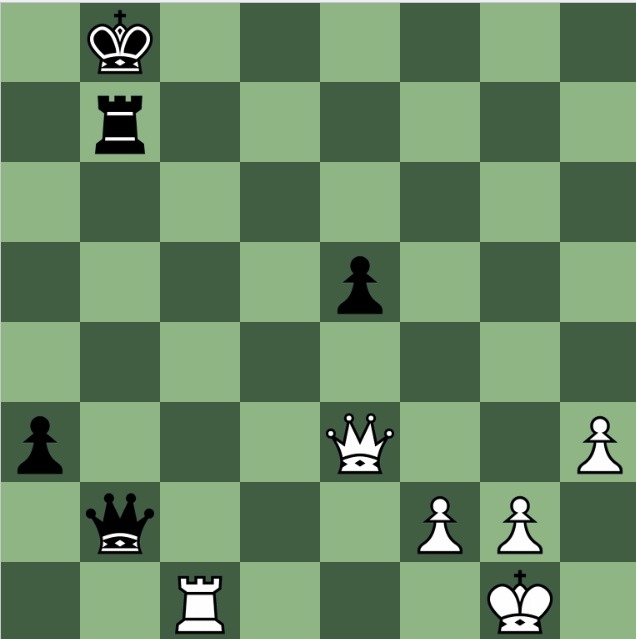
RF Griffiths v J Wolpert 1963
Solution
Reitstein tells the reader that the position was an adjournment one, though not clear if the sealed move was black's Kb8-a8 or white's reply.
I found white's first move by elimination, or by comparison: 1 Rc3! must be best, putting the question to black.

If black defends the e5 pawn, by for instance 1…Qb5, then white takes the a3 pawn, and should eventually win. So, instead, 1…a2 when white does a series of checks until his Q is on d6: 2 Qe5+ Ka7[] (2…Ka8 3 Rc8+ Ka7 4 Qa5 mate; or 3..Rb8 4 Qb2 1-0) 3 Qa5+ Kb8 [] 4 Qd8+ Ka7 5 Qd4+ Kb8 6 Qd6+ Ka7 7 Ra3+ 1-0.

Position before Rc3-a3+
White to play and win
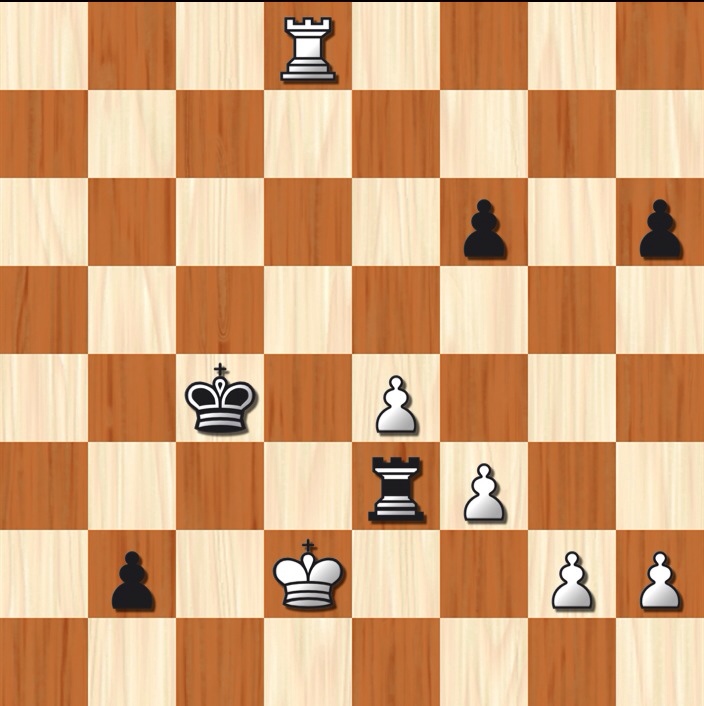
D Friedgood v F Koronstenski 1977
Solution
In the game, white repeated by Rc8+ Rd8+ Rc8+ and the game was drawn. But 1 Ke3! and if 1…b2(Q) 2 Rc8+ and the K must move to the b file, when Rb8+ skewers king and queen: so white can promote a pawn.

 Posted with Blogsy
A lovely finish from Fabiano Caruana who is on 2/2 after today's second round at Dortmund.
White to play and win

Game seen on Playchess.com
Solution
Examine all biffs leads to 1 Re7!, noting that the Rg7 is LPDO, so the Bf7 is truly pinned.
If 1…Kb8, defending the pc7, then 2 Ba6 mates trivially. So 1..Qe7 when-still!- 2 Ba6! and Pono was kind enough to play 2…Ka6, permitting 3 Qa8 mate.

White to play and win
Reitstein's rubric for this puzzle, given since I found it really tough is: Spencer assessed this position well: with his next move he converted a superior game into a winning advantage. What did he play?

RT Spencer v D Macfarlane 1978
Solution
Because of the clue, I knew that time was of the essence, and sensed that 1 Bc5! was the move, which in fact it is.

However, I couldn't easily visualise the position after 1…Qc5 (1…dc 2 Ree7 is even better for white than after 1…Qc5) 2 Ree7 Bd4.
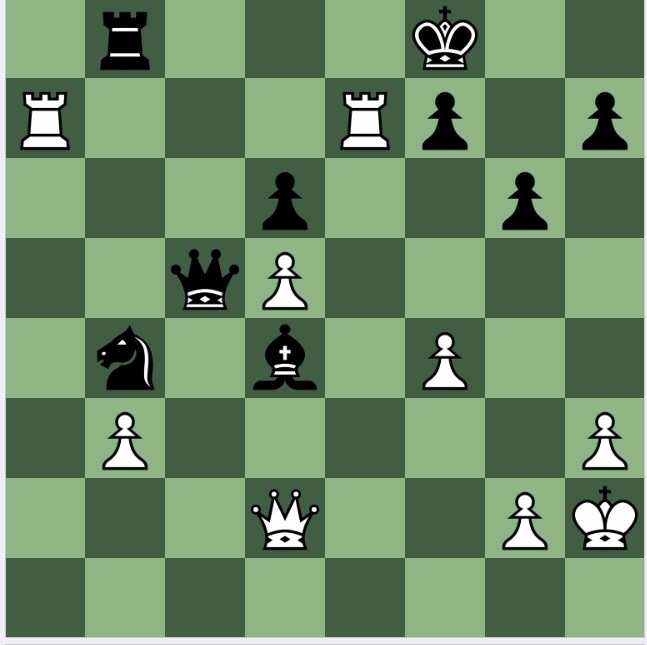
Alas, I failed to see my way through the complexities of this position.
Which is better? 3 Rac7; 3 Rf7+; or 3 f5?
Solution
Reitstein gives 3 Rac7 'and wins', and indeed it does, after 3…Bg1+ 4 Kh1 Be3 5 Rf7+; or 3…Qd5 4 Rf7+ Kg8 (4…Qf7 5 Rf7+ Kf7 and the LPDO Bd4 drops off, 6 Qd4 1-0);
3 f5? loses to 3…Kg8! and black can defend, with for instance one point being that after Qc5-d5, there is the threat of Bg1+ winning the LPDO Qd2;
3 Rf7+! is the most accurate, when 3…Kg8[] 4 Qe1! or 4 Qe2! wins.
I am an avid reader of the broadsheets: rarely a day goes by without me reading one, and during the working week it is normally two or three papers, though never in depth:
Headline articles, business headlines, chess column (always), something which catches my eye, sport (never, or at least rarely)…and letters to the editor (without fail)
On the letters, I always look in the bottom right, where the humourous ones are, with the prime spot being the right hand corner. This one tickled me:

(Blog written in my stripey pyjamas, mug of tea by my hand, Charlie by my feet)

(Library photo of Charlie: I am not blogging in my stripey pyjamas in the woods)
White to play and win

FN Barnett v F Verlinde 1960
Solution
I saw the solution by inspection, the motif being familiar to me: 1 Rh8+! Kh8[] 2 Qf7! and the back rank (file) mate can't be avoided. It is always nice when you recognise prior motifs.
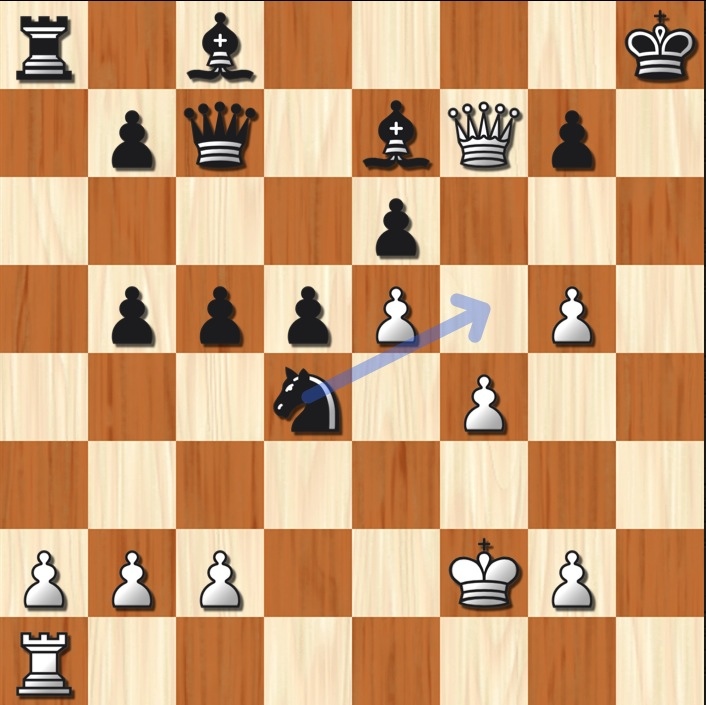
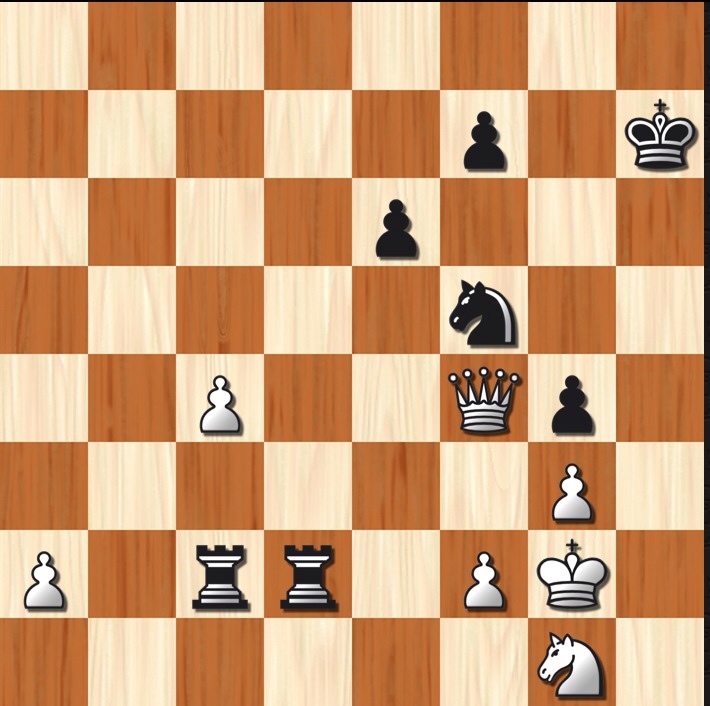
Black to play and win
S Driman v W Heidenfeld 1935
Solution
1…Rf2+ 2 Qf2[] Ne3+! and since 3 Kh1 is forced, the now LPDO queen drops off.

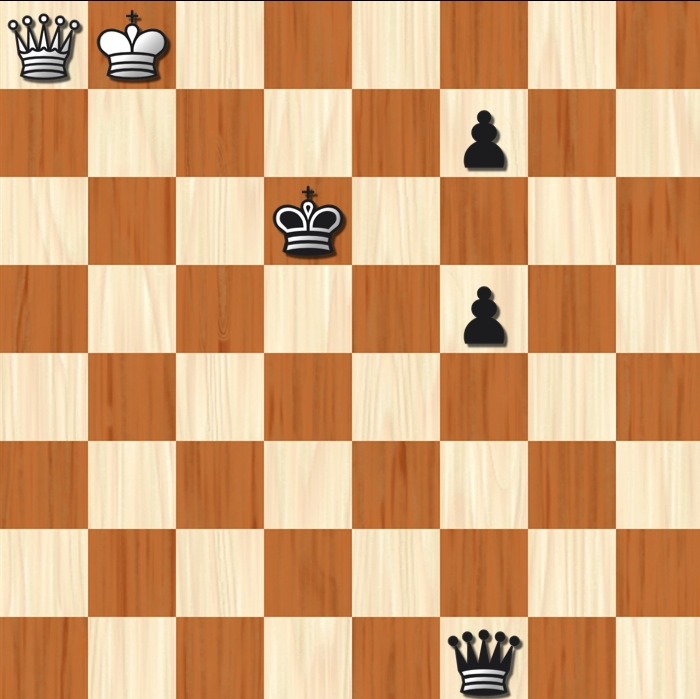
White to play
Black has just played Kc6-d6
A Goosen v PJ Foley 1990
Solution
1 Qa6+! and after 1…Qa6 it is stalemate. No more to say.
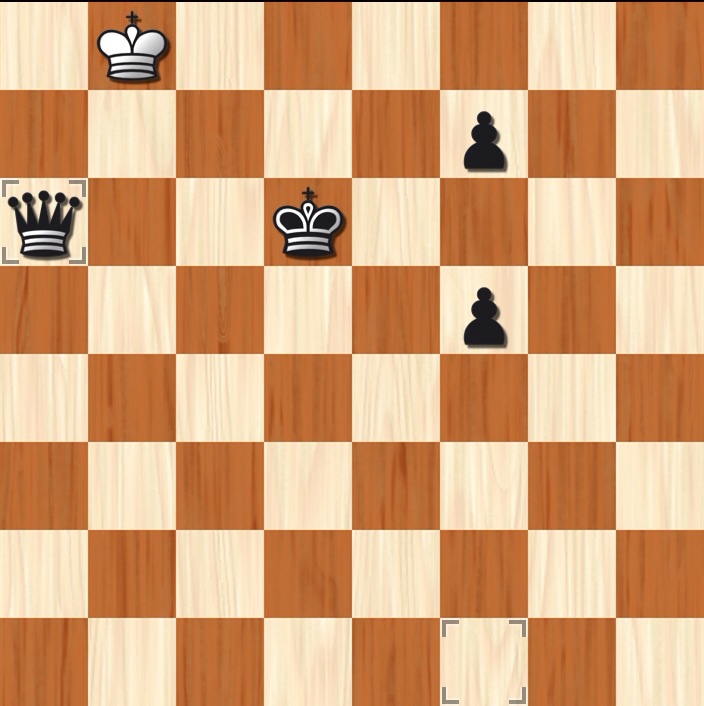
Reitstein says that today's puzzle is the conclusion of 'one of the great games of South African chess'.
Alas, I have been unable to find the game: it is is not in Megabase 2012, nor is it in chessgames.com. From that latter site I learn that white was Moss Kolnik, black Kurt Dreyer. I also have a copy of Leonard Reitstein's book on the history of chess in South Africa, which Leonard gave me in 2006 after I wrote to him, having visited and fallen in love with his country. The game is not in Leonard's book, either.
I wonder if anyone has the game? Would be nice if it could be found and preserved for posterity.
Black to play and win
Try to do better than me: I completely missed the idea
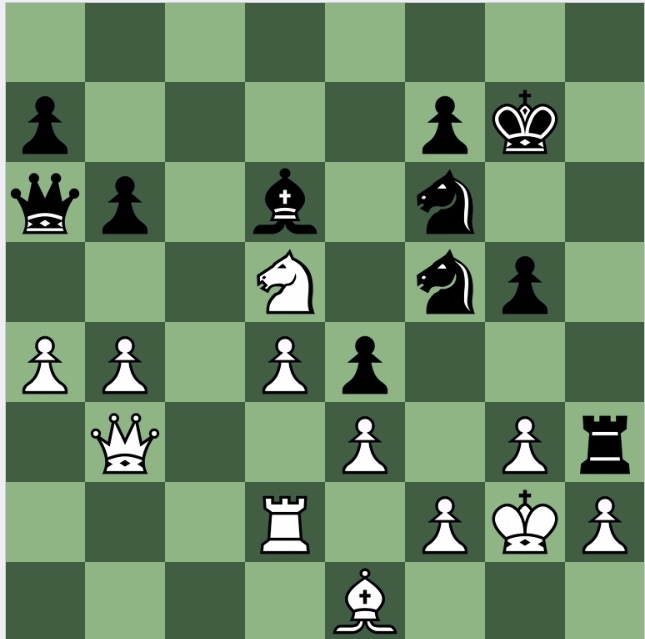
M Kolnik v K Dreyer 1947
Solution
Not my finest day. After trying to make 1…Rh2+! 2 Kh2 Qf1 work, and missing how, I then turned to 1…Ng4! and struggled to victory. I completely missed the neatest win.
In fact, each of 1…Rh2+! and 1…Ng4! do win. Taking the latter first, if 2 Kh3 then 2…Qf1+ 3 Kg4[] 3…Kg6 and either mate or ruinous loss (Nf4+, Qf7+) follows- though Stockfish says 3…Nh6+! 4 Kg5 Qh3 is mate in five.
Before I show why 1..Rh2+! also wins, I'll give the best win: 1…Nh4+!! which I didn't even see- it shouldn't be so hard to follow Purdy's maxim of examining all biffs, but in practice, even in puzzles, it is.
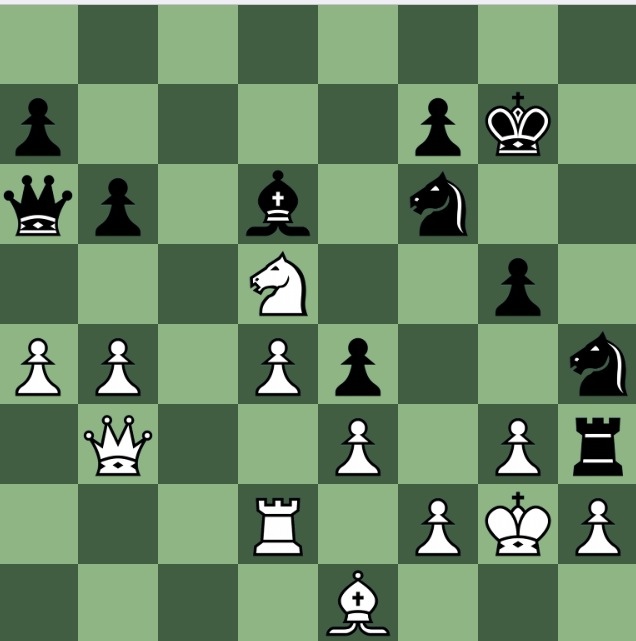
Once you see it, it is clear: 2 Kh3 3 Qf1 mate; 2 Kg1 Nf3+ and 3 Rh2 mate, so 2 gh[] Rh2+ 3 Kg1[] Rh1+! 4 Kh1 Qf1 mate.
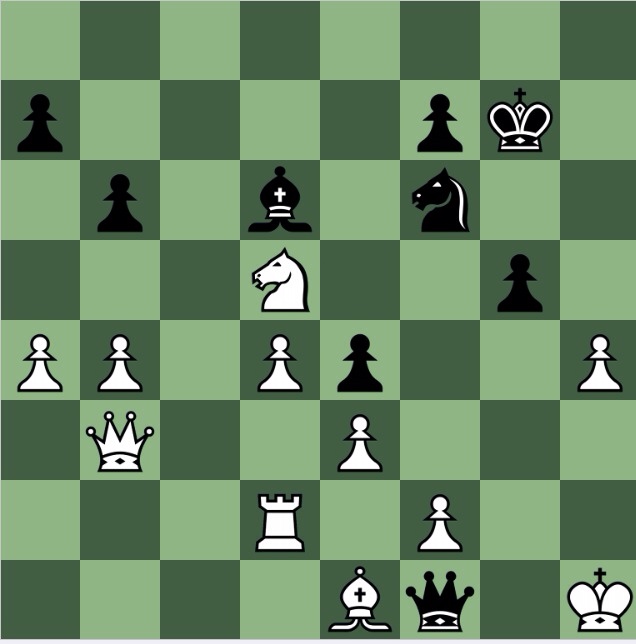
So, in short, I missed a mate in four.
The Nh4+ idea is also relevant to the other winning line: 1..Rh2+! 2 Kh2 Qf1 3 Nf6 Nh4!!
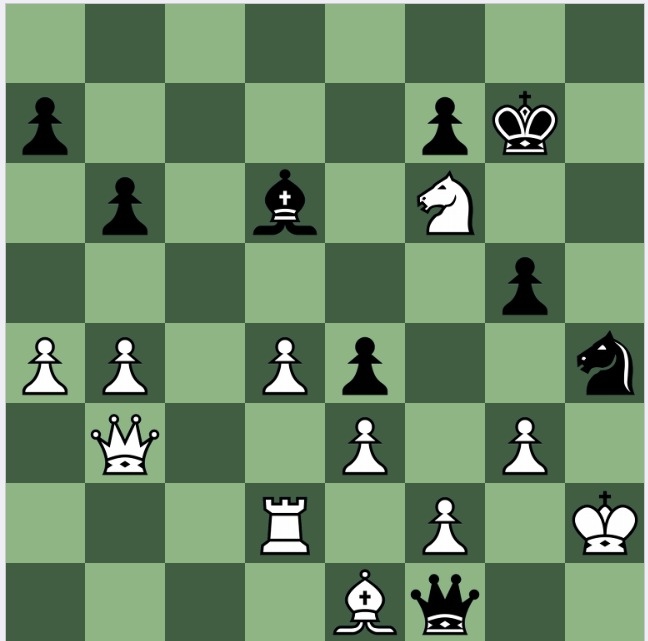
Beautiful.
 allanbeardsworth