White to play and win
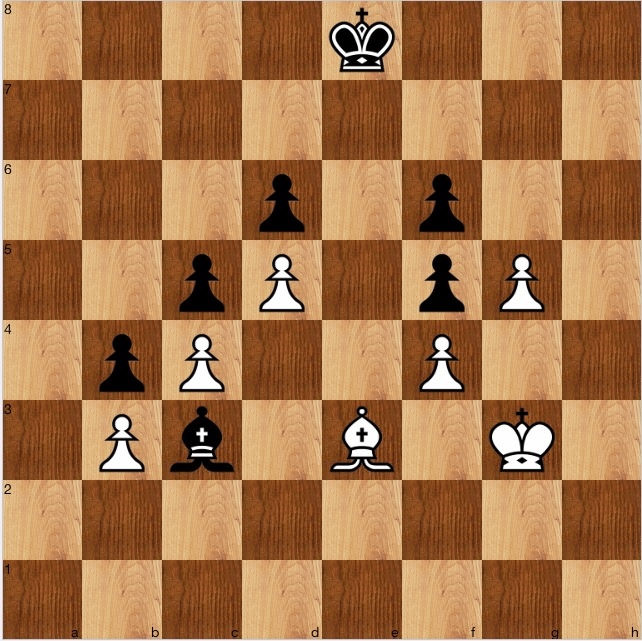
Black has just played 1…f6??
J Wolpert v R Morris 1963
Solution
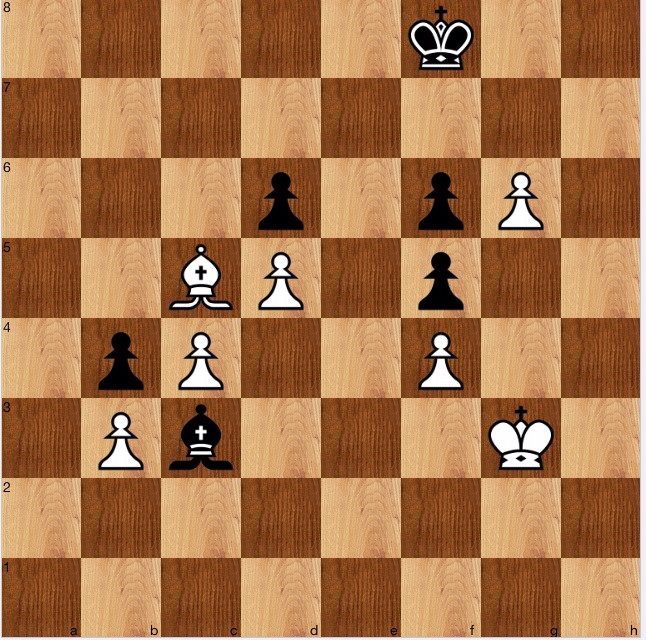
Fairly straightforward again today: 1 g6! with the point that Bc5! will follow, and black's bishop is on the wrong side of his pawns, and his king can't stop both of white's d and g pawns.
 Posted with Blogsy
This recent article caught by eye: I wonder when will be the last time I see a picture of Lady Di? (I suspect it will be a long, long time, and that the emotions of her loss will always be with me and people of my generation)
It has recently been found that Prince Happy is a distant cousin of his current girlfriend Cressida Bonas. I am glad that my eye was drawn to Di and Cressida, since otherwise I wouldn't have known of the recent release on TheGenealogist.co.uk (a site I hadn't heard of) of eleven million Tithe Records.
I 'did' my family tree around three years ago; for a period, it was an all encompassing pastime; and a highly enjoyable and interesting one, with one of the best things about it being the conversations I had with my dad and with my late mother's brother which I otherwise wouldn't have had. Those conversations were priceless to me. It has also succeeded in doing what school never did, namely given me an interest in history.
Once the tree has been 'done', it became a case of very occasional maintenance. Then, for some reason on my son's last birthday I chose to look at the tree again, and bingo! new sources had been made available online (mainly a lot of parish records in Lancashire) which meant that I could easily extend my tree back further. Within half an hour or so I had extended the Beardsworth line back one hundred and fifty or more years back, to 1615; and made other improvements to the tree.
I now plan to look at the Genealogist site and see if it unearths anything new. For the moment, there are no links to royalty, so no invite for me should Harry wed Cressida.
White to play and win
Black has just played Ne1*Nd3

HE Price v G Lawrence 1975
Solution
A rest day today. White doesn't need to recapture, and instead after 1 Qg5!, mate on g7 can be deferred, but not avoided.
I found 1 Qg5 instantly: of course, it is a problem, so you know there is something to find. But if it were a game, or if for some reason 1 Qg5 wasn't 'obvious' then two of Purdy's techniques would have found it: consider all biffs and consider all threats to biff or is recommendation to disregard threats. The following I thought was very insightful:
Purdy on threats, In Search of Chess Perfection, pg 289
You must see all real threats. That means you must also see the unreality of real threats…. When in doubt, you can always save time by remembering it is really your move. Try then the following way of thinking:
Imagine the threat could not possibly be executed. Then what would be my best move? Try out each attractive move separately, considering each one as follows. Visualise the whole position as it would be after this move of yours, and then work out whether the opponent would gain by executing his 'threat'.
White to play and win
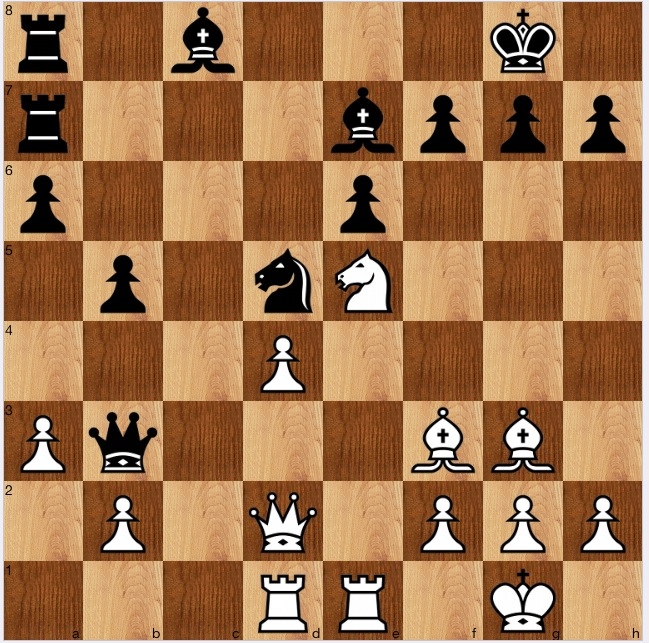
F Korostenski v C Meiboom 1980
Solution
Knowing it is a problem, and with Reitstein giving the hint that white played 1 Rc1? but missed a better move, this one didn't take me long. Clearly, the black queen is in a net, using Purdy's term, and it can also be seen that 1 Rc1 prepares 2 Bd1 but that black's queen can slip to a2. So 1 Ra1! and the trap is complete.
Black's best is to lose the exchange by 1…Nb6 (freeing d5 after Bd1) 2 Nc6 but it is pretty hopeless, with white retaining back rank mate threats, and black's pieces being uncoordinated.
I heard of this puzzle from my friend, Luke McShane.
I was lucky to guess the answer correctly, immediately. I would like to see intuitively (which would be clever) but alas it was just lucky. It took me an hour or so to prove the answer, though my proof (given below) is not rigorous.
Boarding a plane
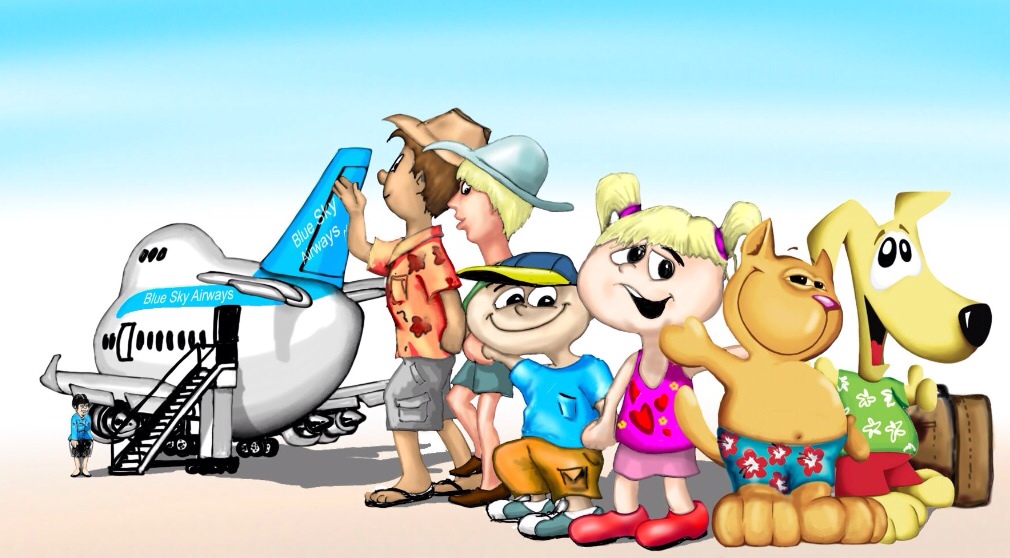
It's amazing what images come up when you google 'boarding a plane'.
Imagine there is a plane with say 100 seats, and on this journey, it is fully booked, with every seat taken. One passenger, the first to get on, has mislaid his seat ticket and decides to just sit anywhere. The second passenger gets on and, if his allotted seat isn't taken, sits in it, but if by chance the first person had sat in the second person's seat, then the second person again just sits somewhere at random. And so does the third, and fourth, and so on. (Quite hard to explain briefly).
What is the chance that the 100th person will sit in his allotted seat?

Solution
It's 50:50.
My logic was 'it can't be 0%, and it can't be 100%, it has to be somewhere in between; it probably doesn't depend on the precise number of seats being 100, and it might converge as the number of gets large, and if it converges, it probably converges to 50%'. This type of logic is called guessing. In fact, there is no convergence, and the answer is the same for n=2 upwards.
My proof, which is similar to mathematical induction, was as follows.
Start with n=2, two seats on the plane. Then it is 50:50 whether the first person sits in his seat or not. Hence it is 50:50 that the second person will.
Now, n=3. There is a 1/3 chance that the first person will sit in his correct seat, and a 2/3 chance that he won't. Take the first case first: he sits in his correct seat. Then we are down to the situation with n=2; in the second case, when the second person joins the plane he finds his seat taken, and sits in one of the two remaining seats: it is 50:50 that he sits in his correct seat.
And so on. It gets harder for n=4 or n=5 (where I stopped) but soon it became clear what the pattern was. For n=4, there is a 1/4 chance that the first person sits in his correct seat, which then means the problem simplifies to the n=3 case; and 3/4 chance he doesn't, when a bit of work is needed to see how it simplifies- but – and I drew diagrams to make it entirely clear, what can be seen is that the case of there being n seats and be simplified either to n-1, where the first person sits in his correct seat, or n-2 when he doesn't…and all cases therefore reduce eventually to the n=2 case.
White to play
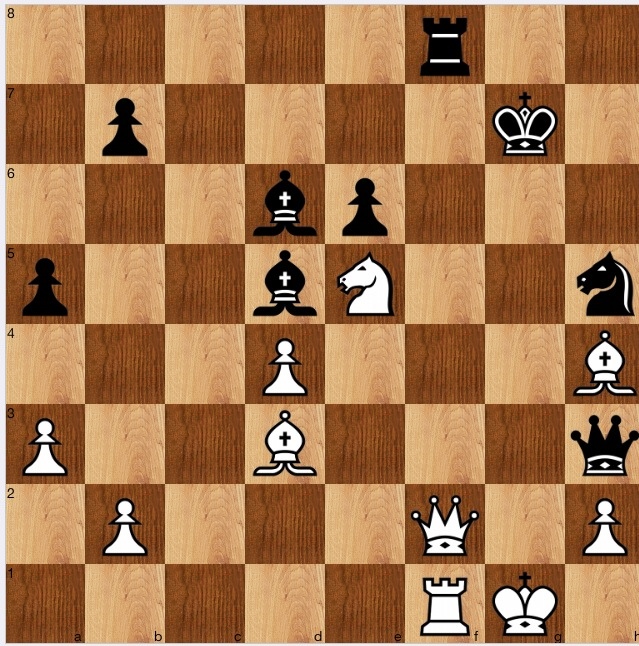
E Bergendorff v D Walt 1940
Solution
White's situation is desperate, so you have to look at 1 Qf7+ and 1 Qf8+!, with the latter, since it takes something, being the first to try. It shouldn't take too long to see that with best play it is then a perpetual: 1…Bf8[] 2 Rf7+ Kh8 (2…Kg8?? 3 Bh7+ Kh8[] 4 Ng6mate; 2…Kh6?? 3 Rh7 mate) 3 Rf8+ Kg7[] 4 Rf7+=
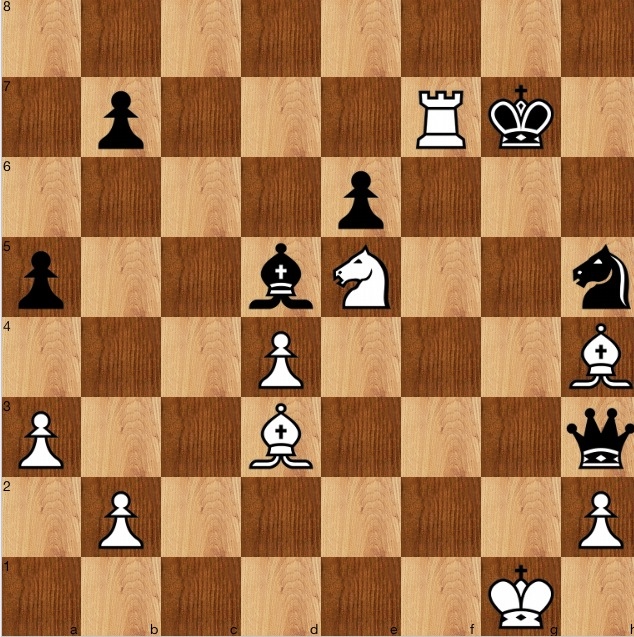
Having established that 1 Qf8+ draws it is necessary to look at 1 Qf7+: but it can be quickly seen that it is inferior (losing) since after 1…Rf7 2 Rf7+, black still has his Bd6, protecting and not on f8.
I wonder if young people can appreciate how wonderful it is to be alive today? I am often thrilled and amazed as to what is available today which wasn't available say twenty years ago, or wasn't available in my childhood.
Thanks to following Tim Harford (@TimHarford) on Twitter {Tim is certainly in my top three people I follow on Twitter, and his tweets have given me hours of interest and pleasure} I recently came across Kurt Vonnegut on the Shape of Stories- as Tim says, 4 minuted of brilliance- dlvr.it/54pL0f. (If the link doesn't work, search in YouTube)

Listening to it, it took me back 30+ years! during which time I have kept the clipping below on the eight plots of fiction.

Kurt's graphical exposition brings a mathematical representation to these plots, and, of course, this is part of its appeal to me.
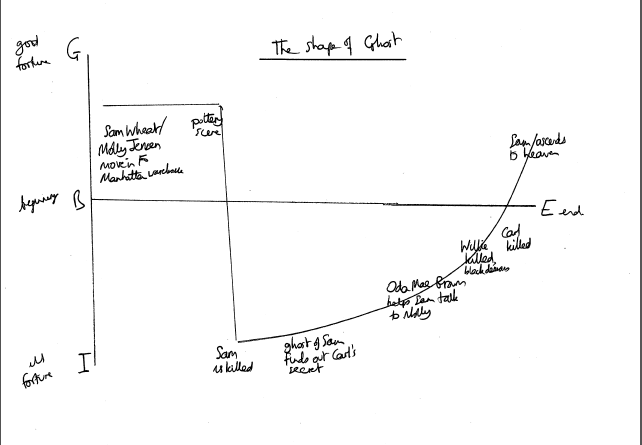
The Shape of Ghost
If I were writing my list of my top ten films, then the 1990 romantic thriller starring Patrick Swayze and Demi Moore would be high on the list: it is one of 'our' films, one which was out at the time Jane and I were gong out together.

Whilst I have an appalling memory for many things (most useful, normal things, I can't remember), I also have an unusually good memory for irrelevant things (tax cases, tax legislation, chess games, characters, lines and plot in Ghost). Below is my plot of the story of Ghost, in which Demi plays Molly Jensen with Patrick playing Sam Wheat.
Of course, no reference to Ghost would be complete without the potter's wheel scene:

I was intrigued by the letter below published recently in the Financial Times.
Fracking letter from economists
I have rarely seen such a letter, where so many economists are in agreement. It made me sceptical, especially since none of the signatories, apart from one from Lancaster, were from Northern Universities, and in particular none from the premier ones in this region.
I don't know what I think about fracking (nor does my iPad's spellcheck, which tries to auto-correct it, and a lot of the opposition to it make play on its resemblance to a less than civil word). On the one hand, it brings me back to the story I have told my family several times which was that as a student in the early 1980s, reading engineering science at Cambridge, there were modules and current interest in the Energy crisis, and I read books and articles about the expiration by the Millennium of the world's oil and coal reserves; and green energies were starting to be explored. It was only about that time, just after the 1979 oil crisis, that production in the North Sea became technically feasible. My present view on fracking is mixed: yes, it would be wonderful to have a significant new source of power; but there seems to be evidence that earth tremors can be caused, and issues such as water pollution: so I am a Nimby, at least at present, on fracking.
I was therefore pleased to see that the economists' letter didn't go unanswered, with their being two responses.


Ukraine and the Crimea are much in the news at present, following the political upheaval and annexation by Russia. Today's Independent cartoon was:
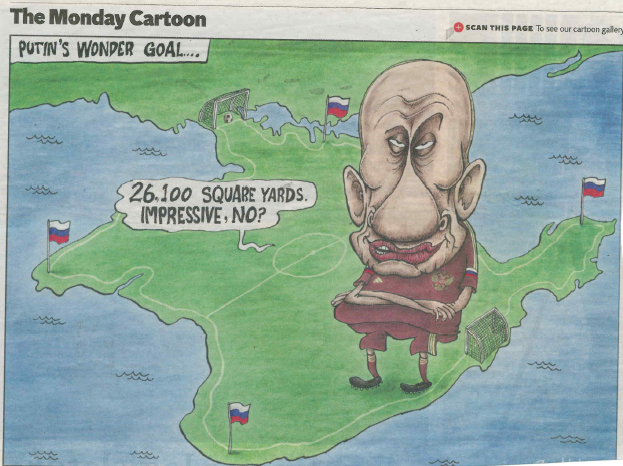
I may be having a sense of humour failure, completely missing the joke behind the cartoon: but the area is wrong. The actual area (actual in the sense of 'as given by Google') is 26,100 sq km, a number I knew having some weeks back googled it, and compared it to the universally accepted (at least in England) unit of size, the area in comparison with the size of Wales– 20,761 sq km.
Of course, this being 2014, whatever you can think of, there is a website for it, and there is a calculator site.
The site's author, Simon Kelk, also gives calculators for comparison with the length of a London bus, comparison with the weight of an African elephant, and certain others. (It doesn't, though, include the definition I use of the time it takes to solve a chess problem of some moderate difficulty, namely the time it takes an Englishman to make a cup of tea, which to me is one standard unit of time. (An even more English unit of time, namely the time to devote to a much harder chess problem, is Sherlock Holme's two pipe problem. I once had leading Counsel tell me, when explaining his proposed charges, that the questions I was asking were a two pipe problem. Alas, being ill-read, at the time I didn't understand his reference).
White to play and win
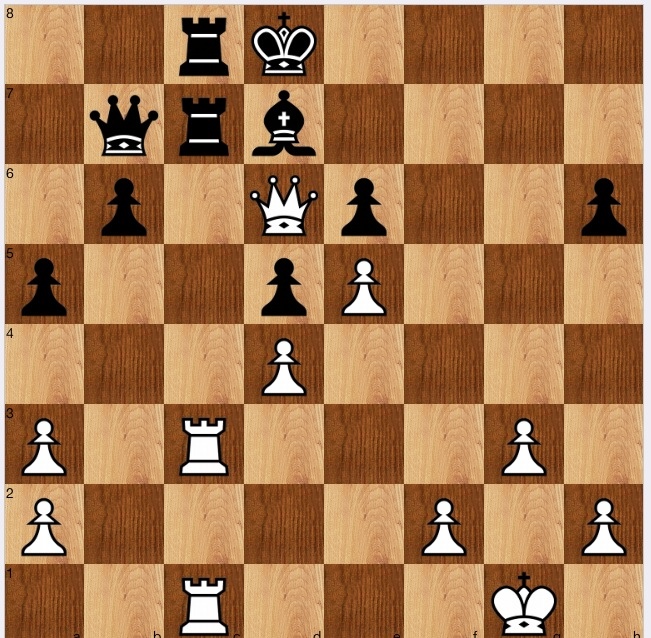
W Heidenfeld v J Wolpert 1957
Solution
White is a piece down, and so clearly must mate. After checking first that Rc7 achieves nothing, and nor does Qf8+ (including looking to see if the typical manoeuvre of Qf8+ Be8[] Qf6+ does anything- often it gets the defender's pieces in a helpless mess, with mate on the black squares, but not here) I quickly saw 1 Rf3!, aiming at f8: Rc1+ prolongs the game (and the desperado Rg1+ afterwards) but Rf8mate follows.
 allanbeardsworth